A $100 Million Bet on Faster Affordable Housing: What It Means for North Park and Normal Heights
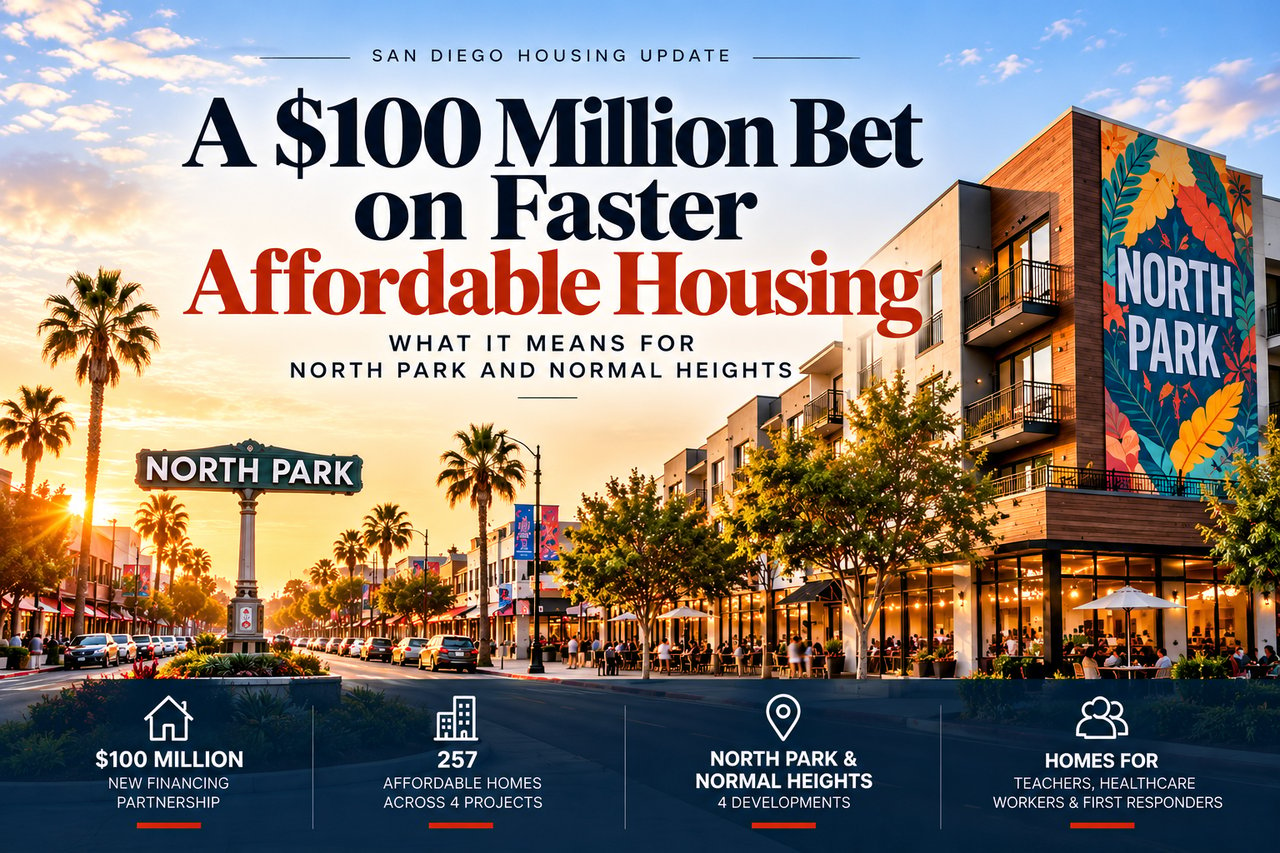
Most affordable housing stories in San Diego follow a familiar, frustrating arc. A project gets approved, gets celebrated at a press conference, and then disappears into years of waiting on financing before a single wall goes up. Earlier this month, San Diego Foundation and Bear Creek Fund Advisors announced something designed to break that pattern: a $100 million financing partnership built specifically to get approved affordable housing projects out of the pipeline and into construction faster. The first shovel went into the ground in North Park on October 6, and three more projects are lined up behind it. For anyone who owns, rents, or is watching the market in North Park and Normal Heights, this is worth understanding, because it's a genuinely different kind of housing story than the usual price-and-rate update.
What was actually announced
San Diego Foundation, a longtime regional philanthropic organization, paired with Bear Creek Fund Advisors to create a new construction financing tool aimed squarely at affordable housing. The announcement coincided with the groundbreaking of a 38-unit development on Louisiana Street in North Park, the first of four projects that together will deliver 257 affordable homes across North Park and Normal Heights. The other three, known as Kansas II, Kansas III, and Oregon, are set to break ground in the coming months. Collectively, the four projects are referred to as the State Streets Portfolio, and all of the homes will be required to remain affordable over the long term for residents earning up to 80 percent of the area median income.
Mayor Todd Gloria attended the groundbreaking and made a point that captures why this partnership matters: an approved housing project is not yet a home. Entitlements and permits get a project on paper, but it takes real financing and committed partners to actually start pouring concrete. That gap between approval and construction is exactly what this new partnership is designed to close.
Why the financing piece is the real story here
Affordable housing in California typically relies on financing tools like low-income housing tax credits, state housing bonds, and competitive grant cycles through agencies at the city, county, state, and federal level. Those tools work, but they're slow by design. Developers often apply, wait months or years to find out if they were selected, and then wait again for funds to actually be disbursed. A fully entitled, fully designed project can sit stalled for years simply because it hasn't cleared a funding queue.
Bear Creek Fund Advisors is stepping into that gap with private construction financing specifically structured for affordable and workforce housing projects, done in partnership with San Diego Foundation rather than through the traditional public funding cycle alone. Jonathan Stern, a partner at Bear Creek Asset Management, described the Louisiana Street project as a model for what a well-structured public-private partnership can accomplish, combining city government, local developers, nonprofit organizations, and private capital into financing tailored to the specific project rather than forced into a one-size-fits-all public program. Mark Stuart, president and CEO of San Diego Foundation, framed it similarly: addressing San Diego's housing needs requires bringing together partners with different strengths and using every available tool, and this partnership puts that philosophy into practice.
For a region that has talked about its housing shortage for the better part of two decades, a financing model built to move projects from entitlement to groundbreaking faster is a meaningfully different kind of progress than another zoning change or another study.
The four projects and who they're built for
Louisiana Street, the first project out of the ground, will deliver 38 studio apartments across five stories in North Park, developed by Naturally Affordable Housing. The three remaining projects, Kansas II, Kansas III, and Oregon, are spread across North Park and Normal Heights and will bring the total to 257 units once complete. Every unit across all four developments is designated for households earning up to 80 percent of the area median income, with long-term affordability restrictions attached to keep them that way.
The target population isn't a vague "affordable housing" category. Mayor Gloria specifically called out teachers, healthcare workers, and first responders as the kind of San Diegans this housing is meant to serve, the workforce that keeps the city functioning but has increasingly been priced out of the neighborhoods they work in. This ties directly into the City of San Diego's Complete Communities initiative, a program designed to encourage exactly this kind of workforce housing near transit and job centers, and it reflects San Diego Foundation's broader goal of helping 1,000 households a year, for the next decade, secure and maintain stable, affordable housing across the county.
Why North Park and Normal Heights specifically
North Park and Normal Heights are established, centrally located, walkable neighborhoods with strong demand and limited vacant land, which is exactly the combination that makes workforce housing both necessary and difficult to build. These are neighborhoods full of restaurants, small businesses, schools, and medical offices that depend on workers who, under current market rents, often can't afford to live anywhere nearby. Every one of those 257 units represents someone who works in or near these neighborhoods gaining the option to actually live in them, rather than commuting in from somewhere far cheaper and far less convenient.
That matters for the character of these communities in a very practical way. Teachers, nurses, and firefighters living in the neighborhoods they serve tend to be invested in those neighborhoods in ways that pay off for everyone around them, from the schools their kids attend to the businesses they patronize on their days off. It's also a meaningfully different kind of growth than the market-rate infill development that's been reshaping other urban San Diego neighborhoods, since these units come with long-term affordability baked in rather than converting to market rate the moment the first lease turns over.
What this means for property values and the surrounding market
A common and understandable worry homeowners have when they hear "affordable housing" near their neighborhood is whether it affects their home's value. The research on this is actually reassuring, and it's worth knowing if you own property in North Park or Normal Heights right now. Well-designed, well-managed affordable and workforce housing developments, particularly smaller-scale infill projects like these rather than massive complexes, consistently show no meaningful negative effect on nearby property values, and in neighborhoods with strong existing demand like these two, any effect tends to be neutral to modestly positive, since new residents support local businesses and transit ridership without materially increasing competition for the market-rate homes that make up most of the neighborhood's housing stock.
What these projects do add is rental housing supply at a price point that's been essentially unavailable in North Park and Normal Heights for years. That's a different lever than the single-family and condo resale market most buyers and sellers are watching, but it's a meaningful piece of the broader housing picture in these neighborhoods, and it signals continued investment and confidence in the area from both the public and private sectors.
The bigger pattern this fits into
This partnership isn't happening in isolation. It lands alongside a string of other development stories reshaping San Diego's housing landscape this year, from Complete Communities infill projects across the city to large-scale efforts like Midway Rising and the SDSU Mission Valley build-out. What sets this one apart is that it's explicitly about financing mechanics rather than entitlements or design, which is honestly the part of affordable housing that gets the least public attention despite being the part that most often determines whether a project actually gets built on any reasonable timeline. If this model proves successful across all four State Streets Portfolio projects, it's reasonable to expect San Diego Foundation and similar organizations to look at replicating it in other centrally located neighborhoods facing the same workforce housing squeeze.
What this means if you're buying in North Park or Normal Heights right now
If you're house hunting in either neighborhood, this is good context rather than a reason for concern. New workforce housing nearby tends to reflect a neighborhood's continued desirability and investment rather than detract from it, and it adds rental inventory that serves a different part of the market than the home you're likely buying. It's also a reasonable data point in favor of these neighborhoods' long-term trajectory, since public and philanthropic capital tends to flow toward areas people want to keep living and working in, not areas in decline.
What this means if you're selling in North Park or Normal Heights right now
There's no reason to see this as a headwind for your listing. If a prospective buyer raises questions about a nearby affordable housing project, you can speak to it accurately: these are small-scale, long-term-restricted developments built for local teachers, healthcare workers, and first responders, not the kind of large-scale, poorly managed housing that occasionally drives the stereotypes people worry about. If anything, it's a point in favor of the neighborhood's ongoing investment and community stability, worth mentioning as part of the broader story of why people want to live in North Park or Normal Heights in the first place.
The bottom line
A $100 million financing partnership between San Diego Foundation and Bear Creek Fund Advisors just broke ground on the first of four workforce housing projects in North Park and Normal Heights, with 257 units total on the way for teachers, healthcare workers, and first responders earning up to 80 percent of the area median income. It's a genuinely different kind of housing story, one about fixing the financing bottleneck that usually keeps approved projects stuck for years rather than another round of price or rate commentary. If you're curious about how development like this fits into the bigger picture for your own neighborhood, or you're thinking about buying or selling in North Park or Normal Heights, reach out and we'll walk through what's actually happening on the ground.