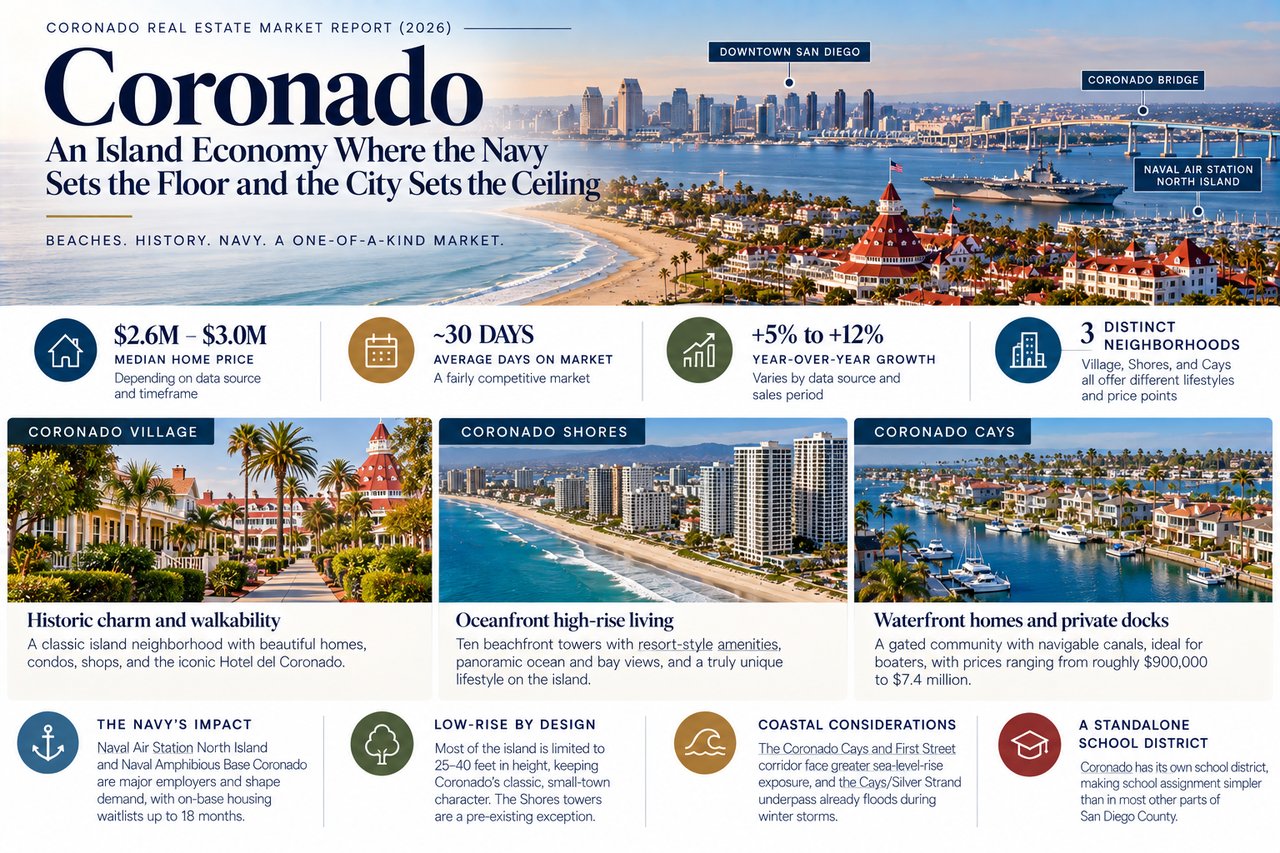
Coronado Housing Market Report: An Island Economy Where the Navy Sets the Floor and the City Sets the Ceiling (2026)
Coronado doesn't behave like the rest of coastal San Diego, and it's not just the postcard scenery. This is a genuinely small, physically separated market, connected to the mainland by a bridge and a thin strip of sand, with its own school district, its own height limits, and a naval base that occupies a real share of the island's footprint. That combination produces a market this blog hasn't covered on its own terms yet: citywide prices in the high seven figures, a building code that's kept most of the island at four stories or under, and a military presence large enough to shape who actually lives here versus who can only afford to visit.
The price picture, and why it depends on who's counting
Depending on which data source and timeframe you pull, Coronado's median home price reads anywhere from roughly $2.6 million to just over $3 million, with year-over-year growth estimates ranging from about 5 percent to as high as 12 percent. That's a wider spread than you'd expect for a market this small, and it comes down to the usual culprits: some figures track a rolling monthly average home value across all of Coronado's housing stock, while others reflect a trailing 30- or 90-day median sale price, which swings harder in a market with relatively few transactions in any given window. Homes here are moving in around 30 days on average, in a market that scores as fairly competitive, so don't read the price spread as evidence of a soft market. It's a function of small sample sizes doing what small sample sizes do.
Three neighborhoods, three different ways to own here
Coronado Village is the historic core and where most of the island's housing actually sits, a walkable grid of classic homes, condos, and small shops built up around the ferry landing era, and it's the closest thing Coronado has to a standard residential neighborhood. Coronado Shores is its own animal entirely: ten high-rise condominium towers along the southern beachfront, offering ocean and bay views with resort-style amenities that you won't find anywhere else on the island, effectively Coronado's answer to a vertical, amenity-heavy luxury product in a city that otherwise stayed low. Then there's Coronado Cays, gated and set apart at the southern end near the Silver Strand, built around private docks and navigable canals for owners who want to keep a boat at the house rather than at a marina. Cays pricing actually runs a notch below the Village and Shores on a median basis, with recent closed sales spanning roughly $900,000 up to $7.4 million, a wide enough range that a single Cays median tells you almost nothing about what a specific canal-front property is worth versus an interior unit further from the water.
The Navy is the island's other major landowner
It's easy to drive around Coronado and not register how much of the island's land and economy belongs to the military. Naval Air Station North Island and Naval Amphibious Base Coronado occupy a substantial footprint here, and between the two installations, Coronado functions as much as a naval town as a beach resort. On-base housing is managed through Lincoln Military Housing, and demand for it is intense enough that families can face waitlists stretching up to 18 months to get in. The reason for that waitlist isn't hard to find once you look at civilian pricing: average per-square-foot costs on the island run well over double what you'd pay on the nearby mainland, and most military families simply can't make Coronado work on Basic Allowance for Housing alone, even at senior officer pay grades. The practical result is that a lot of Coronado's military community lives elsewhere in San Diego County and commutes onto the island for duty, while the families who can actually afford to buy or rent here tend to be either senior officers with substantial outside income, civilians, or second-home owners. Anyone financing a Coronado purchase with a VA loan, a real and common path here despite the price levels, should read the VA loan guide elsewhere on this blog, since the entitlement and appraisal mechanics matter more in a market this expensive than in a more typically priced San Diego neighborhood.
Why Coronado still looks like it did decades ago
A big part of what makes Coronado feel different from La Jolla or downtown isn't just price, it's scale. The city moved away from high-density zoning years ago and has generally held height limits in the 25- to 40-foot range across most of the island, which is a large part of why you don't see the kind of high-rise skyline here that's reshaped other coastal pockets of the county. The Shores towers are the notable exception, largely because they were built before the current limits locked in, and that's part of why they occupy such a distinct niche in the local market rather than representing a broader trend. For buyers used to newer coastal developments elsewhere in San Diego, it's worth understanding that Coronado's low-rise character isn't an accident of the market, it's a deliberate, long-standing planning choice that isn't likely to change.
The coastal risk conversation here looks a little different
Every coastal San Diego community this blog covers eventually runs into erosion and sea-level-rise policy, and Coronado's version centers on a fairly strict setback requirement: new construction near the eroding coastline has to be positioned far enough back that the structure won't eventually need a seawall or other shoreline armoring to survive. Longer-term studies looking at worst-case sea-level-rise scenarios by the end of the century have flagged the Coronado Cays and the First Street corridor as the neighborhoods facing the most exposure, and the low-lying underpass connecting the Cays and Silver Strand State Beach already floods on a fairly regular basis during winter storms even now. None of this is a reason to avoid buying in these areas, but it's a legitimate diligence item for anyone looking at Cays or First Street property specifically, in the same way bluff setback rules matter for anyone buying in Solana Beach or Encinitas.
Schools, and one thing that's genuinely simpler here
Coronado runs its own standalone school district, separate from San Diego Unified and the patchwork of boundary lines that buyers elsewhere in the county have to untangle, the same kind of address-based complexity covered in the Del Mar and Carmel Valley school boundaries piece on this blog. For Coronado specifically, that complexity mostly doesn't apply. The island is small enough, and the district contained enough, that school assignment isn't the kind of address-by-address puzzle it can be in larger, boundary-split communities, which simplifies one piece of diligence that trips up buyers in a lot of other parts of San Diego County.
What this means if you're buying in Coronado
Get specific about which of the three neighborhoods you're actually looking at before anchoring on a citywide median, since Village, Shores, and Cays are different enough in product type and price behavior that blending them into one number will mislead you either direction. If you're financing with a VA loan, budget extra time for the appraisal and entitlement process given how far Coronado's pricing sits above a typical VA loan limit conversation elsewhere in the county, and if you're looking specifically at the Cays or First Street, ask directly about flood history and any coastal setback documentation on the specific property rather than assuming the citywide risk conversation applies evenly across the island.
What this means if you're selling in Coronado
Lean into whichever of Coronado's sub-markets your listing actually represents, the walkability and history of the Village, the amenity-rich vertical living of the Shores, or the private-dock waterfront lifestyle of the Cays, since buyers here are typically choosing a specific lifestyle rather than shopping Coronado as an undifferentiated whole. If your buyer pool includes military families, understand that most of them are priced out of Coronado on BAH alone, so the buyers who do come through tend to be either senior officers with meaningful outside income or civilians, a smaller and more specific pool worth targeting your marketing toward rather than assuming broad military demand will carry the listing.
The bottom line
Coronado runs on its own logic: a genuinely small, physically separate island market where citywide prices in the high seven figures coexist with a naval base big enough to price most military families out of the very community they serve, and where a decades-old commitment to low-rise zoning keeps the skyline looking almost nothing like the rest of coastal San Diego. Village, Shores, and Cays are different enough in character and price that treating Coronado as one market rather than three will cost you accuracy either as a buyer or a seller, and the island's specific coastal risk and military-housing dynamics are worth understanding on their own terms rather than assuming they mirror what's true elsewhere in the county. If you're trying to figure out which part of Coronado actually fits what you're looking for, or what a specific property here is really worth, reach out and we'll go through the real numbers together.