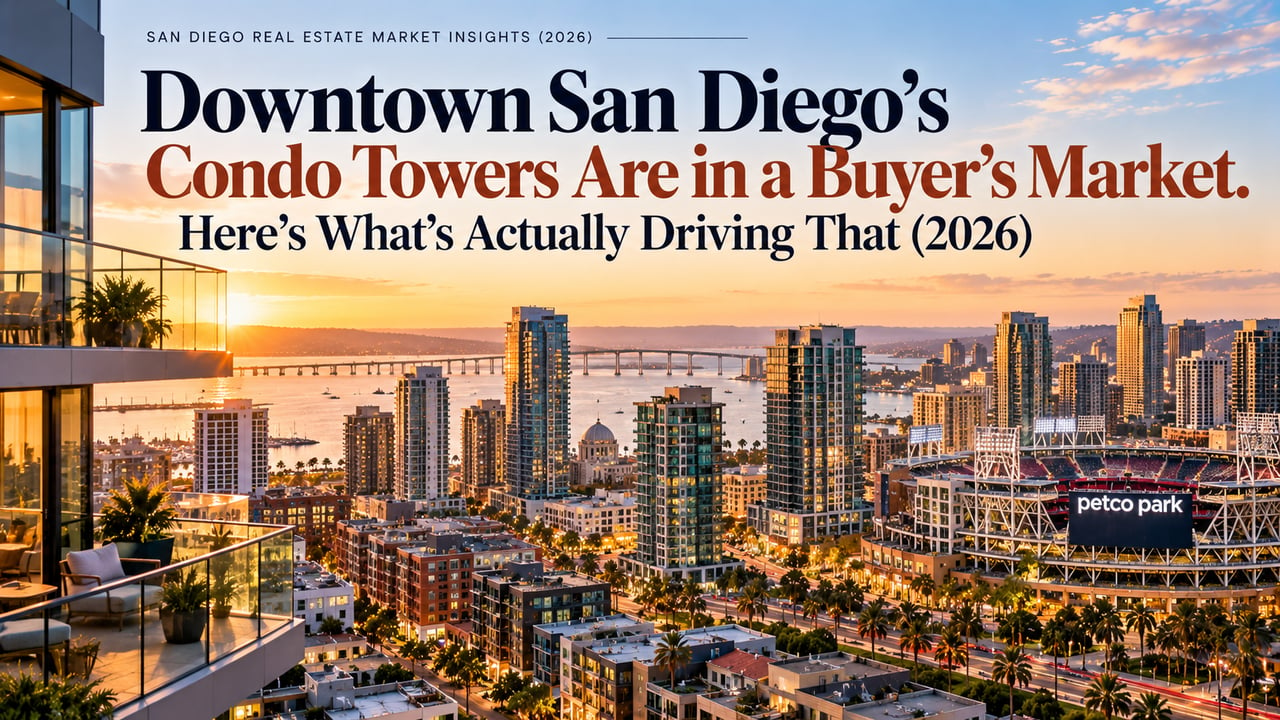
Downtown San Diego's Condo Towers Are in a Buyer's Market. Here's What's Actually Driving That (2026)
Downtown San Diego built an entire skyline on the assumption that people would keep wanting to live in it, and for most of the last two decades they did. Twenty years after Petco Park turned a block of warehouses and vacant lots into East Village's first residential boom, downtown's condo market looks like something it rarely has: a place where buyers, not sellers, are holding the leverage. Nearly a full year of supply is sitting on the market in the high-rise segment specifically, new construction has almost entirely stopped, and HOA fees are climbing fast enough to change what a given unit actually costs to own every month. None of that means downtown is in trouble exactly, but it does mean the math here looks different than it did even a few years ago.
How a ballpark built a neighborhood
East Village's transformation traces back to one specific decision. Petco Park opened at the neighborhood's southeast corner in 2004, and it did more or less exactly what the city hoped it would: it took a stretch of warehouses, vacant lots, and light industrial buildings and turned it into the center of downtown's residential boom almost overnight. Park Blvd West, a 120-unit building a short walk from the stadium, finished that same year. The Legend, a 23-story Bosa Development tower, followed in 2007. Over the two decades since, East Village grew into the largest and most actively developed district downtown, filling in with tower after tower aimed at buyers who wanted walkable, urban living within blocks of the ballpark, the Gaslamp Quarter, and the bay. That boom didn't run in a straight line, it slowed hard during the 2008 crash and again during the pandemic, but it kept resuming, and East Village is still the neighborhood doing most of downtown's new construction and absorption today.
What the current numbers actually show
Downtown's overall condo median sale price sits around $737,000 as of mid-2026, down about 1.7 percent from a year earlier, with homes taking a fairly unhurried 57 days to sell. That blended number hides a real split, though. High-rise units specifically, the towers rather than the mid-rise and loft-style buildings scattered through the Marina District and Cortez Hill, carry a meaningfully higher median sale price around $1,037,250, reflecting the premium buyers are still willing to pay for views, amenities, and the kind of full-service building experience a shorter structure can't really offer. East Village on its own is showing 106 active condo listings with an average price of roughly $752 per square foot and a median list price near $732,450, numbers that track close to downtown's blended figures rather than running meaningfully above or below them.
The buyer's market hiding inside the high-rise segment
The number that actually tells you something about leverage right now is months of supply, and in the high-rise segment it's sitting at nearly 12, with 141 active listings against that pace of absorption. That's a genuine buyer's market by almost any standard measure, a sharp contrast to the sub-two-month supply levels that defined a lot of San Diego's broader housing market during the tightest years of the last decade. A seller listing a high-rise unit right now is competing against a deep bench of similar units, which gives buyers real room to negotiate on price, closing cost credits, or timeline in a way that simply wasn't available in this segment a few years back.
New construction has nearly stopped
Here's the part that separates this cycle from the boom years. Only one new condo building, Andia, is currently under construction downtown, a dramatic slowdown from the steady stream of ground-up towers that defined East Village and the Marina District through the 2010s. The 2025 average price per square foot across downtown landed around $754, and with construction financing costs, labor, and materials all still elevated, it's not hard to see why developers are sitting on the sidelines rather than breaking ground on new towers into a market that already has nearly a year of existing high-rise inventory to work through. That combination, thin new supply and a deep resale glut, is a little unusual. Normally a construction slowdown eventually tightens a market by starving it of new units, but downtown's existing high-rise stock is deep enough that the construction pause hasn't translated into scarcity yet.
What a specific building can tell you that a median can't
Alta, a 21-story East Village tower, is a useful example of how much a single building's numbers can diverge from the neighborhood-wide figures. As of late September 2026, Alta had just three listings on the market, ranging from $539,000 to $679,000, while its trailing 12-month median sale price sat at $513,000, or $786 per square foot. That's a lower absolute price point than the broader East Village median but a comparable or even higher price per square foot, a reminder that unit size, floor level, and view exposure can swing numbers inside a single tower more than the difference between two separate neighborhoods. Anyone shopping a specific building should pull that building's own recent sales rather than leaning on a downtown-wide or even East Village-wide median to gauge what a realistic offer looks like.
The HOA fee problem that's reshaping the real cost of ownership
Downtown high-rise living has always come with higher carrying costs than a typical detached home, but those costs have moved meaningfully in the last few years. Full-amenity towers with concierge service, security staff, and pool or fitness facilities commonly run $600 to $1,200 a month in HOA dues, and some buildings now exceed $1,000 regularly. Fees in some San Diego condo communities have climbed 60 to 70 percent since 2021, driven by insurance costs rising somewhere between 15 and 30 percent annually, the same pressure covered in more depth in this blog's piece on the condo and HOA master insurance crisis, plus new inspection requirements under SB 326, the state law requiring regular structural inspections of elevated walkways and balconies after a fatal balcony collapse in Berkeley years ago. For a downtown high-rise buyer, that means the sale price is really only part of the monthly cost equation, and a unit that looks competitively priced against a comparable building can still end up meaningfully more expensive to own once dues are factored in.
Why this cycle feels different from the last boom
The 2000s and 2010s version of downtown's condo market was defined by scarcity and genuine excitement about urban living finally arriving in San Diego in a real way. This version is defined by abundance on the resale side and real caution on the new-construction side, with HOA costs doing a lot of the work that used to be done almost entirely by purchase price. That's not necessarily a worse market for a buyer willing to do the homework, since nearly a year of high-rise supply is about as much negotiating leverage as this segment has offered in a long time. It is a market that rewards building-specific research over broad neighborhood assumptions, though, given how much Alta's numbers diverge from the blended East Village figures just a few blocks away.
What this means if you're buying downtown right now
Treat the nearly 12-month high-rise supply figure as real leverage and negotiate accordingly, since sellers in this segment are genuinely competing against a deep bench of comparable listings rather than operating from a position of scarcity. Pull a specific building's own recent sales and current HOA fee and reserve fund status before anchoring on a downtown-wide or East Village-wide median, since a tower like Alta can price meaningfully differently from the broader neighborhood number depending on unit mix and age. And budget for HOA dues as a real, possibly rising monthly cost rather than a fixed afterthought, especially in older towers that may be catching up on deferred insurance and SB 326 inspection costs all at once.
What this means if you're selling downtown right now
Understand that you're pricing into a genuine buyer's market in the high-rise segment specifically, with 141 active competing listings and nearly a year of supply working against a quick, full-price sale. A transparent, up-to-date HOA financial picture, current reserve levels, any planned assessments, recent insurance renewal terms, is a real differentiator right now given how much buyers are scrutinizing monthly costs on top of purchase price, and a listing that can answer those questions clearly is going to stand out against the broader glut of inventory competing for the same buyers.
The bottom line
Downtown San Diego's condo market, twenty-plus years removed from the Petco Park-driven boom that built most of it, is sitting in a real buyer's market for the first time in a long while, with high-rise supply near 12 months, new construction almost entirely paused outside a single building, and HOA fees climbing fast enough to change the real cost of owning a unit regardless of its sale price. East Village remains the neighborhood doing the most absorption, but individual towers like Alta show how much a specific building's numbers can diverge from the broader averages. For buyers, this is a rare window with real negotiating room. For sellers, it's a market that rewards transparency about carrying costs as much as it rewards a competitive price. If you want help figuring out what a specific downtown building or unit is actually worth right now, reach out and we'll go through the real numbers together.