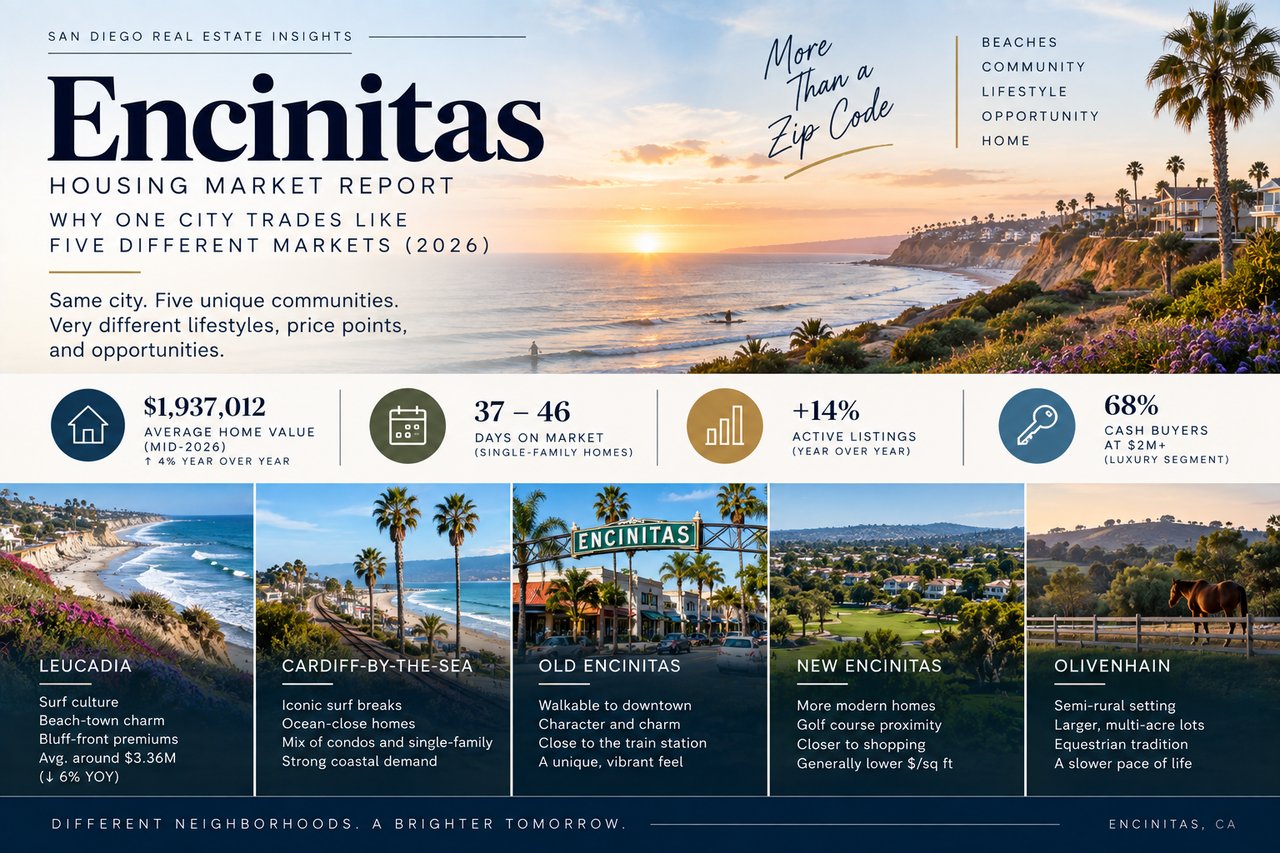
Encinitas Housing Market Report: Why One City Trades Like Five Different Markets (2026)
Encinitas gets talked about as a single housing market, one median price, one days-on-market figure, but that framing hides more than it reveals. The city is legally one municipality with an average home value of $1,937,012 as of mid-2026, up 4 percent year over year, yet it's actually five distinct communities, Leucadia, Cardiff-by-the-Sea, Old Encinitas, New Encinitas, and Olivenhain, each with its own price ceiling, lot pattern, and regulatory quirks that shape what a buyer is really paying for. Add in a coastal bluff overlay zone that caps what's buildable along the ocean-facing blocks and a state housing law rewrite the city adopted this year, and the numbers on a listing sheet only tell part of the story.
Five communities, one zip code
Encinitas was incorporated in 1986 by combining five previously separate areas, and each one still functions like its own micro-market today. Leucadia, the northernmost community, carries the strongest beach-town identity, older cottage-style homes on small lots close to the sand, a surf culture that shows up in everything from the streetscape to home prices, and a bluff-front premium that pushes recent sales into the low-to-mid $2 million range even as the broader Leucadia average has cooled to around $3.36 million, down 6 percent from a year earlier. Cardiff-by-the-Sea, the southernmost coastal community, mixes elegant condos with beachfront homes near its well-known surf breaks and campgrounds, commanding similarly steep premiums for anything with ocean proximity. Old Encinitas sits between the two, walkable to downtown and the train station, with an older housing stock that draws buyers who want character and location over new construction. New Encinitas, inland and built out more recently, reads as a different kind of neighborhood entirely, golf course adjacent, closer to shopping, with a more modern suburban feel and generally lower per-square-foot pricing than the coastal strip. Olivenhain, furthest inland, is the outlier of the group: semi-rural, multi-acre lots, an equestrian tradition, and a slower pace that has more in common with Rancho Santa Fe than with the beach communities three miles west. A buyer comparing a listing in Leucadia to one in Olivenhain isn't really comparing two homes in the same market, they're comparing two different lifestyles that happen to share a mailing address.
What the citywide numbers actually say
Citywide, the median sale price has bounced between roughly $1.79 million and $1.9 million across 2026 depending on the month and the data source, with July 2026 sales landing at a $1,790,000 median against 226 active listings. Days on market has widened noticeably from where it sat a year earlier: homes averaged around 61 days on market in February 2026 compared to just 24 days in February 2025, and by July that figure had stretched to roughly 66 days by some measures, even as Zillow's pending-date metric, a different way of measuring the same slowdown, shows homes going to pending in around 12 days. That gap between different days-on-market figures isn't a data error, it reflects different starting points, days to first offer versus days to a fully closed and recorded pending status, and both are worth knowing depending on whether you're trying to gauge initial buyer interest or the full sales cycle. Inventory has loosened to somewhere in the 2 to 2.5 month supply range earlier in the year, a real shift from the sub-one-month supply that defined the market during the tightest years of the pandemic run-up, though still short of the 4 to 6 month supply generally considered balanced between buyers and sellers.
The Coastal Bluff Overlay Zone shapes what's actually buildable
Anyone looking at a bluff-adjacent property in Leucadia, Old Encinitas, or Cardiff needs to understand Encinitas Municipal Code 30.34.020, the Coastal Bluff Overlay Zone, before assuming a lot's listed square footage translates into buildable space. The city enforces a 40-foot minimum setback from the bluff edge for new structures, with only a narrow 25-foot exception available for additions to a structure that's already seaward of the standard line, and no permanent irrigation is permitted within 40 feet of the edge at all. These setbacks aren't arbitrary, they're calculated using engineering analysis that projects bluff retreat over several decades, which means a lot that looks generously sized on a plat map can have a meaningfully smaller buildable footprint once the setback is applied. Seawalls and other hard armoring, revetments, breakwaters, cribbing, are essentially off the table for new construction under current city policy, permitted only in a genuine emergency where an existing structure faces imminent threat, until a comprehensive shoreline management plan is approved as an amendment to the city's Local Coastal Program. That's a meaningfully more restrictive stance than what's played out in some other San Diego coastal communities, and it means a bluff-front buyer in Encinitas is taking on erosion risk with fewer engineered options to manage it later, a detail worth running past a coastal engineer before making an offer on anything near the edge, not after.
Encinitas rewrote its own zoning rules to match state law this year
Encinitas isn't zoned the way it was even a few years ago. The city council adopted an ordinance integrating state housing law directly into the municipal code, incorporating Senate Bill 9's provisions that let a homeowner on a qualifying single-family lot either build a second primary dwelling unit or split the lot entirely, with the combined potential for up to four primary units and four accessory dwelling units on what used to be a single-family parcel. Layered on top of that, the city's ADU rules allow a detached accessory dwelling unit up to 1,200 square feet, so long as it doesn't exceed the size of the primary residence, plus a junior ADU built within the existing home footprint, and multifamily lots with an existing structure can add ADUs up to a cap of eight detached units. For anyone buying a single-family lot in Encinitas right now, especially in New Encinitas or Old Encinitas where lots tend to be larger and further from the bluff overlay's restrictions, that zoning flexibility is a real value driver that doesn't show up anywhere on a standard listing sheet. It's worth asking specifically what a given lot could support under the new rules, since two otherwise similar homes can carry very different redevelopment potential depending on lot size, zoning designation, and proximity to the coastal overlay.
The North 101 corridor is reshaping Leucadia specifically
Leucadia's beachside commercial strip along Highway 101 operates under its own governing document, the North 101 Corridor Specific Plan, which has guided a years-long streetscape overhaul, narrower travel lanes, a landscaped median, bike lanes, and pedestrian improvements, running through the heart of the community's commercial core. For buyers evaluating property near that corridor, the plan matters beyond aesthetics: it shapes what kind of commercial development can happen nearby, which in turn affects walkability, traffic patterns, and the long-term character of a neighborhood that's already commanding some of the steepest per-square-foot prices in the city. A home a block off the corridor in a fully built-out stretch is a different proposition than one near a parcel still positioned for the kind of infill the specific plan anticipates.
What this means if you're buying in Encinitas
Treat the five communities as five separate markets rather than one city with a single median, since a price that looks high for "Encinitas" in general might be entirely reasonable for a bluff lot in Leucadia, and a price that looks like a bargain might reflect Olivenhain's acreage-driven math rather than a genuine deal. If you're looking at anything near the coastal bluff, get a setback and geotechnical review before writing an offer, not after, since the 40-foot line and the city's tight restrictions on new armoring can meaningfully limit what you're actually able to build or rebuild. And if lot size and future flexibility matter to you, ask directly what SB 9 and the city's ADU rules would allow on a specific parcel, since that potential varies a lot by lot and neighborhood.
What this means if you're selling in Encinitas
With days on market roughly doubling from a year ago and inventory loosening into the low 2-month range, pricing to the specific micro-market your home sits in matters more than it did during the tighter years, a Leucadia bluff listing and a New Encinitas suburban listing shouldn't be priced off the same comp set even though they share a city name. If your lot has real ADU or SB 9 potential, that's worth highlighting explicitly in your listing rather than assuming buyers will work it out themselves, since it's exactly the kind of value that doesn't show up in a basic price-per-square-foot comparison. And if you're near the coastal bluff, having your setback documentation and any prior geotechnical reports ready for a buyer's due diligence can meaningfully shorten a deal that might otherwise stall over questions your listing agent can't answer on the spot.
The bottom line
Encinitas trades less like a single housing market and more like five overlapping ones stitched together by a shared city government, and the numbers that matter, price, days on market, buildable lot potential, bluff setback exposure, shift significantly depending on which of the five you're actually looking at. Whether you're comparing a Leucadia bluff lot to an Olivenhain acreage property, or trying to figure out what a specific parcel's zoning actually allows under the city's new SB 9 rules, reach out and we'll go through the numbers for your specific neighborhood together.