How Does the Real Estate Market Affect Luxury Home Prices?
The short answer is that it doesn't, at least not the way most people assume. The forces that move the median home price in San Diego, mortgage rates, first-time buyer affordability, entry-level inventory, barely touch the luxury market anymore. Luxury prices are being driven by something closer to the stock market than the housing market: cash on hand, portfolio gains, and how much wealthy buyers want to be in a particular zip code. That split has become so pronounced in 2026 that economists have started calling it a K-shaped housing market, one line going up, one line going down, and almost nothing connecting them. Here's what's actually driving the top end right now, and what it means if you're buying or selling above $2 million in San Diego.
The market has split into two markets
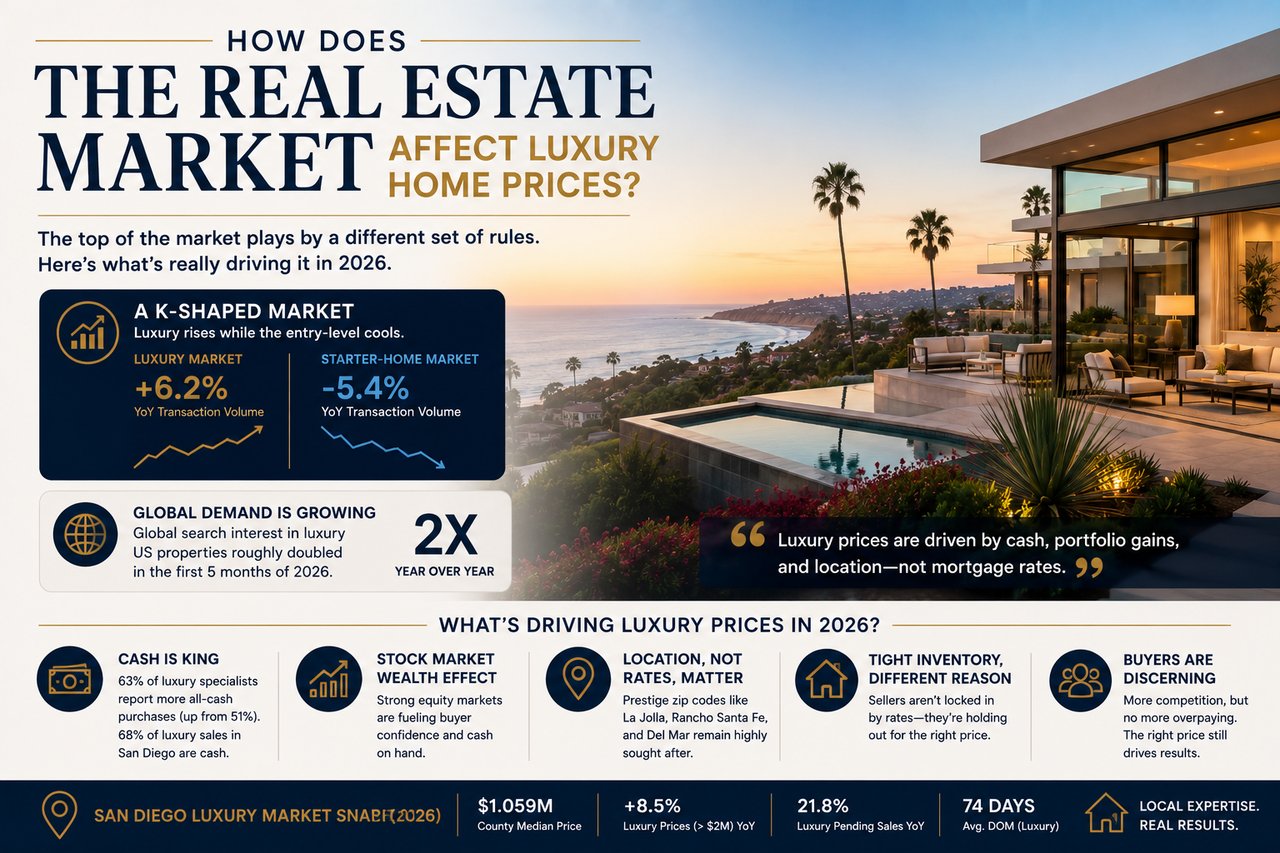
For most of the last decade, luxury and entry-level homes moved together, just at different price points. A rate hike slowed both. A hot spring season lifted both. That correlation has broken down. Luxury home transaction volume grew 6.2 percent year over year in 2026, even as starter-home sales contracted 5.4 percent over the same period, with first-time buyers facing 30-year fixed rates around 6.8 percent and prices that haven't given them much room to work with. Global search interest in luxury US properties roughly doubled in the first five months of 2026 compared to the year before, which tells you the demand pulling on the top of the market isn't just domestic move-up buyers, it's international capital looking for a place to park money.
Nearly 80 percent of luxury real estate specialists surveyed this year describe their local high-end markets as resilient, a word you don't hear much applied to the entry-level segment right now. The two markets are responding to almost entirely different inputs, and treating them as one housing market, the way a lot of national headlines still do, misses what's actually happening at either end of it.
Why mortgage rates barely register at the top
The single biggest reason luxury prices don't move with the broader market is that luxury buyers increasingly aren't using mortgages at all. Sixty-three percent of luxury property specialists reported an increase in all-cash purchases among their clients this year, up from 51 percent the year before. In Miami, one of the most cash-heavy luxury markets in the country, cash represented 46.5 percent of purchases between $1 million and $2 million, climbed to 64.4 percent between $2 million and $5 million, and hit 84.7 percent above $5 million. San Diego's numbers track closely. Cash buyers now account for roughly 68 percent of luxury transactions countywide, which means a rate move that would sideline a median buyer barely registers as a data point to someone buying a $4 million home in Rancho Santa Fe.
What's funding those cash purchases is largely the stock market. Home equity gains have played a role too, but the bigger driver has been a strong run in equities, which has left affluent buyers with more accessible net worth than they had two years ago. When the market posts a good year, luxury real estate tends to see the benefit show up within a couple of quarters, buyers converting portfolio gains into property rather than waiting to finance a purchase at a rate that, for them, is more of an inconvenience than a barrier. It's worth saying plainly what this means for forecasting: if you want a read on where luxury home prices are headed, the S&P 500 is arguably a better leading indicator than the 10-year Treasury yield, which is the opposite of how the entry-level market works.
The lock-in effect looks different from the top
The mortgage rate lock-in effect, homeowners sitting on a 3 percent rate refusing to sell into a 6.8 percent one, gets talked about constantly as a drag on the entry-level market, and it is. But it shows up differently in the luxury segment. A lot of luxury sellers already own their homes outright or are sitting on enough equity that a new rate isn't the deciding factor in whether they list. Their hesitation is more often about price than payment. They're not worried about affording the next mortgage, they're worried about leaving money on the table, which means luxury inventory stays tight for a different reason than entry-level inventory does.
There are early signs the broader lock-in effect is starting to crack. For the first time, there are now more homeowners nationally with mortgage rates above 6 percent than below 3 percent, and roughly one in three sellers this year say they're willing to give up a sub-5 percent rate to list. That shift matters more for move-up buyers in the middle of the market than it does at the very top, where the decision to sell was never really about the rate to begin with. Don't expect luxury inventory to loosen the way entry-level inventory eventually will. It's being held back by a different set of hands.
What this looks like in San Diego right now
San Diego's overall median home price sat around $1.059 million in May 2026, with countywide sales volume actually down 6.9 percent month over month, a sign that the middle of the market is cooling. The luxury segment told a completely different story over the same stretch. Homes priced above $2 million rose 8.5 percent year over year, and according to the San Diego Association of Realtors, luxury pending sales climbed 21.8 percent year over year on a rolling 12-month basis, the strongest gain of any price tier in the county. Detached home sales generated roughly $2.148 billion in June alone, up more than 25 percent from a year earlier, and a meaningful share of that volume sat well above the county median.
That split shows up clearly if you compare specific neighborhoods. La Jolla's median single-family sale price ran around $3.52 million through the first half of 2026, with a median price per square foot near $1,368, reflecting the premium buyers pay for oceanfront and coastal-adjacent prestige. Rancho Santa Fe, San Diego's wealthiest zip code by median price, sat closer to $4.9 million, with a lower per-square-foot number around $950 that reflects larger lot sizes and estate-style properties rather than density. Del Mar's small, tightly bounded footprint keeps supply thin enough that its per-property medians run above La Jolla's even though its per-square-foot numbers are closer. Days on market at the top of the county have stretched to an average of 74 days as of mid-August, but that number hides real variation, La Jolla is currently moving roughly 52 percent faster than Rancho Santa Fe, making it the most liquid segment of the county's luxury market right now even as the broader luxury tier slows compared to 2021 and 2022.
Buyers aren't writing blank checks anymore
It's worth being clear that resilient doesn't mean irrational. Sale-to-list ratios at the top of the market have softened compared to the peak years, and days on market have stretched even as transaction volume rises, which tells you buyers are still there but they're no longer absorbing ambitious pricing the way they did in 2021 and 2022. A well-located, well-priced luxury listing in La Jolla or Rancho Santa Fe is still moving with real competition behind it. An overpriced one is sitting for months, cash buyer or not. The wealth effect has made the buyer pool deeper, not less discerning, and sellers who price a luxury listing off 2022 comps rather than what's actually closing this year are the ones watching their days on market climb toward triple digits.
What this means if you're selling above $2 million
If you're selling a luxury property in San Diego right now, the practical takeaway is that your buyer pool is largely insulated from the affordability pressure squeezing the rest of the market, but that doesn't buy you unlimited room on price. Comps from two or three years ago are close to useless in a market moving this fast at the top. Pull the most recent closed sales in your specific neighborhood, not the county-wide luxury average, since La Jolla, Rancho Santa Fe, and Del Mar are behaving differently enough from each other that a single number won't serve you well. And lean into the fact that a large share of your buyer pool is paying cash. That changes what matters in your marketing, since financing contingencies and appraisal risk are less of a concern for many of these buyers than they'd be for a median-priced sale, which can mean a faster, cleaner escrow if the price is right from day one.
What this means if you're buying above $2 million
If you're on the buying side, the biggest shift to understand is that you're less likely to be competing against rate-sensitive buyers who disappear the moment a Fed decision goes the wrong way. Your competition is other cash-rich buyers responding to portfolio gains and international demand, which means the leverage you have depends more on genuine inventory in your target neighborhood than on macro conditions. Watching days on market by neighborhood, not by county, tells you far more about your actual negotiating position. A 74-day countywide average means very little if the specific pocket you're shopping in, La Jolla right now, for instance, is moving in closer to half that time with real competition behind every well-priced listing.
Getting a read on your specific segment
The luxury market and the broader housing market are answering to different questions right now, one shaped by mortgage affordability and inventory, the other by portfolio gains, cash positions, and neighborhood-specific supply. If you're thinking about buying or selling above $2 million in San Diego and want a clear read on how your specific neighborhood is actually performing right now, reach out and we'll walk through the current numbers together.