La Jolla Housing Market Report: What the Numbers Actually Say Right Now (2026)
Look up La Jolla's median home price and you'll get a different answer depending on where you look: roughly $2 million on one site, $2.35 million on another, an average value north of $2.4 million on a third. That's not bad data, it's a market where a $900,000 Village condo and a $6 million La Jolla Farms bluff estate both count toward the same citywide number. Underneath the noise, La Jolla is dealing with something none of its neighboring coastal markets are: a major regulatory change to how close you can build to the bluff edge, one that's reshaping what ownership actually costs in the neighborhood's most iconic pockets. Here's what's actually happening as of late summer 2026.
Why the median price depends entirely on which source you check
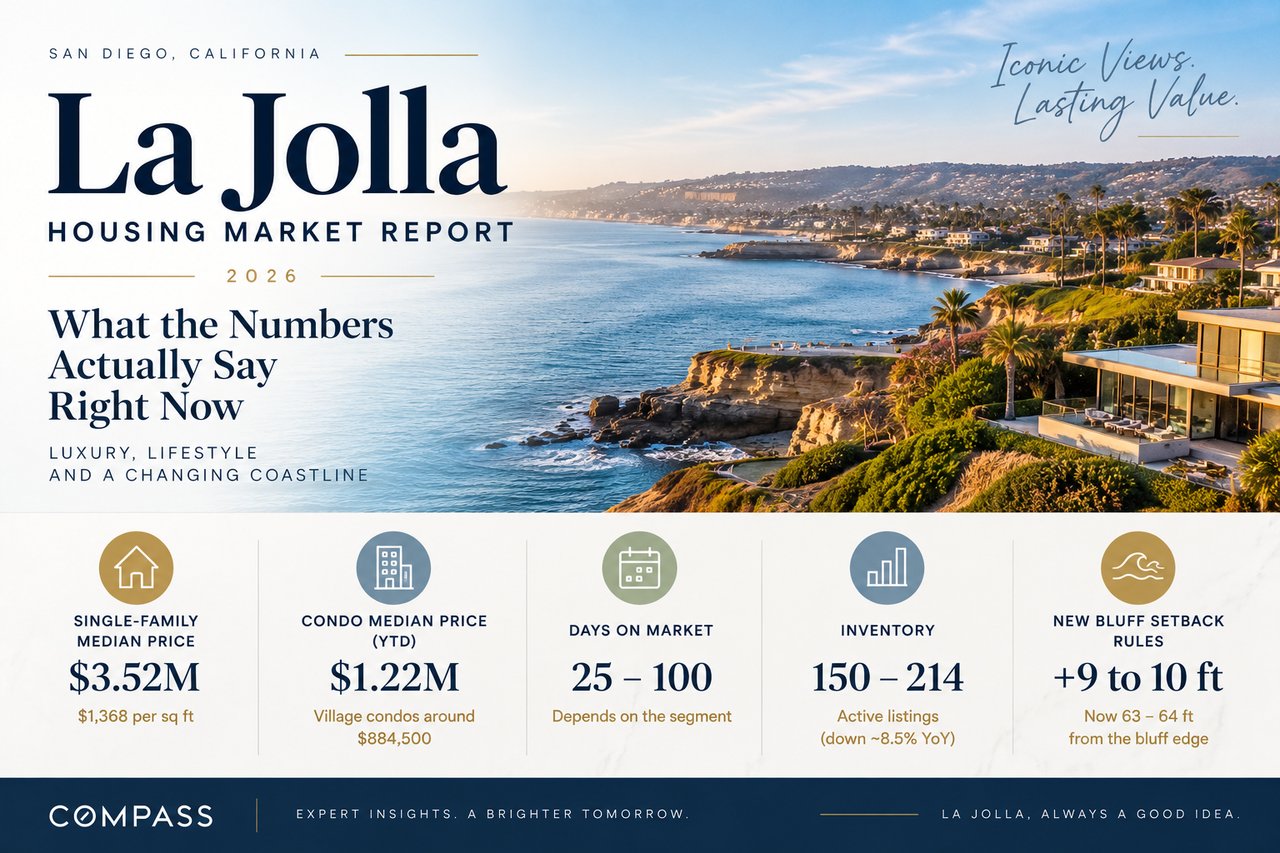
La Jolla's single-family median sale price ran around $3.52 million through the first half of 2026, with price per square foot near $1,368, reflecting the premium buyers pay for oceanfront and coastal-adjacent prestige. That's a very different number from the roughly $2 million to $2.35 million figures showing up in broader "La Jolla" market reports, and the gap comes down to what's actually being averaged. Broader reports blend in La Jolla Village condos, where the median runs closer to $884,500 with units ranging from roughly $490,000 to $1,030,000, alongside single-family homes in Muirlands or La Jolla Farms that sell for multiples of that. A single blended number tells you almost nothing useful about what you'd actually pay for a specific type of property here, and it's worth checking which segment any statistic you read is actually describing before you anchor on it.
Where prices actually stand by segment
Split the market the way buyers actually shop it, and the picture gets clearer. Single-family homes are running at that roughly $3.52 million median with $1,368 per square foot pricing, driven heavily by oceanfront and view properties in La Jolla Shores, the Muirlands, and La Jolla Farms. Condos and townhomes across La Jolla carry a year-to-date median closer to $1,220,000 according to San Diego Association of Realtors data, a full segment above the more walkable, entry-level condo stock concentrated in the Village itself. That's a wide spread even within the attached housing category, and it reflects how much La Jolla's condo inventory varies between compact Village units and larger, view-oriented buildings closer to the water.
How fast homes are actually moving
Days on market figures for La Jolla bounce around even more than price, anywhere from 25 days to over 100 depending on the source and the month measured. That spread isn't inconsistent data, it's the same segment story showing up again. Faster-moving numbers tend to reflect more accessible Village and inland listings, while the slower figures track closer to the ultra-luxury oceanfront tier, where a smaller buyer pool and unique, hard-to-comp properties naturally stretch out the sales timeline. Within the county's broader luxury segment specifically, La Jolla is actually the standout for liquidity: it's been moving roughly 52 percent faster than Rancho Santa Fe, San Diego's other marquee luxury zip code, making it the most actively trading high-end pocket in the county even as luxury sales overall have slowed from their 2021 and 2022 pace.
Inventory: tight for a market this expensive
La Jolla had somewhere between 150 and 214 active listings as of mid-2026 depending on the data source, down roughly 8.5 percent from a year earlier. That's a genuinely thin number of homes for sale in a neighborhood this size, and it's tighter than what a lot of buyers expect from a luxury coastal market. The condo segment specifically is running about 3.3 months of supply with a 97.8 percent list-to-sale price ratio, which puts La Jolla's attached housing market solidly in seller's market territory. That's a real local exception worth flagging, since condos and townhomes countywide have been the softer half of San Diego's housing market this year, with the broader attached median down roughly 1.5 percent year over year and older HOA communities off considerably more. La Jolla's condo market is doing the opposite of that county-wide trend, likely because its own supply is constrained by geography and zoning in a way most other San Diego condo submarkets aren't.
The regulatory change unique to La Jolla
This is the story that separates La Jolla from every other market report in this series. San Diego adopted its first comprehensive Coastal Resilience Master Plan in September 2025, and as of July 1, 2026, updated bluff setback guidance incorporating the California Coastal Commission's sea level rise policy took effect. Total setback requirements are increasing from roughly 53 to 55 feet up to 63 to 64 feet from the bluff edge, a 9 to 10 foot jump that can reduce a bluff-front lot's buildable area by 10 to 15 percent and add $50,000 to $150,000 to a project's cost. Owners in La Jolla's most exposed pockets, La Jolla Farms, parts of La Jolla Shores, and stretches of Bird Rock's oceanfront, should also budget $8,000 to $15,000 for the specialized coastal geotechnical analysis now required, covering 75-year erosion projections, stability calculations, and wave action modeling.
The Coastal Commission's stated philosophy going into this cycle favors managed retreat and nature-based solutions over new seawalls and individual property armoring, treating hard armoring increasingly as a last resort rather than a default option. For anyone buying, remodeling, or rebuilding on a bluff-adjacent La Jolla lot, this isn't a minor permitting footnote, it's a real constraint on what you can add to the property and a real cost to budget before you fall in love with a listing's view.
Schools run on a completely different system here
Buyers cross-shopping La Jolla against Carmel Valley or Del Mar often assume the school situation works the same way. It doesn't. La Jolla sits within San Diego Unified School District, not the San Dieguito Union High School District that governs Carmel Valley and Del Mar. La Jolla High School carries a 10 out of 10 GreatSchools rating with a 99 percent graduation rate, comparable in reputation to Torrey Pines and Canyon Crest Academy, but it's an entirely separate district with its own boundaries, enrollment process, and feeder schools. If school assignment is part of what's drawing you to La Jolla specifically, confirm the exact attendance boundary for any property you're considering rather than assuming it works like the neighboring communities.
The neighborhoods within La Jolla aren't one market
La Jolla is really several distinct pockets sharing one name, and each behaves differently. The Village is dense, walkable, and historic, commanding a premium for proximity to the coastline, restaurants, and galleries, with a condo stock that ranges from modest older buildings to newer luxury developments. La Jolla Shores sits closer to the water with a mix of beachfront condos and larger single-family homes on the bluffs above, putting it squarely in the zone most affected by the new setback rules. Bird Rock offers a walkable commercial corridor with a mix of housing types nearby, drawing buyers who want beach access without the Village's density or price ceiling. The Muirlands and La Jolla Farms sit further from the coast on larger estate lots, trading density for privacy and square footage, though La Jolla Farms in particular includes some of the most bluff-exposed and setback-affected parcels in the neighborhood. Treating any single price or days-on-market figure as representative of all of these pockets at once is exactly how the conflicting statistics floating around online come about.
How La Jolla compares to Del Mar and Carmel Valley
The three coastal North County-adjacent markets get cross-shopped constantly, but they're answering different questions right now. Carmel Valley remains the tightest, most competitive of the three, running just over a month of supply on the strength of its schools and single-family inventory. Del Mar is in the middle of a genuine luxury correction, with prices and price per square foot both down roughly 10 percent year over year and the majority of sales closing well under original ask. La Jolla sits somewhere in between on the single-family side, still a strong, actively trading luxury market, but with a condo segment that's bucking the countywide softening trend entirely, something neither Del Mar nor Carmel Valley's attached housing market can currently claim. And La Jolla carries a coastal regulatory exposure that simply doesn't exist inland in Carmel Valley or in most of Del Mar Heights, which matters enormously if the property you're evaluating sits anywhere near a bluff edge.
What this means if you're selling in La Jolla right now
Know exactly which segment your property competes in before you price it, since a Village condo, a Shores view home, and a Muirlands estate are effectively three different markets wearing the same zip code. If your property is anywhere near a bluff, get ahead of the new setback rules now: a professional read on how the updated geotechnical and setback requirements affect your lot's buildable area can materially change how you market the home, and buyers doing real diligence are going to ask about it regardless. And if you're selling a condo, lean into the fact that La Jolla's attached market is actually tight right now, a genuinely different story than most of the county's softening condo segment.
What this means if you're buying in La Jolla right now
Get clear on which of La Jolla's distinct pockets actually fits what you want before comparing prices across the neighborhood, since a per-square-foot number from the Village tells you very little about what you'd pay in La Jolla Farms. If you're looking at anything bluff-adjacent, budget for the new geotechnical analysis and reduced buildable area before you get attached to renovation or rebuild plans, since the July 2026 setback changes are a real cost, not a formality. And if school assignment matters to your decision, confirm La Jolla High School's specific boundary rather than assuming it maps the same way Torrey Pines or Canyon Crest Academy does for Carmel Valley and Del Mar buyers.
The bottom line
La Jolla is a genuinely strong, liquid luxury market on the single-family side, one of the fastest-moving luxury submarkets in the county, with a condo segment that's holding up against a countywide trend working against most other attached housing in San Diego. What sets it apart from Del Mar and Carmel Valley isn't just price, it's a real regulatory shift now in effect that changes what bluff-adjacent ownership actually costs. If you want a clear read on what a specific La Jolla property, or a specific pocket of the neighborhood, is actually worth right now, or how the new coastal setback rules might affect a property you're considering, reach out and we'll go through the real numbers together.