Midway Rising: The Sports Arena Site Is Finally Moving, and 4,254 Homes Are Coming With It (2026)
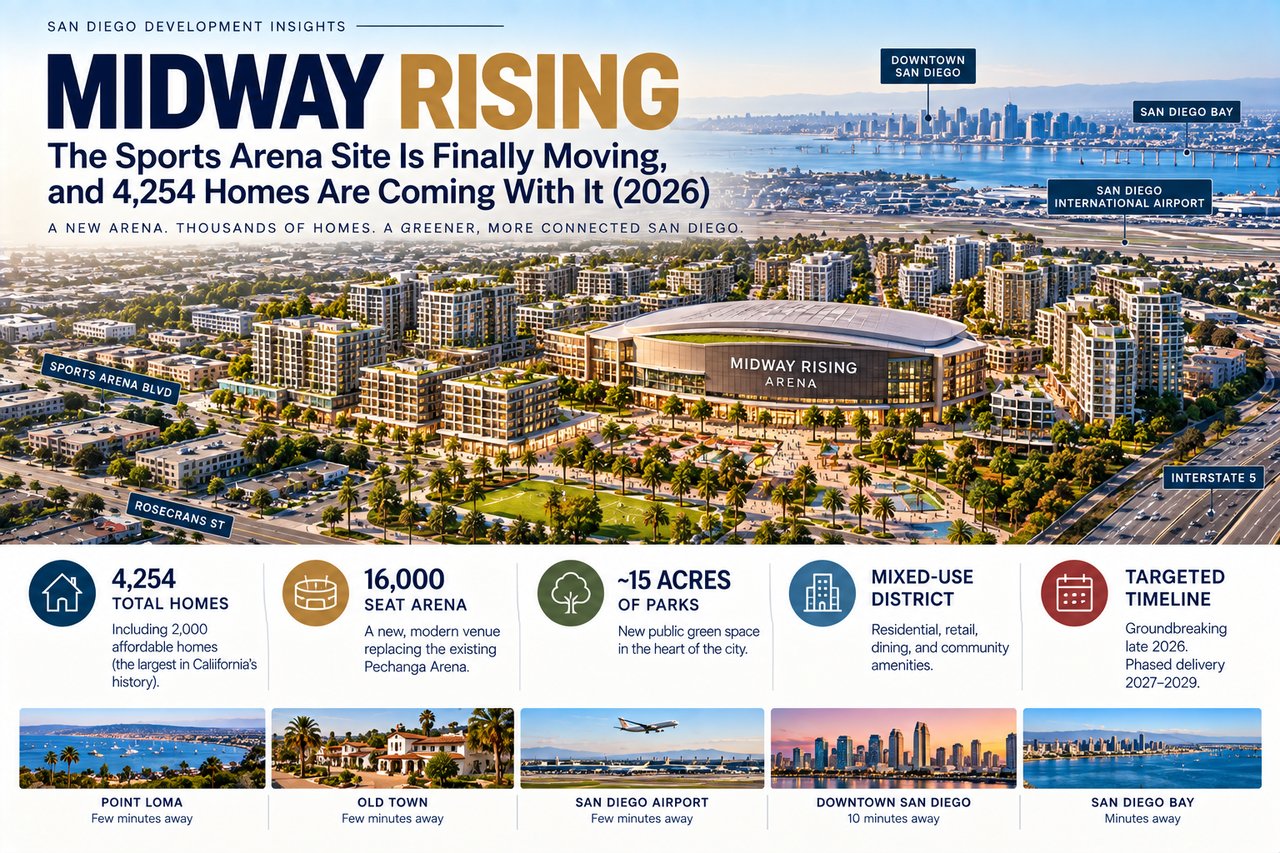
The Pechanga Arena site has been an odd piece of San Diego for years now, a 49-acre stretch of parking lots and an aging arena sitting on some of the most centrally located land in the city, a few minutes from the airport, Point Loma, Old Town, and the bay, doing almost nothing with its potential. That's finally changing. Midway Rising, the plan to redevelop the site into thousands of homes, a new arena, and public parkland, cleared a major legal and legislative hurdle in August 2026, and groundbreaking is now being targeted for later this year. For a project that's spent years tangled up in lawsuits and community pushback, that's a real shift, and it's worth understanding what's actually happening here before the headlines get ahead of the facts.
What's on the table
The scale of this project is hard to overstate for a site this close to the urban core. The plan calls for 4,254 housing units total, with 2,000 of those set aside as affordable housing, a number the city has described as the largest affordable housing development in California's history. The 60-year-old Pechanga Arena, the current home to concerts, minor league sports, and community events, gets replaced with a new 16,000-seat entertainment venue. Nearly 15 acres of the site are set aside for public parks, a meaningful commitment of green space on land that's currently almost entirely paved. Taken together, this isn't a tweak to the Sports Arena, it's a full conversion of one of the last large, centrally located, underused parcels in the city into a dense residential and entertainment district.
Why it stalled for so long
If you've heard the Midway Rising name before and assumed nothing came of it, that reaction makes sense given how long this has dragged. The city selected the Midway Rising team's proposal back in 2023, but the project has spent the years since fighting through a mix of legal challenges and community opposition, much of it centered on the California Environmental Quality Act review process and concerns from neighboring residents about scale, traffic, and the loss of existing recreational uses on the site. CEQA litigation has a well-earned reputation in California for tying up exactly this kind of large infill project for years, regardless of how much political support it has, and Midway Rising ran into that buzzsaw just like plenty of major developments before it.
The state stepped in
What changed the trajectory here wasn't a court ruling in the project's favor, it was the state legislature. SB-958, a bill specifically written to give Midway Rising a CEQA exemption, cleared the Assembly Appropriations Committee in August 2026, a significant procedural milestone on the path to becoming law. Mayor Gloria has been vocal about the project's importance, going as far as saying publicly that failure isn't an option for the Sports Arena redevelopment, and the legislative carve-out is essentially the city and state acknowledging that the normal environmental review timeline was going to keep this project stuck indefinitely without some kind of intervention. That's not a small thing. A project-specific CEQA exemption bill making it through committee is a strong signal of institutional commitment, the kind of political capital that doesn't get spent on projects seen as likely to fail.
Where the timeline actually stands
The city's exclusive negotiating agreement with the Midway Rising development team has been extended through December 4, 2026, giving both sides a defined runway to finalize the deal terms before that date. Groundbreaking is now being targeted for late 2026, and current projections put the delivery of housing and the new arena somewhere in the 2027 to 2029 window, phased rather than all at once. That's a meaningfully more concrete timeline than Seaport San Diego's, which is still sitting in environmental review with construction realistically five or more years out. Midway Rising has already been through its environmental fight, at least on the legislative front, and is now positioned closer to the Ocean Kamp stage, past its hardest procedural obstacle and pointed at an actual construction start within the next year or so.
What this could do to the Midway District and Point Loma-adjacent neighborhoods
The Midway District has functioned for decades as a kind of in-between zone, not quite Point Loma, not quite Old Town, not quite downtown, mostly known for big-box retail, self-storage, and the arena itself rather than as a residential destination in its own right. Adding over 4,000 housing units, a modern entertainment venue, and substantial new parkland would change that character fundamentally, and it would do it on land that's genuinely central to the rest of the city rather than on the urban fringe. Nearby areas like Loma Portal, Midtown, and the western edge of Old Town are the ones most likely to feel this first, both from construction activity in the near term and from a meaningfully different neighborhood identity once phases start delivering. It's also worth noting the affordable housing component specifically, since a development of this size setting aside roughly half its units as affordable is going to shape the local rental and ownership market differently than a purely market-rate project would.
The honest caveat here
None of this means the fight over Midway Rising is fully over. The project has already survived years of legal challenges once, and a CEQA exemption bill clearing one committee is a milestone, not final passage into law, let alone the end of every possible legal avenue opponents could pursue afterward. Large infill projects in California have a track record of finding new obstacles even after clearing ones that looked decisive at the time. The realistic read is that Midway Rising is meaningfully closer to breaking ground than it's been at any point since 2023, but "targeted for late 2026" is still a target, not a locked date, and anyone making real estate decisions around this project should watch for an actual groundbreaking event rather than assuming the legislative progress alone guarantees it.
How this compares to the other big projects in play right now
This blog has now covered three major San Diego development stories working through very different stages: the Gaylord Pacific and Chula Vista Bayfront, already open and generating real economic activity a year in; Ocean Kamp in Oceanside, past its hardest site-prep hurdle and targeting 2026 construction; Seaport San Diego, still early in environmental review with years to go; and now Midway Rising, which just cleared its own version of Seaport's biggest obstacle and is aiming for a similar 2026 groundbreaking to Ocean Kamp. Of the four, Midway Rising is arguably the most consequential for the city's overall housing supply given the sheer unit count, and it's the one where a genuinely underused, centrally located piece of San Diego could look completely different within a few years rather than a decade.
What this means if you're buying near the Midway District
If you're considering property in the Midway District, Loma Portal, or the western stretch near Old Town, understand that you're buying ahead of what could be one of the largest single neighborhood transformations in the city over the next several years, but also that the project still has a legislative and construction runway ahead of it before any of the 4,254 units or the new arena actually exist. That combination argues for treating nearby property as a legitimate long-term thesis rather than assuming today's prices already reflect a finished, thriving new district. Keep an eye specifically on the SB-958 outcome and an actual groundbreaking announcement as the milestones that would meaningfully firm up the timeline.
What this means if you're selling near the Midway District
Midway Rising is a genuinely strong, well-documented talking point right now given how far it's come in 2026 specifically, the legislative movement is real and recent enough that most buyers won't already know about it. At the same time, be straightforward about the project's history of delays and ongoing legal exposure rather than presenting a late-2026 groundbreaking as a certainty, since a buyer who does even basic research will find the years of litigation easily, and a seller who addresses that honestly is going to come across as more credible than one who only mentions the exciting parts.
The bottom line
Midway Rising just had its most significant year yet: a state legislative carve-out clearing the Assembly Appropriations Committee, an extended negotiating agreement running through December 2026, and a groundbreaking target before the end of the year on a 49-acre project that would bring 4,254 homes, including the largest affordable housing component in state history, a new 16,000-seat arena, and nearly 15 acres of parks to one of the most centrally located underused sites in San Diego. It's not finished fighting every possible legal battle, and "targeted for late 2026" isn't the same as dirt actually moving, but this is meaningfully further along than it's been in years. If you want help thinking through what proximity to the Midway District redevelopment is worth for a property you own or are considering, reach out and we'll go through the real numbers together.