North Park Is Building Up Fast, and Its Housing Market Is Still Running Hot (2026)
North Park has spent the last two decades turning from a quiet, slightly overlooked neighborhood into one of San Diego's most recognizable identities, a Craftsman-and-Spanish-Revival streetscape wrapped around what beer writers nationally call Beer Street. That reputation hasn't slowed down the neighborhood's construction pace in 2026. A $100 million workforce housing initiative just broke ground on new apartments, an entire block is being cleared for eight-story luxury condos, and detached homes are still selling in about two weeks. North Park is growing and staying competitive at the same time, which is a combination worth understanding if you're watching this neighborhood at all.
What the market actually looks like right now
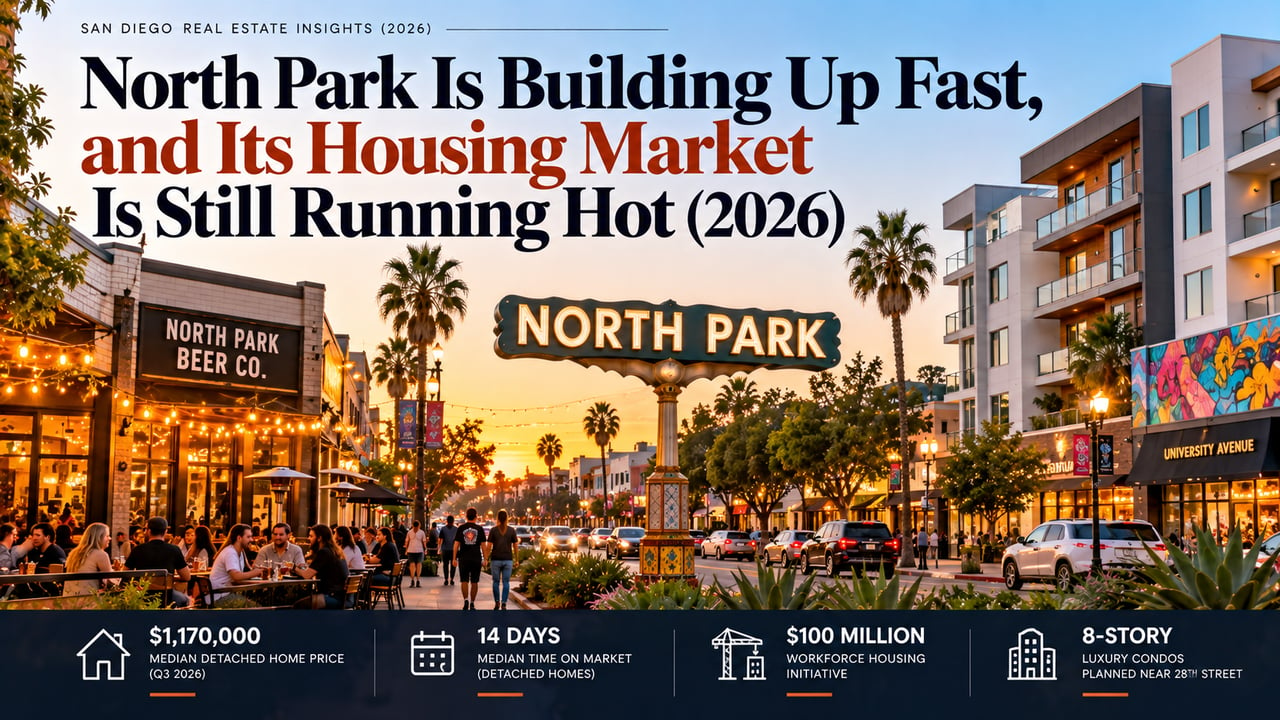
Detached single-family homes in North Park's 92104 zip code sold at a median price of $1,170,000 in the third quarter of 2026, and they did it fast, typically going under contract in around 14 days. That's a genuine seller's market by almost any measure, houses moving quickly and close to asking price, in a neighborhood where land is limited and a lot of the housing stock predates modern lot sizes. Condos and smaller attached units trade at a meaningfully lower price point, which keeps North Park accessible to a wider range of buyers than its detached-home median alone would suggest, a split similar to what shows up in several other established San Diego neighborhoods once you separate house prices from condo prices.
A historic streetscape that's also an active construction zone
North Park's defining visual identity, blocks of Craftsman bungalows and Spanish Revival homes built mostly in the first half of the twentieth century, is exactly the kind of housing stock covered in this blog's piece on the Mills Act, the state program that can cut a qualifying historic property's tax bill by 20 to 70 percent. North Park, along with South Park, Kensington, and a handful of other nearby neighborhoods, has one of the deepest concentrations of plausible Mills Act candidates in the county, and that historic character is part of what makes the neighborhood's current wave of new construction feel like such a visible contrast. Several multi-story projects are moving through demolition and construction right now along University Avenue specifically, including a large luxury condo development planned for an entire block near 28th Street, where a mix of 1941-era homes, a commercial building, and a church parking lot are being cleared to make way for an eight-story building. The project sits directly across from a popular neighborhood breakfast spot and an elementary school, a reminder of just how tightly this kind of redevelopment is woven into blocks that have looked largely the same for decades.
The affordable housing side of the story
New construction in North Park isn't just chasing the luxury end of the market. A $100 million line of credit from the San Diego Foundation is funding four affordable housing projects across North Park and neighboring Normal Heights, and one of them, a five-story, 38-studio building on Louisiana Street near University Avenue, broke ground this month and is scheduled to finish by the end of 2027. These units are earmarked for households earning up to 80 percent of the area median income, roughly $98,000 a year for a single person in San Diego right now, with developers specifically targeting police officers, firefighters, teachers, and healthcare workers. That's a meaningful detail for a neighborhood that's gotten more expensive over the years, since it means North Park's growth isn't entirely tilting toward the luxury segment even as eight-story condo towers rise a few blocks away.
Why 30th Street matters more than it might seem
It's easy to treat North Park's food and drink scene as a lifestyle detail rather than a housing market fact, but it genuinely shapes what buyers are willing to pay to live here. Roughly 14 breweries sit packed into a 2.7-mile stretch along University Avenue, 30th Street, and El Cajon Boulevard, a concentration dense enough that national beer writers nicknamed the corridor Beer Street years ago and the name stuck. North Park carries a Walk Score of 86, among the highest of any San Diego neighborhood, and the flat, gridded blocks around 30th Street between University and Upas are genuinely designed to be parked near once and walked for the rest of the evening. That combination of walkability and a dense, independently owned restaurant and brewery corridor is a real driver of demand in a market where plenty of San Diego buyers are explicitly looking for a neighborhood they can live in without a car-dependent routine.
An arts scene that reinforces the housing demand
North Park's identity runs deeper than restaurants and breweries, and that matters for understanding why demand here has stayed resilient. The neighborhood anchors a recognized arts district built around the Ray Street gallery corridor, where the monthly Ray at Night art walk draws crowds into a stretch of working studios and small galleries, and the restored Observatory North Park theater brings regular touring concerts into a building that's been part of the neighborhood for decades. That density of independent cultural institutions, packed into a compact, walkable footprint alongside the brewery corridor, is part of what distinguishes North Park from newer, more generic mixed-use developments elsewhere in the county. Buyers paying a premium here are often paying for that specific combination, walkability, nightlife, and a real arts and music scene, not just square footage and a historic facade.
A location that's genuinely hard to replicate
Part of what makes North Park's current building boom make sense is geography that newer, farther-out San Diego neighborhoods simply can't match. North Park sits a short drive from downtown, borders Balboa Park directly to its west, and has quick freeway access via the 805, the 15, and the 8, putting commuters within easy reach of downtown, Mission Valley, and the broader central San Diego job market without the longer drives that come with a lot of North County and South Bay housing. That combination of central location and established walkable infrastructure is essentially impossible to recreate in a newly built suburban community, which is a real part of why developers and public funders alike keep choosing to invest in North Park specifically rather than building equivalent density somewhere with more available land but a weaker location.
What all this construction activity actually signals
A neighborhood doesn't attract $100 million in affordable housing financing and an entire block's worth of luxury condo redevelopment unless investors and public funders both see real, durable demand underneath it. North Park is pulling off something a lot of established, historic San Diego neighborhoods struggle with, adding meaningful new housing supply at both the affordable and luxury ends of the market without losing the bungalow-lined streets and brewery corridor that make it recognizable in the first place. That's a genuinely positive setup for the neighborhood's long-term trajectory, even though any individual resident watching a familiar block get demolished for an eight-story building might reasonably feel differently about the pace of change happening right outside their door.
What this means if you're buying in North Park right now
Move quickly if you're looking at a detached home, since a 14-day median time on market in the current environment means well-priced listings aren't sitting around waiting for a second look. If you're drawn to the neighborhood's historic character specifically, check whether a property you're considering might qualify for Mills Act designation, since North Park's housing stock is exactly the kind this blog's Mills Act piece describes as strong candidates, and a lower property tax bill can meaningfully offset what's already a competitive price point.
What this means if you're selling in North Park right now
Current conditions favor you, with homes selling quickly and close to asking, but it's worth being upfront with buyers about any nearby redevelopment activity, since the pace of construction on University Avenue and elsewhere in the neighborhood is visible enough that most buyers doing basic diligence will notice it anyway. Leaning into what makes North Park distinct, the walkability, the brewery corridor, the historic architecture, is a stronger pitch than competing purely on price against newer luxury inventory a few blocks away.
The bottom line
North Park is managing to grow and stay hot at the same time, with a $1,170,000 median detached home price moving in about two weeks, a $100 million affordable housing initiative breaking ground, and an entire block clearing for luxury condos, all while its Craftsman streetscape and Beer Street reputation stay fully intact. That's a genuinely good position for a neighborhood to be in, adding real housing supply across price points without losing what made people want to live there to begin with. If you want help figuring out what a specific North Park property, historic or brand new, is actually worth right now, reach out and we'll go through the real numbers together.