Ocean Beach's Pier Defined the Neighborhood for 58 Years. Now It's Coming Down (2026)
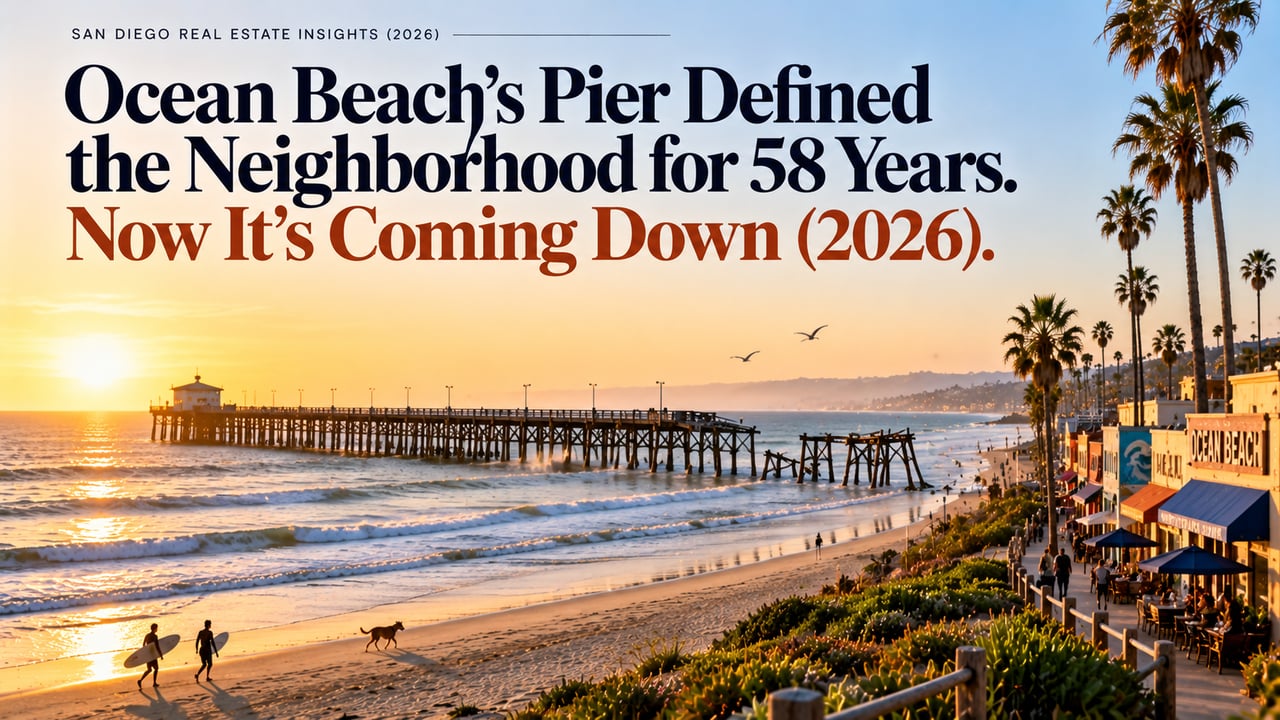
Ocean Beach has always traded on being the beach town that didn't try too hard, a dog beach at one end, a walkable downtown strip of surf shops and dive bars, and a pier stretching out over the water that's served as the neighborhood's actual center of gravity since the 1960s. That pier has been closed since October 2023, and the city has now decided it isn't coming back in its current form. San Diego is moving forward with tearing the whole thing down and building a new one, a years-long project that says as much about Ocean Beach's future as the housing numbers do.
What actually happened to the pier
High surf first damaged the Ocean Beach Pier in October 2023, and the situation got worse two months later when a support pile, one of the structural posts holding the pier up, broke off and fell into the ocean in December 2023. The city closed it to the public and has kept it closed since, and after reviewing the options, San Diego determined that repairing the 58-year-old structure wasn't the safest or most cost-effective path forward. Instead, the plan now is full demolition and a ground-up replacement, built over roughly the same footprint as the original pier but with a higher deck elevation specifically meant to reduce future wave damage and account for sea-level rise over the structure's lifespan. The estimated cost for the new pier runs between $170 million and $190 million, and the project is currently working through the environmental review required under the California Environmental Quality Act, with a draft Environmental Impact Report expected for public review in spring 2026. Based on that timeline, permitting is projected to wrap in early 2028, with construction actually starting in early 2029, a longer runway than residents watching the closed structure deteriorate would probably prefer.
The money isn't fully lined up yet
Here's the part that makes this less than a sure thing on a fixed schedule. The city currently has roughly $8.4 million in state funding earmarked for the project, a small fraction of the $170 to $190 million the full rebuild is expected to cost, and officials are still pursuing additional state and federal grants, including potential support tied to a proposed federal American Pier Revitalization Act. Until that larger funding gap actually closes, the 2029 construction start is a projection built on an assumption that the money shows up on schedule, not a guarantee. In the meantime, residents have reported vandalism and tagging at the closed, deteriorating structure, which has added a layer of local frustration to what's already been a slower-moving process than most people in the neighborhood would like.
Why this matters beyond nostalgia
It's easy to treat a pier rebuild as a tourism story rather than a real estate one, but the pier has functioned as Ocean Beach's actual anchor for decades, the thing that gives the foot of Newport Avenue its reason to exist as a walkable commercial strip rather than just another beach parking lot. A multi-year closure during construction, however it's ultimately sequenced, is going to change foot traffic patterns along that strip in ways that matter to anyone who owns or is considering buying property near it. On the other side of that disruption, a brand new, flood-resilient pier is a genuine long-term upgrade to the neighborhood's defining landmark, which is worth weighing against the near-term inconvenience of years of construction.
What makes Ocean Beach different from its beach-town neighbors
This blog has already covered Pacific Beach and Mission Beach, and the comparison to Ocean Beach is useful precisely because the three get lumped together by outsiders despite having genuinely different personalities. Ocean Beach keeps a more laid-back, less commercialized feel than Pacific Beach, with a walkable downtown strip built around independent shops and bars rather than the dense bar-and-restaurant corridor that defines Garnet Avenue, and it draws a crowd that skews toward repeat visitors and longtime residents over the louder, more transient party crowd associated with its northern neighbor. Dog Beach, at the north end of the neighborhood, has allowed off-leash dogs year-round since 1972, making it one of the only beaches in the county where that's permitted, and it's become as much a part of Ocean Beach's identity as the pier itself. That combination, less commercial intensity, more of a local, settled feel, shapes who's actually drawn to buy here.
A neighborhood that's resisted changing much on purpose
Part of what makes Ocean Beach's pier saga feel so personal to residents is that the neighborhood has spent decades actively resisting the kind of change that's reshaped a lot of the rest of coastal San Diego. Community opposition has repeatedly pushed back against taller buildings, chain retailers, and larger-scale redevelopment along Newport Avenue, which is a big part of why the strip still feels more like a small beach town main street than a polished commercial corridor. That same instinct shows up in how residents have responded to the pier's closure, less as a bureaucratic planning story and more as a direct threat to the neighborhood's identity, which helps explain why the slow pace of funding and environmental review has generated real, ongoing local frustration rather than quiet patience.
The price picture
Ocean Beach homes sold at a median price around $990,000 in July 2026, putting the neighborhood solidly in line with the broader coastal San Diego market rather than at either the high or low end of it. That figure sits below Pacific Beach's single-family median and well above Pacific Beach's condo median, reflecting Ocean Beach's own mixed housing stock of older beach cottages, small multifamily buildings, and a smaller share of larger single-family homes than some other coastal neighborhoods. Rental pricing in the area has moved unevenly across unit sizes, with some segments climbing sharply year over year, a reminder that Ocean Beach's rental market, like a lot of San Diego's coastal rental stock, doesn't move as one uniform block depending on bedroom count and building type.
The short-term rental landscape here
Most of Ocean Beach falls under the city's Tier 3 short-term rental category, which allows whole-home rentals for more than 20 days a year outside of Mission Beach's separate, neighborhood-specific tier system, provided the property is also rented for at least 90 days a year with quarterly utilization reporting. As of March 2026, the citywide Tier 3 pool still had roughly 964 licenses available, with a $41 application fee and a $1,129 license fee covering a two-year term. That's a meaningfully more open position than Mission Beach, covered in this blog's piece on Pacific Beach and Mission Beach's rental licensing squeeze, where the neighborhood-specific tier is already fully allocated with an active waitlist. For an investor specifically weighing a short-term rental purchase, Ocean Beach's STR licensing situation is currently a lot less constrained than its southern neighbor's, though that pool is shared citywide and worth checking at the time of any specific purchase rather than assumed to stay open indefinitely.
What this means if you're buying in Ocean Beach right now
Factor the pier's closure and eventual rebuild timeline into how you think about the Newport Avenue corridor specifically, since years of construction activity near the foot of the pier is a realistic near-term reality even as the long-term outcome, a new, more resilient structure, is a genuine upgrade. If a short-term rental strategy is part of your plan, Ocean Beach's Tier 3 availability is currently more favorable than Mission Beach's capped system, but confirm current license availability directly before counting on it, since that pool is shared across the whole city rather than reserved for this neighborhood alone.
What this means if you're selling in Ocean Beach right now
Lean into what actually differentiates Ocean Beach from Pacific Beach and Mission Beach for buyers who are cross-shopping all three, the quieter, more residential feel, Dog Beach, and a downtown strip that still feels like a real neighborhood rather than a tourist corridor. If your property sits close to the pier itself, be upfront with buyers about the construction timeline ahead rather than letting it surface as a surprise, since the city's own project updates are public and a buyer doing basic research will find the demolition and rebuild plans regardless.
The bottom line
Ocean Beach is heading into a real transition, losing its 58-year-old pier to demolition and a $170 to $190 million rebuild that won't be finished for years, while its housing market continues trading at a median around $990,000 with a notably more open short-term rental landscape than its beach-town neighbors to the south. The neighborhood's identity, the dog beach, the walkable strip, the less-commercial feel, isn't going anywhere, and a new, more resilient pier is a legitimate long-term win once construction wraps. If you want help figuring out what a specific Ocean Beach property is worth given where the pier project and the rental licensing landscape currently stand, reach out and we'll go through the real numbers together.