Ocean Kamp: What Oceanside's Surf Lagoon Project Actually Means for Real Estate Nearby (2026)
Ask around Oceanside about the empty lot off Mission Avenue near the 76 and you'll get some version of the same answer: something with a wave pool is supposed to go there, eventually. That vague awareness is fair, given how long the project has taken to get moving, but the underlying plan is real, specific, and finally showing visible progress on the ground. It's called Ocean Kamp, a 92-acre mixed-use development on the former Valley Drive-In and swap meet site at 3460 Mission Avenue, just north of State Route 76, and it's built around a 3.5-acre programmable surf lagoon as its centerpiece rather than an afterthought amenity.
What's actually being built
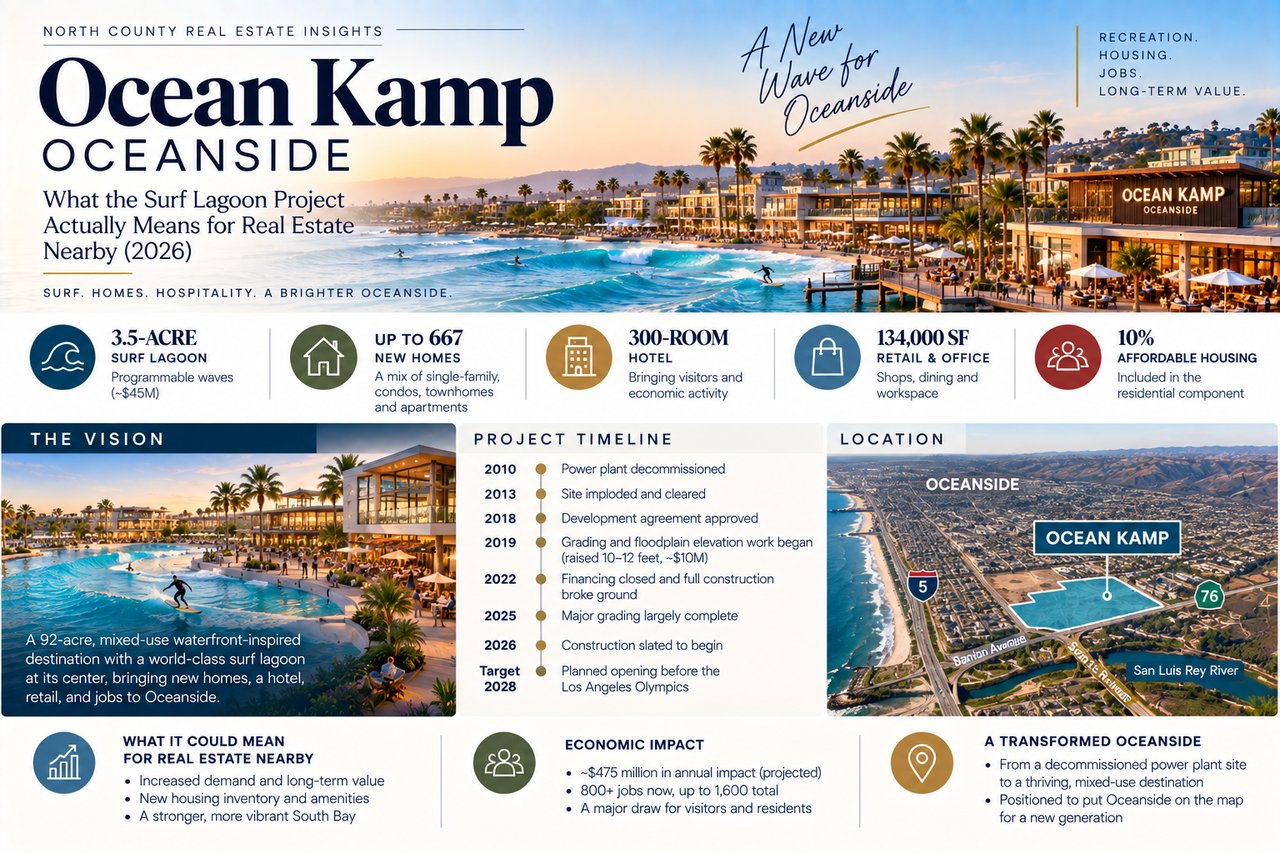
The wave pool is the part everyone's heard about, and it's a legitimate anchor: a 3.5-acre surf lagoon using pneumatic wave technology, with the vendor not yet publicly confirmed, carrying a project cost of roughly $45 million for that piece alone. But the lagoon sits inside a much larger master-planned development. The residential component calls for up to 667 all-electric homes across a mix of single-family houses, condos, townhomes, and apartments, with 10 percent of that total set aside as affordable housing. Alongside the housing, the plan includes a 300-room hotel and roughly 134,000 square feet of commercial and office space. The developer is N4FL Worldwide, and the scale of the project, nearly 100 acres with housing, hospitality, retail, and a genuine recreational draw all in one footprint, puts it closer in ambition to a small planned community than a typical infill project.
Why it's taken this long
If you've heard about Ocean Kamp before and assumed it stalled out, that impression isn't wrong, it's just outdated. The site has been in some form of planning or entitlement process for years, and the delays weren't minor paperwork holdups. Environmental lawsuits challenged aspects of the project's approval, archaeological discoveries on the site required direct coordination with the San Luis Rey Band of Mission Indians before work could proceed, and the site itself needed extensive physical preparation before any vertical construction could realistically begin. Grading work started back in 2019, and a significant part of that work involved raising the property 10 to 12 feet above the floodplain, a roughly $10 million undertaking on its own given the site's proximity to the San Luis Rey River. That combination, litigation, cultural resource review, and floodplain engineering, is exactly the kind of stack of hurdles that turns a project's public perception from "coming soon" into "is this actually happening," even when the underlying plan hasn't changed.
Where things stand right now
The good news for anyone tracking this specific project is that the most significant physical prep work, the mass grading needed to lift the site out of the floodplain, is now largely complete. That's a meaningful milestone, since it's the kind of unglamorous, expensive groundwork that has to happen before a wave pool or a single home can be built, and it's exactly the phase that dragged on for years. Construction on the development itself is slated to begin in 2026. It's worth being straightforward about the project's track record here: earlier public timelines had pointed to an early-2026 start on the lagoon specifically and vertical construction beginning by spring of this year, and neither of those narrower sub-targets has been confirmed as met at the time of writing. That's consistent with a project that has repeatedly slipped its own schedule, and it argues for treating 2026 as a directional target rather than a locked date until actual vertical construction is visibly underway. The developers' stated goal remains opening before the 2028 Los Angeles Olympics, which would give Ocean Kamp a built-in moment of national attention if the timeline holds, but there's no confirmed official opening date as of now.
Why a wave pool matters more than it sounds like it should
It's worth taking a moment on why a private surf lagoon is a meaningful real estate catalyst rather than just a novelty amenity, because the comparison to other coastal recreational anchors is instructive. A programmable wave pool offers something the ocean itself can't: consistent, scheduled, rideable surf regardless of swell conditions, tide, or crowding, which is a genuine draw for both recreational surfers and competitive training. Surf parks built on similar technology elsewhere in the country have functioned as legitimate destination amenities, pulling visitors and, eventually, residents who want to live near a consistent, high-quality surf break without needing the ocean to cooperate. For a development trying to justify hundreds of new homes, a hotel, and a meaningful retail footprint on a site that was a drive-in and swap meet a decade ago, an amenity with genuine destination pull does more for long-term property values than a standard clubhouse-and-pool package would.
What this could do to real estate in the surrounding area
Oceanside's housing stock near the 76 corridor and Mission Avenue has historically been a mix of older, moderately priced homes and light industrial or commercial parcels, not the kind of area that draws premium pricing on its own. A development of this scale, hundreds of new homes, a 300-room hotel, meaningful new commercial square footage, and a genuinely unique recreational anchor, has the potential to function the way large anchor projects tend to for the neighborhoods around them: raising the baseline appeal of nearby existing housing stock even before the new construction itself comes to market, provided the project actually delivers on its scope. That's a real but conditional upside. The project's history of delays is a legitimate reason for some caution about timing, and anyone evaluating nearby property specifically because of Ocean Kamp's presence should treat the 2026 construction start as the milestone to watch rather than assuming the wave pool and finished homes are imminent.
The comparison worth keeping in mind
This blog has covered a similar dynamic recently with the Gaylord Pacific and Chula Vista's Bayfront, another large, multi-year, public-private waterfront project that took a decommissioned industrial site and turned it into an anchor for new housing and commercial development. The throughline in both cases is the same: a single large catalytic project reshapes the immediate area around it well before, and sometimes well ahead of, any shift in the broader city's overall market data. Chula Vista's citywide median hasn't caught up to what's happening specifically around the Gaylord a year after it opened, and Oceanside's citywide numbers are unlikely to move meaningfully off Ocean Kamp alone until construction is well underway and the surf lagoon and first phase of homes are actually open. The lesson from Chula Vista applies directly here: evaluate proximity to Ocean Kamp on its own terms, not by assuming Oceanside's overall market data already reflects a project that hasn't broken ground on vertical construction yet.
What to watch for as a buyer or seller nearby
For anyone with property near the 76 and Mission Avenue corridor, or considering buying there specifically because of Ocean Kamp, the practical approach is to track actual construction milestones rather than the project's stated goals. Confirmation that vertical construction, actual buildings, not just grading, has started is the clearer signal than any previously stated target date, given the project's track record of slipping earlier sub-deadlines. It's also worth watching for any public announcement naming the wave technology vendor or setting a firmer opening date tied to the 2028 Olympics window, since either would suggest the project has moved from planning into an active build phase with real financing and contractor commitments behind it. Buyers specifically drawn to the area because of the future lagoon and hotel should price that expectation as a multi-year bet rather than something already reflected in current asking prices for nearby homes.
What this means if you're buying near Ocean Kamp
Understand that you're buying ahead of a development that's had a genuinely difficult path to construction, and that the most significant physical hurdle, the floodplain grading, is now behind the project even though vertical construction hasn't been publicly confirmed as started. That makes this a more credible bet today than it would have been a year or two ago, but it's still a bet on a multi-year build-out rather than a finished amenity, and pricing nearby property as if the wave pool and hotel are already open would be getting ahead of where the project actually stands.
What this means if you're selling near Ocean Kamp
If your property sits close enough to genuinely benefit from proximity to the site, the project's history and current momentum, completed floodplain grading, a stated 2026 construction start, and the 2028 Olympics as an implicit deadline, are legitimate talking points, but they're strongest when paired with honesty about the timeline rather than implying the amenity is closer to completion than it is. A buyer who does even basic diligence on Ocean Kamp's history will find the delays easily, so a seller who addresses that history directly and accurately is going to be more credible than one who leans only on the exciting parts of the pitch.
The bottom line
Ocean Kamp is real: a 92-acre development anchored by a 3.5-acre programmable surf lagoon, up to 667 homes, a 300-room hotel, and meaningful commercial space on the site of Oceanside's old drive-in and swap meet off the 76. The project has cleared its hardest physical hurdle, raising the site out of the floodplain, after years of environmental litigation and archaeological review, and construction is now targeted for 2026 with an eye toward opening before the 2028 LA Olympics, though several earlier sub-deadlines have already slipped. For real estate near the site, that makes this a genuine, still-developing catalyst worth watching closely rather than a settled amenity to price in today. If you want help thinking through what proximity to Ocean Kamp is actually worth for a specific property, or how to time a purchase or sale around a project still moving through construction, reach out and we'll go through the real numbers together.