Pacific Beach and Mission Beach: What a Shrinking Rental License Supply Is Doing to Two of San Diego's Busiest Beach Markets (2026)
Pacific Beach and Mission Beach get lumped together constantly, next-door neighbors sharing a sand strip, a party reputation, and a tourist crowd that doesn't always know where one ends and the other begins. They're actually two fairly different real estate markets wearing a shared identity, and in 2026 there's a specific force reshaping both of them at once: the city's short-term rental licensing caps, covered in more depth elsewhere on this blog, are close to fully allocated in both neighborhoods. That's turning a rental license itself into something close to a scarce asset, and it's worth understanding how that's playing out differently in each community before assuming either one works the way it used to.
Two beach towns, one shared strip of sand
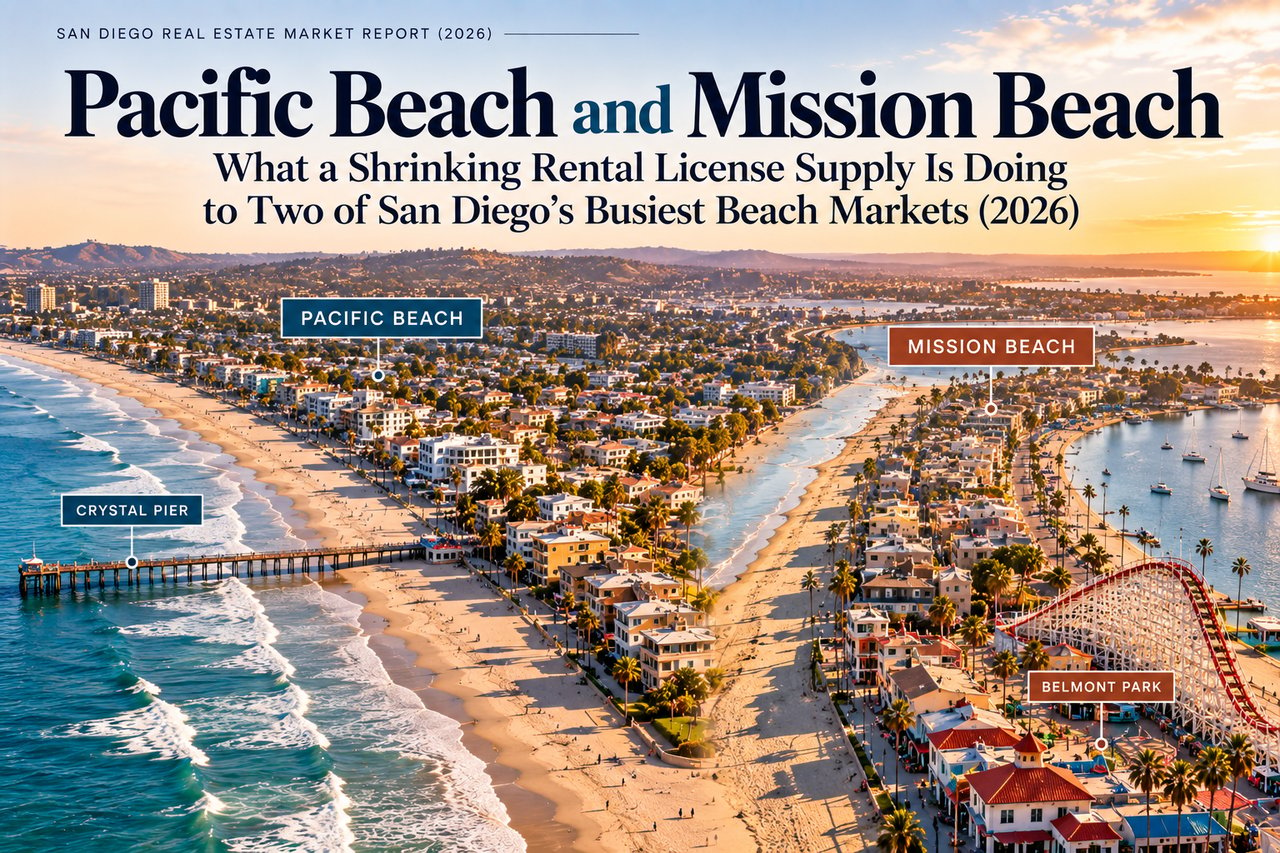
Pacific Beach runs along the coast north of Mission Beach, anchored by Garnet Avenue, a commercial corridor packed with more than two dozen bars and restaurants that gets busier the closer you get to the water, where it dead-ends at the 1927 Crystal Pier, still home to a row of rentable cottages built out over the breaking waves. North Pacific Beach, closer to La Jolla, carries a quieter, more residential feel, while Crown Point, wrapping the northern edge of Mission Bay, draws a different buyer entirely, one who wants flat water for paddleboarding over surf out front. Mission Beach sits just south, and it's a genuinely different kind of place: a narrow peninsula rarely more than a few blocks wide, squeezed between the open ocean and Mission Bay, built up mostly in the 1930s and 1940s into what's now the most densely developed residential neighborhood in the entire city. Small cottages, duplexes, and tightly packed multi-level homes dominate the housing stock, and Belmont Park, the historic amusement park built in 1925 to help sell real estate in the first place, still anchors the south end of the peninsula with its wooden roller coaster.
The price split within Pacific Beach is substantial
Lump Pacific Beach into one number and you'll miss what's actually happening. Single-family homes here have been running at a year-to-date median around $2.3 million, while condos and townhomes sit at a median closer to $895,000, a gap of roughly $1.4 million between the two product types in the same zip code. Blended citywide-style figures for the broader neighborhood land anywhere from about $1.1 million to $1.3 million depending on the data source and the month pulled, which is really just an average of two very different buyer pools, one shopping detached homes near the water and one shopping a dense, young, rental-heavy condo stock a few blocks inland. Treating either of those blended numbers as the "real" Pacific Beach price is going to mislead you regardless of which side of that split you're actually shopping.
Why Mission Beach's rental supply is already capped
Mission Beach has operated as something close to a whole-home vacation rental factory for decades, long before the city's current short-term rental ordinance existed, which means a huge share of its housing stock was already functioning as STR inventory when the licensing system got built around it. That history matters directly now. Under the city's tiered system, Mission Beach falls into Tier 4, the tier built specifically around neighborhoods with an existing concentration of whole-home rentals, and that tier is already fully allocated, with roughly 1,098 licenses issued against the cap and zero remaining, leaving an active waitlist for anyone hoping to add a new one. In practical terms, a Mission Beach property that doesn't already carry an active Tier 4 license isn't eligible to become a new whole-home rental today, full stop, regardless of how perfect the property looks for that use. That single fact has turned an existing license into a meaningfully valuable, transferable asset in its own right, separate from the value of the real estate underneath it.
Pacific Beach is running the same scarcity, just slightly behind
Pacific Beach sits under the citywide Tier 3 cap rather than Mission Beach's neighborhood-specific Tier 4 system, and that broader pool is close behind in getting exhausted. Citywide, Tier 3 licenses are capped at roughly 1 percent of San Diego's housing stock, somewhere around 5,400 total, and as of recent counts the city had already issued close to 4,840 of them, leaving well under a thousand remaining across the entire city, not just Pacific Beach. Because Pacific Beach is one of the most in-demand coastal submarkets competing for whatever's left of that citywide pool, a buyer here specifically chasing a whole-home rental play needs to treat license availability as a live, fast-depleting resource rather than something they can sort out after closing.
The flood risk piece that specifically hits Mission Beach
Mission Beach's geography, a thin strip of land with open ocean on one side and a tidal bay on the other, comes with real, well-documented flood exposure. Recent risk modeling puts roughly three-quarters of properties in Mission Beach at meaningful flood risk over a 30-year horizon, and the neighborhood sits within FEMA's Zone AE, the standard high-risk floodplain designation that triggers mandatory flood insurance for anyone financing with a federally backed loan, the same mechanism covered in detail in this blog's piece on San Diego's 2026 FEMA flood map update, which specifically reclassified portions of nearby Pacific Beach too. Anyone evaluating a Mission Beach purchase, especially on the bayfront or oceanfront rows where exposure is highest, should budget for flood insurance as a near-certain carrying cost rather than a remote possibility, and confirm current zone status directly rather than relying on an older listing sheet.
What this means for how each neighborhood actually gets used
Put these pieces together and Pacific Beach and Mission Beach are sorting into somewhat different investment theses even though they sit right next to each other. Mission Beach's capped, waitlisted Tier 4 system means the neighborhood's whole-home rental supply is effectively fixed going forward, which could support values for properties that already carry a license while making life harder for anyone hoping to enter that specific business model fresh. Pacific Beach still has a thin window of citywide Tier 3 availability left, but it's closing, and its condo and single-family markets are differentiated enough that an investor-minded buyer and an owner-occupant buyer are often not really competing for the same inventory at all.
What this means if you're buying in Pacific Beach or Mission Beach
If a short-term rental strategy is part of your plan, confirm license status and tier eligibility before you write an offer, not after, since a property without an existing license in Mission Beach's Tier 4 or San Diego's broader Tier 3 pool may simply not be eligible for the use you're picturing. If you're buying in Mission Beach specifically, get a clear flood zone determination and an actual insurance quote early, since the FEMA Zone AE designation there is common enough that it should be treated as a default assumption rather than a surprise. And if you're comparing a Pacific Beach condo against a single-family home, measure each against its own product-type median rather than the blended neighborhood figure, since the gap between the two is too wide for one number to guide you.
What this means if you're selling in Pacific Beach or Mission Beach
If your property carries an active short-term rental license, especially a Mission Beach Tier 4 license, that's a genuine, quantifiable asset worth highlighting explicitly to prospective buyers, since the alternative path to obtaining one right now is a waitlist with no clear timeline. If you don't have a rental license and your buyer pool includes investors, be direct about that limitation upfront rather than letting it surface as a disappointment during due diligence. And if you're selling in Mission Beach, having a current flood zone determination and insurance quote ready to hand over is going to make your listing look far more prepared than leaving a buyer to discover the Zone AE designation on their own.
The bottom line
Pacific Beach and Mission Beach share a sand strip and a reputation, but they're increasingly distinct markets once you look past the surface. Pacific Beach splits sharply between a roughly $2.3 million single-family market and an $895,000 condo market, while Mission Beach runs as the city's most densely built residential neighborhood, with a short-term rental license supply that's already capped and waitlisted, and a flood risk profile serious enough to shape the carrying cost of nearly any purchase there. Both neighborhoods are now operating inside a citywide rental licensing squeeze that's turning an existing license into real, separate value, which makes understanding exactly where each property stands on that front just as important as the sale price itself. If you want help sorting out what a specific Pacific Beach or Mission Beach property is actually worth given its rental license and flood status, reach out and we'll go through the real numbers together.