Pacific Highlands Ranch vs. Carmel Valley: What Actually Separates Them (2026)
Pacific Highlands Ranch gets described as part of Carmel Valley so often that a lot of buyers never realize it's a separate, distinctly planned community with its own history, its own price tier, and its own Mello-Roos structure. Search for a home in "Carmel Valley" and Pacific Highlands Ranch listings show up right alongside it. Ask a local agent where one ends and the other begins and you'll often get a shrug. That blurriness costs buyers real money, because Pacific Highlands Ranch's headline median price runs dramatically higher than Carmel Valley's, and the two communities carry meaningfully different carrying costs even when a listing description makes them sound interchangeable.
What Pacific Highlands Ranch actually is
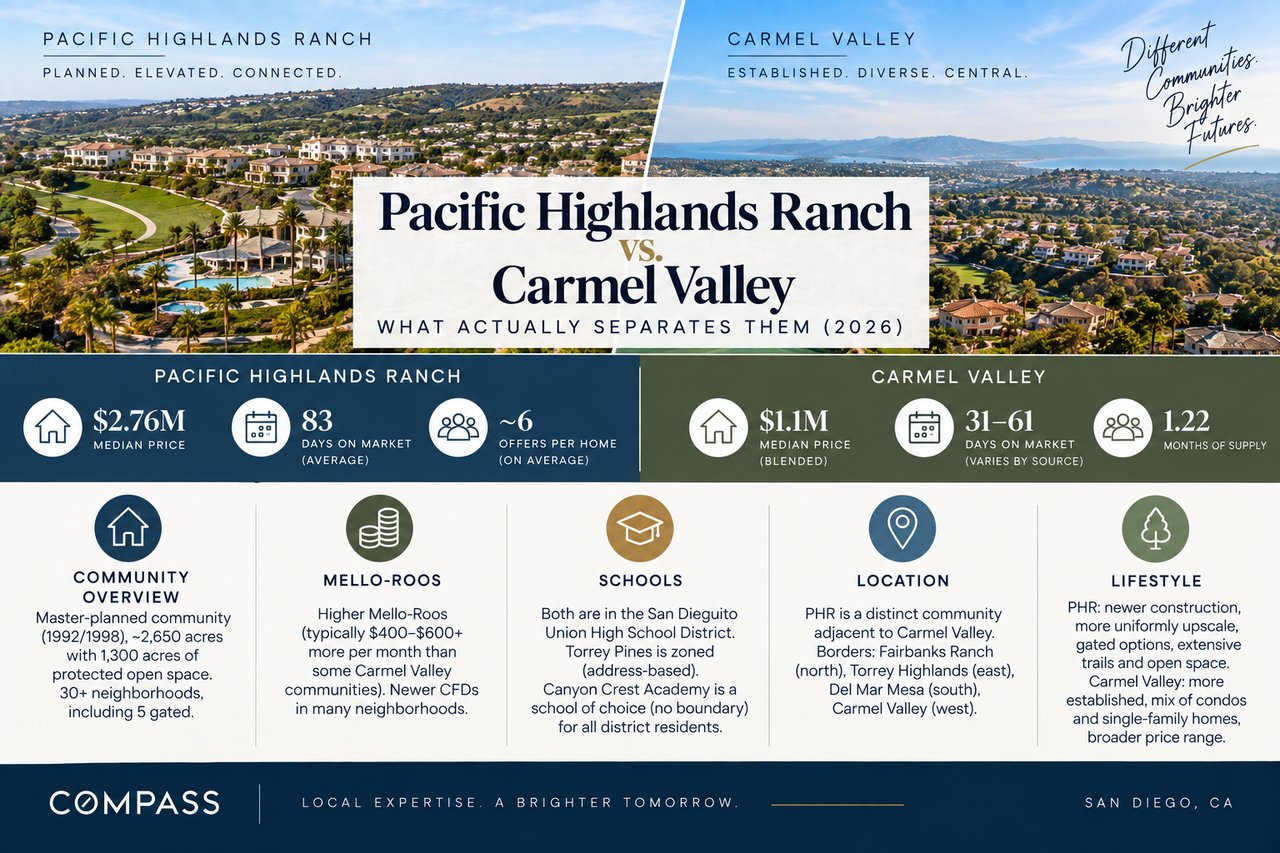
Pacific Highlands Ranch isn't an informal name for a corner of Carmel Valley, it's its own master-planned community with a paper trail going back to 1992, when the San Diego City Council adopted the North City Future Urbanizing Area Framework Plan, an amendment to the General Plan that laid out the subarea for up to 5,470 residential units alongside a mixed-use core with roughly 400,000 square feet of commercial and office space. The community's development was formally approved in 1998, and most of it was built out through the 2000s and into the following decade, primarily by Pardee Homes, now part of Tri Pointe. The finished community spans roughly 2,650 acres, with about 1,300 of those acres preserved as walkable, protected open space, and it's built out as more than 30 distinct neighborhoods ranging from townhomes to fully gated single-family enclaves. Geographically, it sits bounded by Fairbanks Ranch to the north, Torrey Highlands to the east, Del Mar Mesa to the south, and Carmel Valley to the west, adjacent to Carmel Valley rather than a subset of it.
Why the median price looks so different
Pacific Highlands Ranch's median real estate price runs around $2.76 million, a figure that ranks among the most expensive neighborhoods in the state and puts it well above Carmel Valley's blended median of roughly $1.1 million. That gap is real, but it's worth understanding what's driving it before assuming Pacific Highlands Ranch is simply a pricier version of the same market. Much of Pacific Highlands Ranch's newer inventory, particularly gated communities built in the more recent development phases, sits in the $3 million to $5 million range and has been producing steady multiple-offer activity this year. That newer, larger, more amenity-heavy product pulls the community's overall median up hard, the same way Carmel Valley's blended median gets pulled around by the mix of $2.3 million single-family homes and $719,000 condos trading in a given month. Pacific Highlands Ranch does have its own townhome and attached product, concentrated in a handful of specific neighborhoods, but the community's built form leans overwhelmingly toward detached single-family homes, five of its neighborhoods fully gated, which is a meaningfully different product mix than Carmel Valley's broader spread between condos and houses.
An unusual combination: 83 days on market, and still six offers
One number worth sitting with is that homes in Pacific Highlands Ranch are averaging around 83 days on market while still drawing roughly six offers each. On its face that looks contradictory, a home fielding six offers should sell fast, not slowly. The more likely explanation is that Pacific Highlands Ranch's inventory skews toward larger, more expensive, more bespoke homes than Carmel Valley's, and that kind of property draws a smaller, more selective buyer pool that takes longer to assemble even when the eventual competition among qualified buyers is real. A $4 million gated home isn't competing against the same volume of active shoppers a $1.5 million Carmel Valley single-family home is, so it can sit longer while still ultimately closing with several offers on the table once the right buyers find it. That's a different dynamic than a slow market in the way Del Mar's is slow right now, it's a thin, patient market rather than a soft one.
The Mello-Roos gap is bigger than most buyers expect
Pacific Highlands Ranch is flagged specifically as a high Mello-Roos area, and the community-to-community spread this creates is large enough to change what a home actually costs to carry each month. Two homes at an identical purchase price in different San Diego master-planned communities can differ by $400 to $600 a month in carrying cost from Mello-Roos assessments alone, and Pacific Highlands Ranch's more recent build-out phases mean its Community Facilities District bonds are, in a lot of cases, newer and further from being paid down than some of Carmel Valley's older CFDs. For a seller, that makes Mello-Roos transparency close to non-negotiable, since a buyer comparing a Pacific Highlands Ranch listing against a similarly priced Carmel Valley or Del Sur home needs the actual special tax bill in hand to compare true cost, not just the sale price. For a buyer, it means the sticker price on two otherwise comparable homes can mask a genuinely different monthly obligation depending on which community, and which specific CFD, the property sits in.
Canyon Crest Academy sits here, but that's not an admissions advantage
Canyon Crest Academy, established in 2004 as the newest comprehensive high school in the San Dieguito Union High School District, is physically located within Pacific Highlands Ranch, which is a big part of why the two communities get lumped together in casual conversation. But as covered in more detail elsewhere, Canyon Crest Academy has no attendance boundary at all. It's an open enrollment school of choice, available to any resident of San Dieguito Union's district through the annual selection window regardless of address, which means living inside Pacific Highlands Ranch's boundary doesn't grant any admissions edge over a family living in Carmel Valley, Del Mar, or Solana Beach. A buyer paying a premium specifically because a Pacific Highlands Ranch home sits close to the Canyon Crest campus is paying for proximity that has no bearing on whether their child actually gets a seat there.
How the two communities actually compare
Carmel Valley is the older, more built-out, more heterogeneous of the two, a mix of condos and single-family homes spanning a wide price range with tighter, more competitive inventory overall, currently running about 1.22 months of supply. Pacific Highlands Ranch is newer, more uniformly upscale, weighted more heavily toward larger detached homes and gated product, and it commands a real price premium driven largely by that newer, bigger housing stock rather than by any meaningful difference in school access, since both communities feed into the same San Dieguito Union High School District options. Buyers who assume the two are functionally the same market, just with Pacific Highlands Ranch listings sprinkled into Carmel Valley searches, are missing a real distinction in age of construction, HOA and Mello-Roos structure, and overall price tier that has nothing to do with which streets happen to be closer to which school.
What this means if you're buying
Don't treat a Pacific Highlands Ranch listing as a pricier Carmel Valley home without checking what's actually different, the newer construction, the gated community amenities, and the CFD structure are real value drivers, not just a higher number on the same product. Get the actual Mello-Roos bill before comparing a Pacific Highlands Ranch property against a similarly priced home elsewhere in the 92130 corridor, since the $400 to $600 monthly spread between communities is exactly the kind of detail a sale price alone won't reveal. And if Canyon Crest Academy access is part of your decision, remember that proximity buys you nothing under the current open enrollment system, so there's no reason to pay a location premium for it specifically.
What this means if you're selling
Be precise about what actually distinguishes your Pacific Highlands Ranch listing from Carmel Valley comps nearby, the gated access, the newer construction, and the preserved open space are genuine selling points worth calling out rather than assuming buyers already understand the difference. Have your Mello-Roos documentation ready and current, since a buyer doing real diligence on a high-Mello-Roos community is going to ask, and a seller with the numbers on hand looks a lot more credible than one who doesn't. And expect a longer runway to a sale than a typical Carmel Valley listing given the smaller pool of buyers who shop specifically in this price tier, even if you ultimately end up fielding multiple offers once the right buyers find the listing.
The bottom line
Pacific Highlands Ranch and Carmel Valley sit next to each other, share a school district, and get marketed together constantly, but they're genuinely different communities with different histories, different price tiers, and different carrying costs once Mello-Roos enters the picture. The premium buyers pay for Pacific Highlands Ranch traces back to newer construction and gated product, not to any school access advantage the two communities don't actually differ on. If you're trying to figure out whether a specific Pacific Highlands Ranch or Carmel Valley listing is priced fairly once you account for its actual Mello-Roos load and construction age, reach out and we'll go through the real numbers together.