San Diego's 2026 Loan Limits Just Moved. Here's Who That Actually Affects (2026)
Ask most San Diego buyers where the line between a "normal" mortgage and a jumbo mortgage sits, and you'll get a shrug. It's not a question most people think about until their lender brings it up mid-application, usually right around the point where the paperwork suddenly asks for two years of bank statements instead of one. For 2026, that line moved again. The conforming loan limit for San Diego County is now $1,104,000 for a single-family home, up from last year, and given that the county's median home price is sitting close to that same number, this isn't a detail that only applies to luxury buyers anymore. It's relevant to a huge chunk of ordinary purchases happening right now.
The number itself, and the one behind it
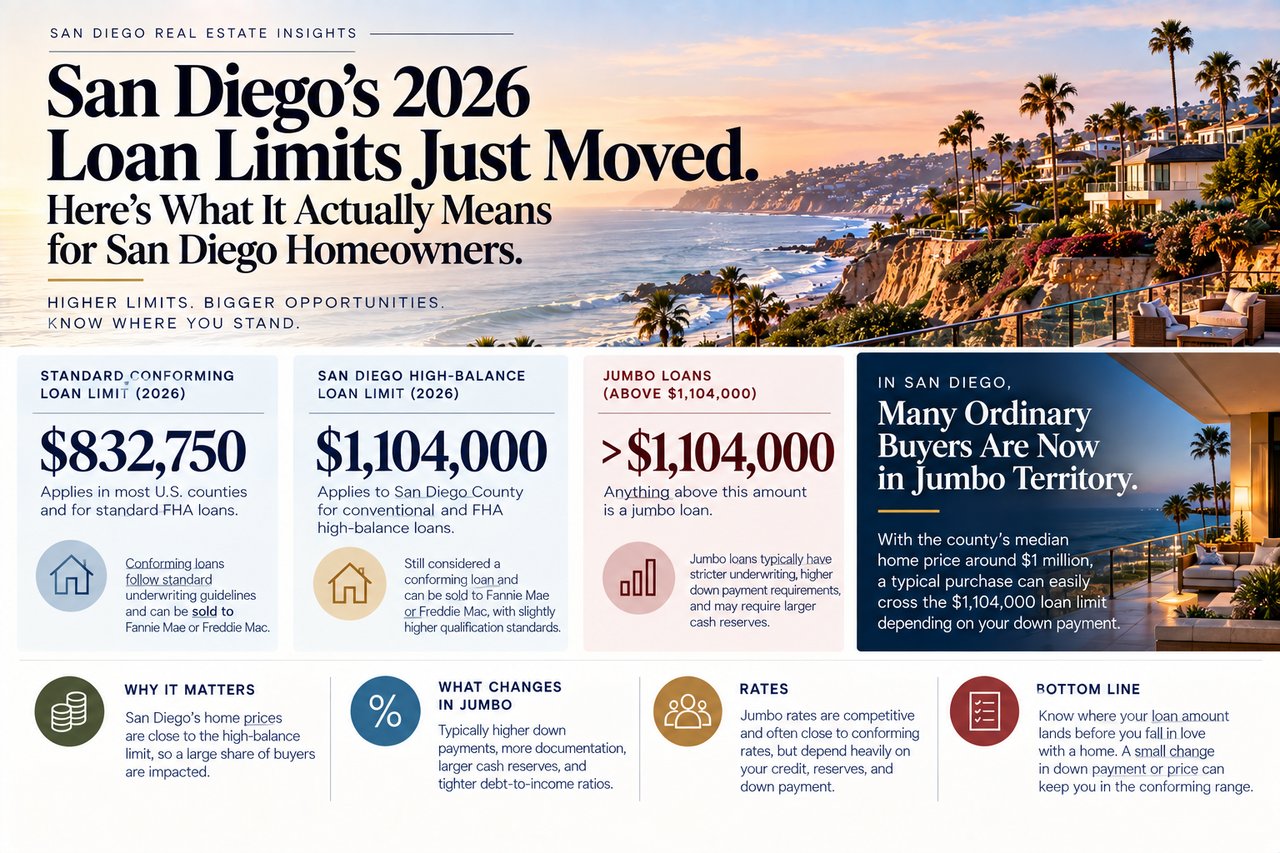
There are actually two figures worth knowing, not one. The baseline conforming limit, the number that applies almost everywhere in the country, is $832,750 for 2026. San Diego County, like other high-cost markets, gets a higher ceiling on top of that, called the high-balance limit, and for 2026 that number is $1,104,000. Anything you borrow at or below $1,104,000 can still be underwritten as a conforming loan, meaning Fannie Mae or Freddie Mac can eventually buy it from your lender. Cross above that number and you're in jumbo territory, where a different, generally stricter set of underwriting rules kicks in. FHA loans follow the same split locally: $832,750 for standard FHA, $1,104,000 for FHA high-balance, so the same basic math applies whether you're going conventional or FHA.
Why this matters more here than almost anywhere else
In a lot of the country, the gap between a median home price and the conforming loan limit is wide enough that this whole conversation is irrelevant to a typical buyer. San Diego doesn't have that luxury. With the county's median home price hovering right around $1 million, a fairly ordinary purchase, especially once you account for a smaller down payment, can land a loan amount close to or over that $1,104,000 ceiling without anyone involved thinking of themselves as buying a "jumbo" property. A buyer purchasing a $1.2 million home with 20 percent down is borrowing $960,000, comfortably inside the conforming limit. That same buyer putting 10 percent down instead is borrowing $1,080,000, still just under the line. Drop the down payment further, or buy a home priced closer to $1.3 or $1.4 million, and the loan amount slides past $1,104,000 fast. This is exactly why so many San Diego buyers end up dealing with jumbo underwriting despite never picturing themselves as buying anything extravagant. The home isn't unusual for this market. The loan amount just crosses a line that was drawn with a national, not local, housing market in mind.
What actually changes once you cross the line
Jumbo underwriting isn't a minor variation on conforming underwriting, it's a genuinely different process, and the reason comes down to risk. A conforming loan can be sold off to Fannie Mae or Freddie Mac, which spreads the risk across the broader mortgage market. A jumbo loan typically stays on the originating lender's own books, so that lender is a lot more particular about who they're willing to lend that money to. In practice, that means a few things. Down payment expectations climb, often into the 10 to 20 percent range depending on loan size, lender, and how the rest of your file looks, with loans well above $2 million sometimes requiring even more. Lenders also want to see cash reserves sitting in the bank after closing, commonly six to twelve months of your full housing payment, sometimes climbing to eighteen months on the largest loans. Debt-to-income ratio gets scrutinized more tightly too. A lot of jumbo lenders want to see something close to 43 percent or lower, and a ratio nearer 36 percent puts you in noticeably better shape both for approval and for the rate you're quoted. None of this is designed to be punitive. It's just what happens when a bank decides to hold the full risk of a large loan itself instead of passing it along.
The rate gap isn't automatic anymore, but it's still real
For years, the conventional wisdom was that jumbo loans always carried a higher rate than conforming loans. That gap has actually narrowed and occasionally flipped in recent cycles, since jumbo lenders compete hard for the kind of borrower who qualifies for one of these loans in the first place, strong credit, real reserves, low leverage. Right now, jumbo rates in this market are running somewhere in the high 6 percent range, not wildly different from conforming rates, but the pricing is far more sensitive to your specific file than it is on the conforming side. Two buyers with the same loan amount can get meaningfully different jumbo quotes based on credit score, reserves, and down payment in a way that's less common with a standard conforming loan, where pricing tends to be more standardized across buyers with similar credit profiles.
The buyer who trips over this line without realizing it
The buyer most likely to get caught off guard here isn't the one shopping in the $2 million range who already expects jumbo underwriting. It's the buyer looking at homes in the $1.1 to $1.4 million range, a completely normal price point in a lot of San Diego neighborhoods, who assumes their loan will behave like every other mortgage they've had. If your down payment is on the smaller side, or you're rolling closing costs into the loan, or you're buying at the upper edge of your price range, it's worth running the actual loan amount against $1,104,000 before you're deep into a purchase contract, not after your lender flags it. A slightly larger down payment, even just enough to keep the loan amount under the conforming ceiling, can sometimes be worth more in underwriting ease and rate stability than people expect, and it's a conversation worth having with a lender early rather than discovering the tradeoff mid-escrow.
High-balance conforming is the middle ground worth knowing about
It's easy to think of this as a binary, conforming or jumbo, but the high-balance conforming category that runs from $832,750 up to $1,104,000 is really its own middle tier, and it's worth understanding on its own terms. High-balance loans still get sold to Fannie Mae and Freddie Mac, so they generally come with more standardized underwriting and pricing than a true jumbo loan, even though the qualification bar is a bit higher than it is for a standard conforming loan under $832,750. For a lot of San Diego buyers, landing inside that high-balance band rather than crossing into full jumbo territory is the difference between a fairly conventional mortgage experience and a meaningfully more document-heavy one.
Where this fits with everything else driving San Diego affordability
Loan limits are only one piece of what's shaping affordability here in 2026. Mortgage rates have been easing gradually, with 30-year fixed rates recently running in the high 6 percent range, down from where they sat a year or two ago, and that alone has added real purchasing power for a lot of buyers even without prices moving. Combine that with the expanded SALT deduction cap covered elsewhere on this blog, and the net effect for a lot of higher-income San Diego buyers is that the true cost of carrying a larger loan looks somewhat different than it did even two years ago. None of that changes the loan limit math directly, but it's part of the same broader picture: San Diego's price levels keep pushing ordinary buyers into territory that federal loan rules were never really built around, and it pays to understand each piece of that puzzle rather than just the headline mortgage rate.
What this means if you're buying in San Diego right now
Before you fall in love with a specific price range, ask your lender to run your likely loan amount against both the $832,750 and $1,104,000 thresholds, not just once you've picked a house but early, while you're still figuring out your budget. If you're hovering close to $1,104,000, a modest change in down payment or purchase price can shift you from jumbo underwriting into high-balance conforming, and that shift can mean a meaningfully smoother, faster, and sometimes cheaper path to closing. This is especially worth doing if you're planning a smaller down payment, since that's the fastest way to end up in jumbo territory on a home that doesn't feel like a jumbo purchase.
What this means if you're selling in San Diego right now
If your home is priced in that $1.1 to $1.4 million range, understand that a meaningful share of your buyer pool may be navigating jumbo underwriting, which tends to move a little slower and require more documentation than a standard conforming purchase. That's not a reason to worry about your buyer pool, but it is a reason to build a bit more cushion into your expected closing timeline and to be patient with a financing contingency that might take longer to clear than it would on a lower-priced home financed conventionally.
The bottom line
San Diego's 2026 loan limits, $832,750 for standard conforming and FHA, $1,104,000 for the high-balance ceiling, aren't just numbers for a lender to track quietly in the background. Given where local home prices actually sit, they determine whether a huge share of ordinary San Diego buyers end up with a standard mortgage experience or a stricter, more document-heavy jumbo process, often without realizing which side of that line they're on until they're deep into an application. Knowing where your likely loan amount falls relative to $1,104,000, and understanding what changes once you cross it, is the kind of detail that's easy to overlook and genuinely useful to get ahead of. If you want help figuring out where your own purchase is likely to land, reach out and we'll run the actual numbers together.