SDSU Mission Valley: The Old Qualcomm Stadium Site Is Finally Becoming a Neighborhood (2026)
Mission Valley has spent most of the last few decades known for one thing: a stadium parking lot the size of a small town, surrounded by freeways and strip malls. That's changing, slowly and in pieces, as San Diego State University works through what is genuinely one of the largest urban redevelopment projects in the city's history. The stadium is already open and hosting games. The housing, the part that actually changes what Mission Valley feels like day to day, is just now breaking ground, with the first residents still a couple of years out.
How a city-owned stadium became a university campus
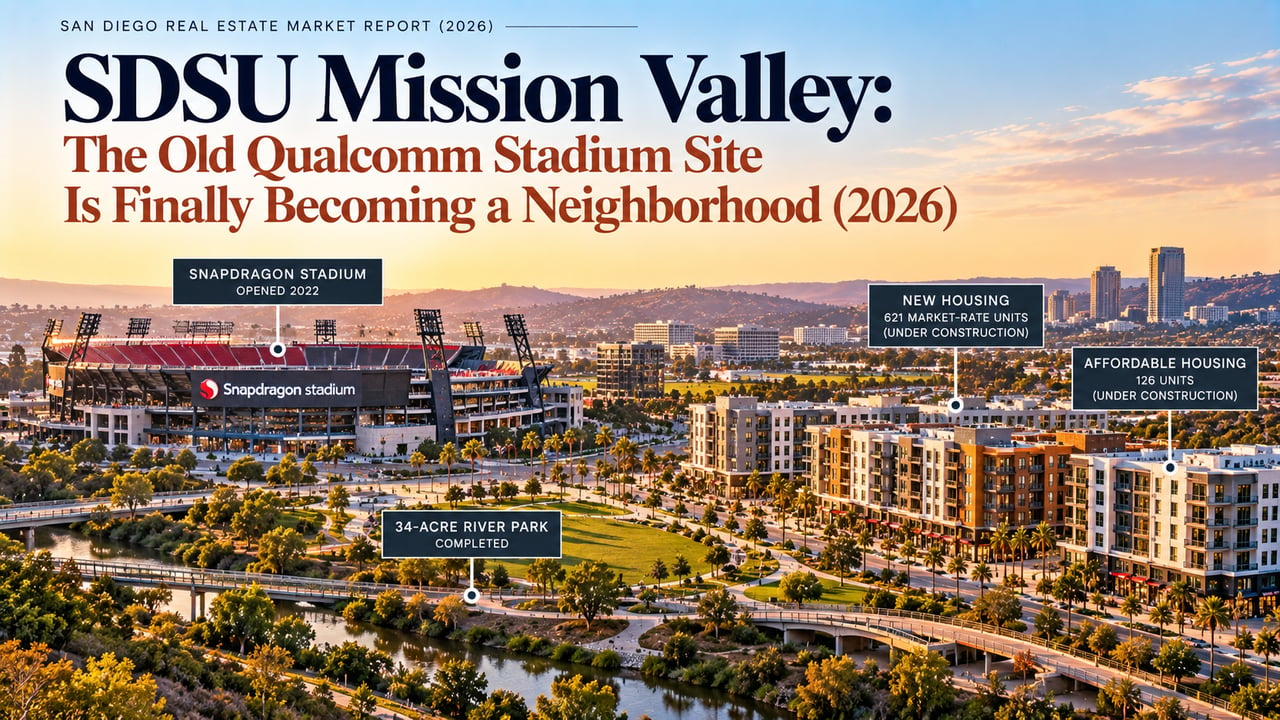
The story starts with a 2018 ballot measure. San Diego voters approved Measure G that November, clearing the way for the city to sell the old Qualcomm Stadium site to San Diego State rather than redevelop it through some other city-led process. The sale closed in May 2020 at $86.2 million, handing the university 135 acres along the San Diego River that had functioned almost entirely as parking and tailgate space for decades. Demolition and construction on a new stadium started almost immediately, and Snapdragon Stadium opened in August 2022, a $310 million, 35,000-seat venue that now hosts SDSU football along with concerts and other events. That stadium was never the real point of the purchase, though. It was the opening piece of a master plan that calls for turning the rest of the site into something that actually functions as a neighborhood, not just a campus annex with a parking problem.
What the full build-out actually includes
At full build-out, SDSU's plan for the site totals roughly $3.5 billion and calls for up to 4,600 residential units, a mix of market-rate and affordable housing, along with 80 acres of parks and open space, 1.6 million square feet of research and office space, 95,000 square feet of retail, and around 400 hotel rooms. That's a scale that puts it in the same conversation as North City in San Marcos or Seaport San Diego downtown, both covered elsewhere on this blog, except this one sits almost dead center in the county, a few minutes from downtown, Hillcrest, and the I-8 corridor. The river park component, 34 acres of multiuse fields, bike paths, and walking trails along the San Diego River, was finished years ago and already functions as a genuine public amenity, which is part of why the housing phase now breaking ground feels like the next real chapter rather than a speculative plan still searching for funding.
The housing that's actually under construction right now
Two residential projects are currently moving. AvalonBay Communities broke ground in August 2025 on the site's first market-rate development, a 621-unit project built east of the stadium on what had been the Orange Lot, with 602 of those units at market rate split across studios, one-, two-, and three-bedroom layouts, plus a grocery store and street-level retail built into the base of the building. First occupancy there is targeted for 2028. Right behind it, SDSU and developer Chelsea Investment Corporation broke ground in May 2026 on Addison, a 126-unit affordable mid-rise also located near the stadium, with 99 of those units reserved for households earning roughly half of the area's median income or less, around $82,700 a year for a family of four in San Diego. Addison carries a 55-year affordability covenant and is also aiming for first residents by 2028. On top of both, SDSU announced plans in August 2026 for a senior living community on the site, with construction expected to start at the end of 2027 and wrap by 2030.
Why this matters for a county trying to hit housing targets
San Diego, like every California city, is under real pressure from the state to plan for a lot more housing than it's historically approved, and a single large, already-entitled site like this one is a far faster way to make progress on those numbers than fighting through dozens of smaller infill approvals one at a time. SDSU's Mission Valley land isn't subject to the same kind of neighborhood-by-neighborhood zoning fights that slow down infill projects elsewhere in the city, since the university controls the land directly and the master plan cleared its major entitlements years ago. That's the same dynamic that's let North City in San Marcos move faster than most comparable North County projects, and it's worth watching here for the same reason: once a project like this clears its hardest approval hurdles, the remaining work is really just sequencing construction, not refighting old battles.
What the current Mission Valley market actually looks like
Mission Valley's existing housing stock, mostly condos and apartments built up around the trolley line and the malls over the last three decades, is already showing some separation by product type. Recent data puts the neighborhood's overall median home sale price somewhere between about $747,000 and $785,000 depending on the month pulled, while condos and townhomes specifically have traded at a year-to-date median closer to $577,000, down roughly 9 percent from the same period a year earlier on a fairly thin number of closed sales. Detached homes are rare enough in Mission Valley that a reported median above $1 million there is based on only a handful of transactions and shouldn't be read as representative of much. Homes here are selling in around 43 days on average, faster than the national pace, with limited inventory keeping prices from softening much even as the condo segment's year-over-year numbers look soft on paper.
How new supply is likely to interact with existing prices
It's worth being honest about what 4,600 new units does and doesn't do to a market like this. Over a long build-out, that much new supply generally helps affordability at the margin, but SDSU's product mix, new construction with structured parking, on-site retail, and in Addison's case a deliberate affordability covenant, is aimed at a somewhat different renter and buyer than the existing 1990s- and 2000s-era condo stock scattered around the rest of the neighborhood. That means the new SDSU Mission Valley units are more likely to expand the total range of what's available in the area than to directly undercut resale pricing on an existing Mission Valley condo a mile away. The more direct effect, at least in the near term, is what thousands of new residents, a grocery store, and more retail do to the neighborhood's walkability and amenity base, which tends to show up in how desirable the surrounding blocks become over time rather than in next quarter's comps.
What this means if you're buying near SDSU Mission Valley
Treat this as a multi-year build-out rather than a project that's about to flip the neighborhood overnight, since the first new residents aren't expected until 2028 at the earliest. If walkability, river park access, and proximity to a growing retail and grocery base matter to your decision, the value of being close to this site is likely to keep increasing as more of the 4,600-unit plan gets delivered, which is worth weighing against paying a premium for that proximity today versus waiting for more of it to actually open. If you're specifically shopping existing Mission Valley condos, compare pricing against the condo-specific median rather than a blended neighborhood number, since the detached-home figures here are too thin a sample to be useful.
What this means if you're selling near SDSU Mission Valley
SDSU's river park, the new stadium, and the housing now under construction are legitimate, concrete talking points for a listing in this area, not speculative future upside, since the river park has been open for years and the residential buildings are physically under construction rather than still in planning. Be clear with buyers about which phase of the broader project is actually complete versus still years out, since a buyer doing their own research will quickly find the 2028 occupancy timelines for Avalon and Addison, and overselling how soon the full vision arrives can undercut your own credibility more than it helps the sale.
The bottom line
SDSU Mission Valley is moving from a long-running plan into a physically real neighborhood, with Snapdragon Stadium already open, a 34-acre river park already finished, and two residential projects, a 621-unit market-rate building and a 126-unit affordable project, both under construction with 2028 occupancy targets. The full $3.5 billion vision, up to 4,600 units, a hotel, research space, and retail, is still years from finished, but this is no longer a site defined by a parking lot and a ballot measure. For anyone buying or selling nearby, the real question is less whether this project happens and more how fast the next phases land, and what that timing means for a specific property's value between now and full build-out. If you want help thinking through how this specific development affects a property you're considering in Mission Valley, reach out and we'll go through the real numbers together.