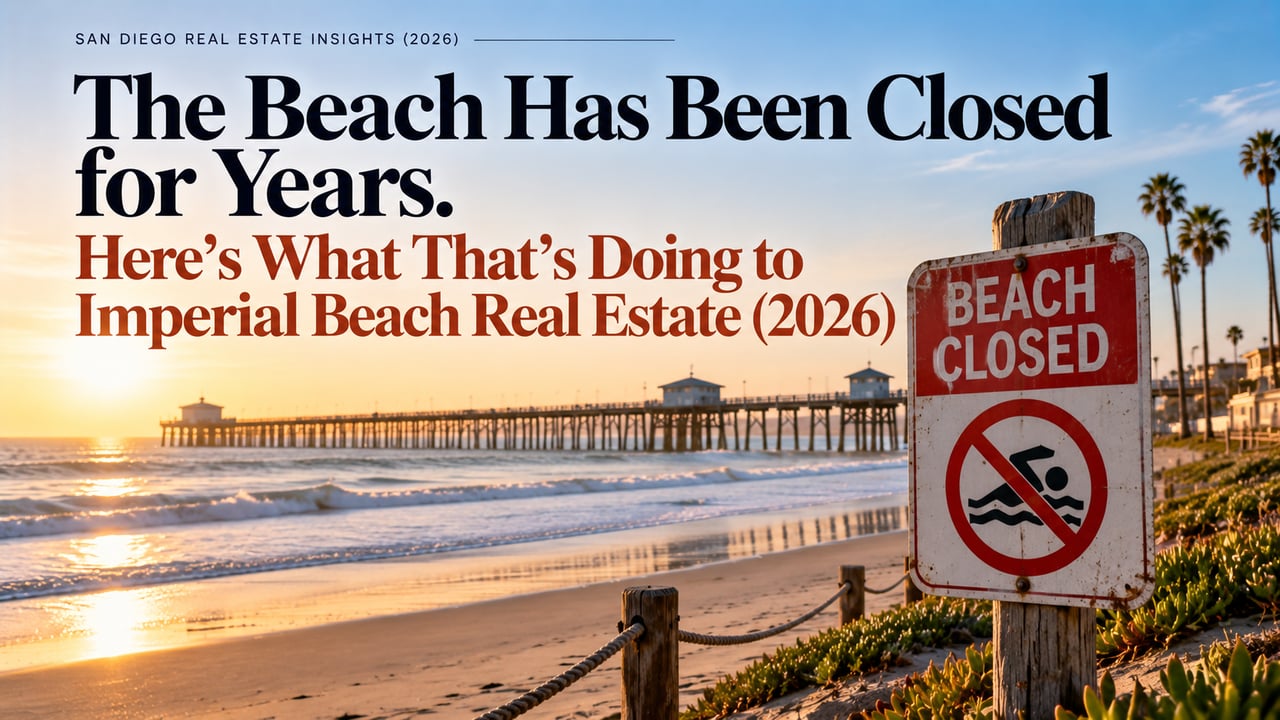
The Beach Has Been Closed for Years. Here's What That's Doing to Imperial Beach Real Estate (2026)
Every coastal hazard this blog has covered so far, wildfire, flood zones, earthquake risk, is a matter of probability. Something that could happen, modeled against odds over the next 30 years. Imperial Beach is dealing with something different: a hazard that's already here, happening continuously, and has been bad enough for long enough that it's started showing up directly in sale prices. The Tijuana River has been carrying raw sewage across the border into San Diego County for years, the city's own shoreline has been closed to swimming for most of the time since late 2023, and a local agent recently summed up what that's doing to buyer interest about as plainly as it can be said: offer Imperial Beach as an affordable beach town, and the answer is "absolutely not."
A border river that's been failing for decades
This isn't a new problem, it's an old one that got dramatically worse. The Tijuana River watershed has been a cross-border pollution flashpoint for nearly three decades, but conditions deteriorated sharply between 2020 and 2023 as Tijuana's sewage infrastructure fell further behind the city's population growth. Deferred maintenance at the South Bay International Wastewater Treatment Plant, the binational facility meant to treat flows before they reach the ocean, left more than a third of that plant in what regulators described as critical condition by 2022. Since October 2023 alone, more than 31 billion gallons of raw sewage and polluted water have crossed into the United States and eventually the Pacific, and on bad days transboundary flows can carry up to 35 million gallons of untreated wastewater, industrial waste, and debris into the watershed. These aren't occasional spill events. They're closer to a chronic condition the region has been living with for years, one the infrastructure simply hasn't kept pace with.
What that looks like on the actual beach
Imperial Beach's shoreline has been closed to swimming since December 18, 2023, and that closure hasn't meaningfully lifted since. The city's waters were posted unsafe for 322 days in 2023 alone, and the Surfrider Foundation's water quality testing that year found that one hundred percent of samples collected at Imperial Beach came back with bacteria levels exceeding state health standards, enough to rank it the most polluted beach tested anywhere in the country. More recent closures, including one as recent as late September 2026, show this hasn't resolved into some permanent before-and-after story. It's an ongoing, recurring condition that residents and visitors are still navigating in real time, years after it first became impossible to ignore.
The military has its own version of this problem
It's not just residents and tourists dealing with the exposure. Naval Special Warfare Command, which trains Navy SEAL candidates in the waters off Coronado and Imperial Beach, recorded 1,168 cases of acute gastrointestinal illness among SEALs and candidates between January 2019 and May 2023, with symptoms including nausea, vomiting, and diarrhea. Roughly 39 percent of those cases were diagnosed within a week of the servicemember being in ocean water that exceeded the state's contamination limits. A Pentagon watchdog later found that training continued in some instances without following the county's own beach closure postings. That detail matters for the real estate conversation specifically because it underscores that this isn't a vague environmental concern being overstated by nervous homebuyers. It's a documented health exposure serious enough to draw its own federal oversight, hitting trained military personnel who aren't exactly in the business of avoiding discomfort.
What it's doing to prices
The price data out of Imperial Beach right now tells a genuinely split story, and it's worth being straightforward about why rather than picking whichever number tells the cleanest narrative. Median sale prices have actually ticked up year over year in some recent readings, with one three-month window showing a median around $852,000, up slightly from the year before. But price per square foot, often a cleaner read on underlying value since it strips out which specific homes happened to sell in a given window, is down roughly 10 percent year over year. Separately, local agents covering the market directly have described overall property values declining more than 10 percent over the past couple of years, tied specifically to prolonged beach closures, falling tourism, and businesses cutting staff and hours as visitors stay away. The likely explanation threading these numbers together is that Imperial Beach's housing stock is thin enough, and buyer psychology around the water quality issue strong enough, that a handful of sales can swing a median in one direction while the more persistent, broader pressure on value keeps showing up elsewhere, in price per square foot, in listing-to-sale gaps, and in agents describing real buyer hesitation that doesn't always show up cleanly in a single monthly statistic.
The money the county says it's losing
San Diego County has started trying to quantify this loss at a regional level, not just a neighborhood one. A recent county-commissioned report estimated the broader economy loses somewhere between $125 million and $500 million annually because of the pollution, a range wide enough to reflect real uncertainty but still large enough to signal this isn't a localized, easily absorbed problem. Beach closures, lost tourism dollars, and reduced business revenue in Imperial Beach and surrounding South Bay communities all factor into that estimate, and county officials have indicated more detailed analysis specifically targeting property value impacts is still coming, which suggests this is a problem local government is now treating as a measurable economic issue rather than purely an environmental or public health one.
Is anything actually being fixed
There's real money and real construction moving, even if the pace has frustrated residents who've been waiting years. Congress has appropriated more than $600 million to repair and expand the South Bay International Wastewater Treatment Plant, and as of recent progress updates, a parallel gravity sewage line has been completed, construction has started on the second phase of new river gates meant to control cross-border flows, and the first major contract for the plant's next expansion phase has been awarded. These are genuinely substantial infrastructure projects, not symbolic gestures, but they also take years to finish, and critics have pointed out that a lot of the funded fixes are concentrated on the US side of the border while the root of the sewage volume problem sits in Tijuana's own aging system, which isn't something San Diego County or the federal government fully controls. That mismatch is worth understanding before assuming a construction contract means a fast resolution.
Where disclosure obligations actually stand
California sellers are required to disclose known material facts that could affect a property's value or desirability, and a years-long beach closure in the immediate neighborhood is a reasonable candidate for that standard, even though there's no single checkbox on a standard disclosure form that spells out "ongoing cross-border sewage contamination." In practice, this tends to come up through conversation with a listing agent rather than through paperwork alone, which puts more responsibility on both sides to actually address it directly instead of assuming silence covers the issue. Buyers represented by their own agent, the kind of representation covered in this blog's recent piece on California's new buyer-broker agreement rules, have a real opening here to ask pointed questions before writing an offer rather than discovering the scope of the problem after moving in.
What this means if you're buying in Imperial Beach right now
Go in with eyes open about the water quality situation as a present, ongoing condition rather than a historical blip that's already resolved, since the shoreline closures have continued into late 2026 with no firm end date. If affordability near the coast is the draw, which it legitimately still is here relative to nearby beach towns, weigh that against the real possibility that values stay suppressed for as long as the infrastructure fixes remain incomplete, and ask directly about how a seller or their agent is addressing the issue rather than assuming it won't come up.
What this means if you're selling in Imperial Beach right now
Be upfront about the water quality situation rather than hoping a buyer doesn't ask, since this is now well enough documented, in local news, county reports, and even military health data, that a buyer doing basic research will find it regardless. If you can point to a specific home's distance from the most affected stretches of shoreline, or to any personal experience that the broader neighborhood and community still function well day to day away from the water itself, that kind of direct, honest framing is likely to land better with buyers than a listing that avoids the topic entirely.
The bottom line
Imperial Beach is dealing with a real, ongoing environmental and public health crisis, not a hypothetical risk modeled decades out, and it's already showing up in beach closure counts, Navy SEAL illness data, and a measurable drag on local property values and the broader South Bay economy. Hundreds of millions of dollars in infrastructure investment are finally moving through construction, but the underlying sewage volume crossing the border hasn't stopped, and nobody involved is promising a specific date when Imperial Beach's shoreline reopens for good. For buyers, that means treating the water quality situation as a core piece of due diligence rather than a footnote, and for sellers, it means being the one who brings it up first. If you want help thinking through what a specific Imperial Beach property is actually worth given where things stand right now, reach out and we'll go through the real numbers together.