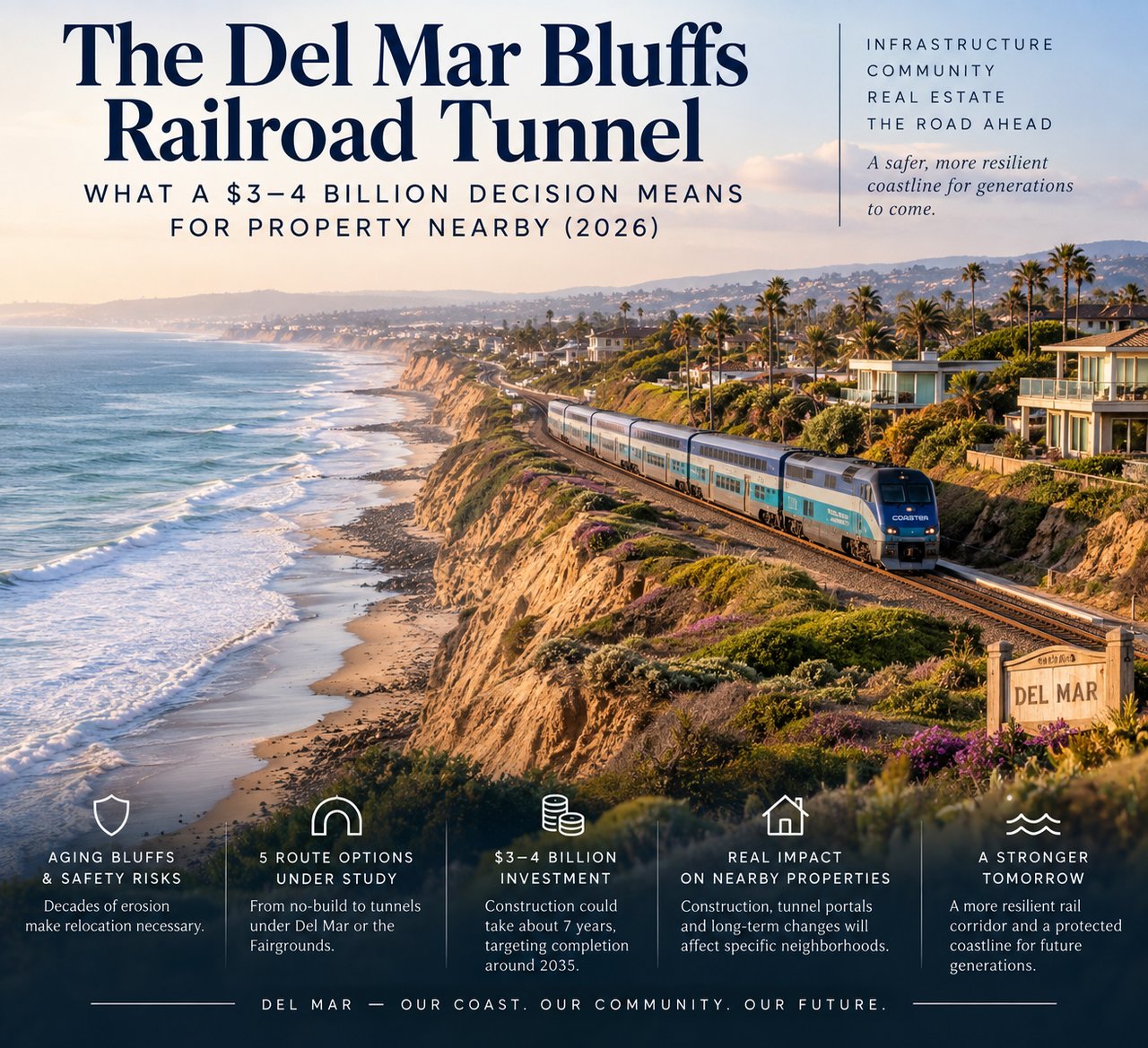
The Del Mar Bluffs Railroad Tunnel: What a $3-4 Billion Decision Means for Property Nearby (2026)
Most Del Mar buyers know the train runs along the bluffs above the beach. Fewer know that the agency that runs it has spent more than two decades trying to figure out how to move it somewhere else, and that 2026 is shaping up to be the year that decision finally gets narrowed down. SANDAG's board has advanced five possible routes for relocating the railroad off the eroding Del Mar bluffs, ranging from reinforcing the tracks where they sit to tunneling directly underneath parts of the city, and the environmental review process that will start narrowing those options is expected to begin this spring. For anyone buying or selling near the corridor, from Jimmy Durante Boulevard to the fairgrounds to the bluff-front homes above Coast Boulevard, this is no longer a distant planning exercise. It's a live decision with real implications for specific properties.
Why the tracks actually need to move
The Del Mar bluffs have been failing, gradually and then suddenly, for decades. The first fatal incident dates back to New Year's Eve 1940, when heavy rains softened the roadbed and a northbound freight train ran off the rails, sliding partway down the slope toward the beach. The modern version of the same problem accelerated sharply between August 2018 and February 2019, when six separate bluff collapses occurred along a two-mile stretch of track, each one forcing short-term suspensions of passenger rail service. A November 2019 collapse near Seagrove Park came within a few feet of the tracks themselves, and in February 2021, a 60-foot section of seawall gave way at the base of the same 1.7-mile stretch, serious enough that SANDAG temporarily suspended rail service entirely over concerns about further failure before geotechnical engineers cleared trains to resume at reduced speed.
Since 2003, SANDAG and the North County Transit District have completed four separate bluff stabilization projects along this corridor, drilling anchors into the bluff face and reinforcing it with concrete. A fifth phase began in spring 2024 at a cost of roughly $88 million, funded through a mix of state, federal, and local money. SANDAG's own leadership has been candid that this reinforcement work buys time rather than solving the underlying problem, estimating the strengthened bluffs should hold for another two to three decades. That window is exactly why the long-term relocation project, formally called the LOSSAN Rail Realignment, exists in the first place: the stabilization work is a bridge to a permanent fix, not the fix itself, and the clock on that bridge is already running.
Five options, and a real fight over which one wins
SANDAG's board voted 13-3 to advance five alternatives for further study, with Encinitas, Escondido, and Coronado voting against moving all five forward. One option is essentially a no-build approach, keeping the tracks where they are and continuing to reinforce the bluffs indefinitely. Two of the alternatives would tunnel directly underneath parts of Del Mar itself, options residents have pushed back against hard given the prospect of construction and permanent infrastructure running beneath existing neighborhoods. A fourth alternative would double-track the current alignment while continuing bluff reinforcement rather than tunneling at all. The fifth would route the tunnel around the city entirely, running beneath the Del Mar Fairgrounds instead, an option fairgrounds officials have opposed given the cost and the potential impact on the adjacent lagoon and fairgrounds operations. Earlier route concepts, labeled Alternatives A, B, and C in prior planning rounds, had already sketched out a version running largely along the I-5 corridor with the longest tunnel starting in Solana Beach, a version cutting a straighter path directly through Del Mar, and a shorter, more coastal-hugging tunnel option, giving a sense of just how differently these alignments could land depending on which is ultimately selected. The environmental review process starting this spring is where these options get further narrowed, and it's likely to take years before a single locally preferred alternative is formally chosen.
The cost and timeline are both substantial
Current estimates put the project cost in the $3 to 4 billion range, with construction expected to take around seven years once a final alignment is selected and funded, putting a realistic completion date somewhere around 2035 if the project stays on schedule from here. That's a big if. Funding hasn't been fully secured for a project of this size, and a decade-plus gap between now and an actual track relocation means the bluffs will need continued reinforcement in the meantime regardless of which alignment eventually wins out. For property owners and buyers, that long runway matters as much as the eventual outcome: this isn't a project that reshapes the corridor next year, but it is one where the eventual route, once chosen, will directly determine which specific properties face construction, tunnel portals, or permanent changes to what sits above and around the new alignment.
Where the property-specific risk actually concentrates
The financial exposure for individual homeowners isn't spread evenly across Del Mar, it concentrates hard around wherever the eventual tunnel portals and staging areas end up. Properties near Jimmy Durante Boulevard, close to the Del Mar Fairgrounds, and around Los Peñasquitos Lagoon sit closest to the alignments currently under study, and homes in the direct path of a chosen route could face eminent domain proceedings for a partial or full taking of the property. Residents have raised specific concerns about what it would mean to have a home sitting directly above or near a tunnel bore, worries about construction-phase noise and vibration, long-term structural risk from tunneling beneath existing foundations, and the kind of access changes to driveways, roads, and pathways that can meaningfully affect a property's usability and value even without a direct taking. Del Mar's own city government has staked out guiding principles opposing eminent domain and opposing tunnel portals sited near residential areas, but those are stated preferences shaping the city's advocacy in the process, not a guarantee about where the final alignment lands.
How this fits alongside San Diego's other coastal bluff issues
Del Mar isn't the only San Diego coastal community wrestling with bluff instability right now, but the shape of the problem here is genuinely different from what's playing out elsewhere. La Jolla and Encinitas are managing erosion primarily through setback rules that limit what private property owners can build near the edge, and Point Loma's Sunset Cliffs corridor is dealing with active, ongoing bluff collapse threatening a public roadway and cliff walk. Del Mar's situation is distinct because the asset at risk is a regional rail line rather than private development, which is exactly why the proposed fix is a multi-billion dollar public infrastructure project rather than a setback ordinance or a seawall. That distinction matters for property owners near the corridor: this isn't a case where tighter local zoning might eventually ease the pressure, it's a case where the ultimate outcome depends on a regional transportation agency's route selection, a process individual property owners have limited ability to influence beyond public comment during the environmental review.
What this means if you're buying near the corridor
Ask directly whether a property sits near any of the currently studied alignments, particularly along Jimmy Durante Boulevard, near the fairgrounds, or close to Los Peñasquitos Lagoon, since those are the areas most likely to see direct project impact whenever a route is finalized. Don't assume a project with a 2035 target completion date is irrelevant to a purchase you're making now, the environmental review and route selection happening over the next several years will shape property-specific risk long before construction actually begins, and that uncertainty is worth factoring into how you value a property in the meantime. And if bluff-front exposure is part of what you're weighing, keep in mind that the current stabilization work is explicitly designed as a decades-long bridge rather than a permanent fix, which is worth discussing with a geotechnical professional alongside any coastal bluff analysis you're already doing.
What this means if you're selling near the corridor
Get ahead of questions about the rail realignment project the same way you would with any other pending infrastructure issue, since a well-informed buyer is going to ask, and a seller with clear, accurate information about where their property sits relative to the studied alignments comes across far better than one who seems unaware of a multi-billion dollar project running through the neighborhood. If your property is nowhere near any of the currently studied routes, that's worth stating plainly rather than leaving buyers to wonder. If it is close, transparency now is a lot less costly than a deal falling apart later once a buyer does their own research and feels blindsided by what they find.
The bottom line
The Del Mar bluffs railroad relocation is a real, multi-decade infrastructure decision with a genuine timeline: bluff stabilization work buying two to three more decades, five route alternatives now advancing through environmental review starting this spring, a project cost in the $3 to 4 billion range, and a realistic completion target around 2035 if everything stays on schedule. None of that means the sky is falling on Del Mar real estate, but it does mean that property near the Fairgrounds, Jimmy Durante Boulevard, and Los Peñasquitos Lagoon carries a specific kind of long-horizon risk that generic coastal market data won't tell you about. If you're evaluating a property near the corridor, whether you're buying and want to understand the exposure or selling and want to get ahead of the questions, reach out and we'll go through what's actually known about the route so far.