The Gaylord Pacific and Chula Vista's Bayfront: What It's Actually Doing to South Bay Real Estate (2026)
For most of the last two decades, Chula Vista's bayfront was a decommissioned power plant site, the kind of industrial dead zone that shows up on a map but never on a buyer's radar. That changed on May 15, 2025, when the Gaylord Pacific Resort & Convention Center opened as the largest hotel in California, a $1.3 billion, 1,600-room anchor for a master-planned waterfront district that's already pulling thousands of new housing units into its orbit. Chula Vista and the broader South Bay haven't shown up in this blog's coverage before now, largely because there wasn't yet a specific, timely reason to write about them separately from the rest of San Diego. The Gaylord's first full year of operation, and the development pipeline it's triggered, is that reason.
From power plant to the largest hotel in California
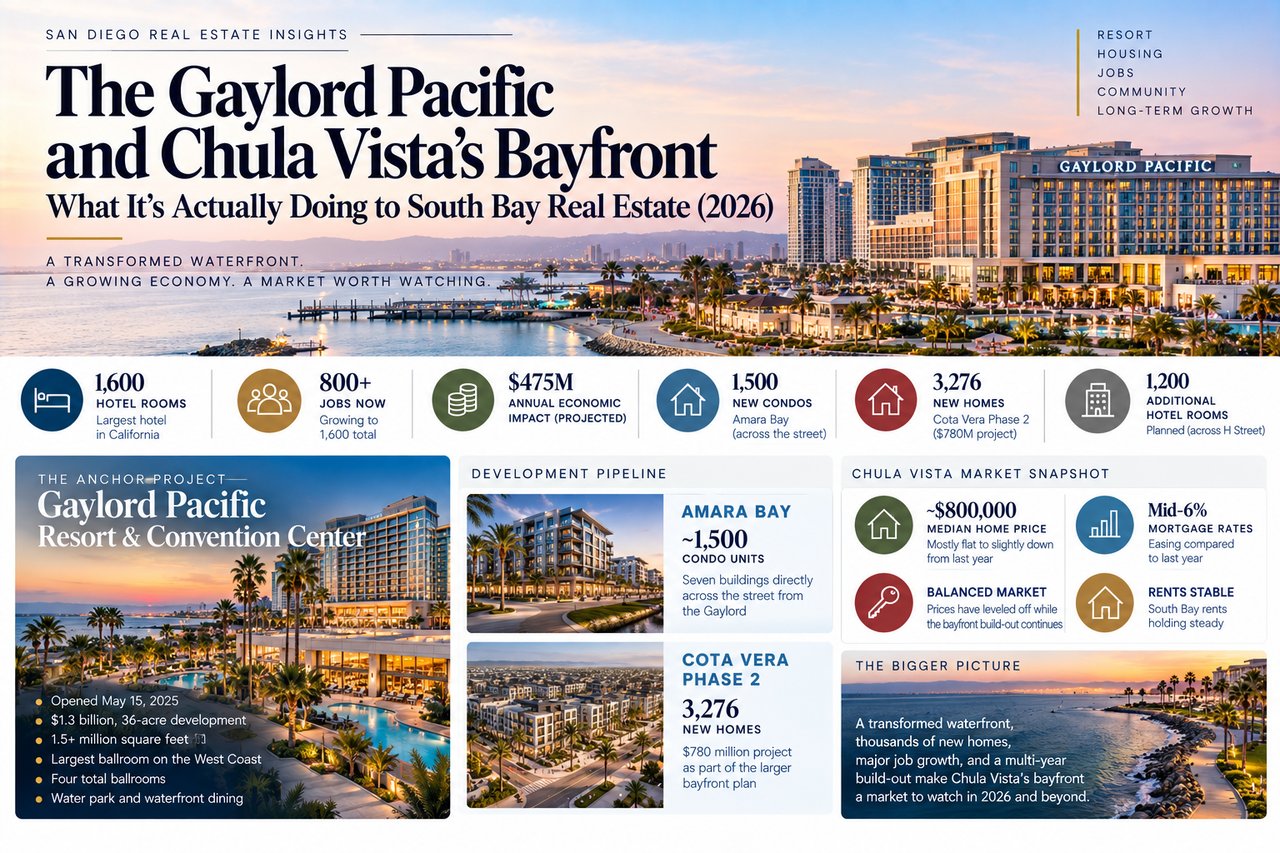
The site's transformation followed a long, deliberate public process rather than a sudden private development. The South Bay Power Plant that previously occupied the site was decommissioned in 2010 and imploded in 2013, clearing the way for what became a decade-long collaborative planning effort between the Port of San Diego, the City of Chula Vista, and private developers to create the Chula Vista Bayfront Master Plan. The City Council and the Port's Board of Port Commissioners unanimously approved a formal development agreement with RIDA Chula Vista in April 2018, financing closed in May 2022, and construction broke ground on May 30, 2022. Three years later, the Gaylord Pacific opened across 36 acres and more than 1.5 million square feet, featuring the West Coast's largest hotel ballroom, four total ballrooms, and a water park, built by the Mortenson and McCarthy joint venture with RIDA Development and lead architect HKS.
The economic case, and where it actually stands a year in
City and regional officials projected the resort would generate roughly $475 million in annual new economic impact once fully operational, and the hotel is already employing more than 800 people with plans to reach a total of 1,600 positions. A year-out assessment of the project found the picture more nuanced than either the initial hype or early skepticism suggested: the financial promises made during the planning process appear to be tracking toward being fulfilled, but the full impact hasn't fully materialized yet, a fairly typical trajectory for a project of this scale in its first year rather than a sign of trouble. That's worth keeping in mind for anyone evaluating the bayfront's ripple effects on nearby real estate, since a $1.3 billion anchor project reshaping a neighborhood's economics happens over years, not months.
What the resort has already pulled into the development pipeline
The more immediately relevant signal for property values is what's being built around the Gaylord, not just inside it. Directly across the street, the Amara Bay development is planned to bring roughly 1,500 condo units across seven buildings, positioning new housing inventory within walking distance of the resort and its convention traffic. Separately, HomeFed's Cota Vera Phase 2, a $780 million project, is set to add 3,276 homes to the broader Chula Vista Bayfront footprint, a scale of new housing that would meaningfully shift the character and inventory of this part of the South Bay on its own. A second hotel, with roughly 1,200 rooms, along with a planned cultural center, is also in the pipeline just across H Street from the Gaylord. Real estate economists tracking the area have noted that several of these housing developments were already in the pipeline years before the Gaylord opened, positioned specifically to capture the catalytic effect a project like this was expected to have once it materialized, which is part of why the development response has moved relatively quickly once the resort actually opened its doors.
What the broader Chula Vista market looks like right now
It's important to separate the bayfront's specific momentum from what citywide Chula Vista price data currently shows, because the two aren't telling the same story yet. Chula Vista's median home price has been sitting close to $800,000 through the middle of 2026, essentially flat to slightly down compared to a year earlier depending on the exact data source and month, with mortgage rates easing toward the mid-6 percent range and South Bay rents holding roughly steady. Some datasets show a sharper year-over-year decline, closer to 10 percent, while others show prices essentially unchanged, a gap that typically comes down to differences in which price tier and which specific months are being compared rather than any single number being wrong. The practical takeaway is that Chula Vista's citywide numbers describe a market that's leveled off and become more balanced overall, not one that's already been transformed by the bayfront development, which makes sense given that the Gaylord has been open barely a year and the major residential projects around it are still under construction or in planning.
Why the bayfront-adjacent story and the citywide story can both be true
A single citywide median doesn't capture what's likely happening in the specific footprint closest to the new development, and that's a distinction worth taking seriously rather than assuming the whole city moves together. New construction pricing at Amara Bay and Cota Vera will be set fresh against current demand and proximity to the resort, convention traffic, and eventual retail, largely independent of how the existing, older Chula Vista housing stock a few miles inland is pricing in a softer broader market. That's the same pattern this blog has covered in other parts of the county, where a citywide or community-wide median obscures real differences between a newer, amenity-driven pocket and the older housing stock around it, and it means evaluating a bayfront-adjacent property purely against Chula Vista's overall median is likely to understate what proximity to this specific project is worth, at least once more of the surrounding retail and residential build-out is actually complete.
The financing detail worth checking before you buy new construction here
Large public-private waterfront developments like this one are typically funded in part through dedicated financing authorities, and the Chula Vista Bayfront Facilities Financing Authority, a joint entity of the Port and the City, was structured specifically to fund infrastructure for this project. Buyers considering new construction at Amara Bay, Cota Vera, or future phases of the bayfront build-out should ask directly whether the specific property carries a Community Facilities District assessment or similar special tax tied to that financing structure, the same category of cost covered in more detail in this blog's Mello-Roos guide. New, large-scale master-planned developments in San Diego County very often carry this kind of assessment, and confirming it upfront is a normal part of underwriting a purchase in any brand-new community, not a red flag specific to this project.
What this means if you're buying in Chula Vista or the South Bay right now
If you're specifically interested in exposure to the bayfront's growth, understand that you're buying into a multi-year, in-progress build-out rather than a finished amenity, and price new construction accordingly rather than assuming today's asking prices already reflect a fully mature district. If you're shopping the broader, older Chula Vista housing stock instead, current data suggests a relatively balanced, roughly $800,000 median market with easing rates, a genuinely different value proposition than the North County coastal communities covered elsewhere on this blog, and worth evaluating on its own terms as one of the more accessible entry points into San Diego County homeownership. And on anything new construction near the bayfront specifically, confirm CFD or special assessment status directly before you're deep into a purchase.
What this means if you're selling in Chula Vista or the South Bay right now
If your property sits within a reasonable distance of the bayfront, the Gaylord's traffic, employment growth, and the surrounding development pipeline are legitimate, specific talking points worth highlighting rather than assuming buyers already understand the connection, particularly for buyers relocating from outside the region who may not know the bayfront's backstory. At the same time, it's worth being straightforward about where the broader Chula Vista market actually sits today, a leveled-off, balanced market rather than one already reflecting the bayfront's full eventual impact, since an overstated pitch is easy for a buyer's agent to check against current comps.
The bottom line
The Gaylord Pacific turned a former power plant site into the largest hotel in California and, in its first year, into the anchor for a real, quantifiable development pipeline, roughly 1,500 units at Amara Bay and 3,276 homes in HomeFed's Cota Vera Phase 2 alone. The broader Chula Vista market hasn't caught up to that story yet, sitting close to a flat $800,000 median while the surrounding build-out is still mid-construction, which is exactly the kind of gap that makes this a market worth watching closely over the next several years rather than judging off where prices sit today. If you're trying to figure out what proximity to the Chula Vista Bayfront is actually worth for a specific property, or whether now is the time to get into this market ahead of the next phase, reach out and we'll go through the real numbers together.