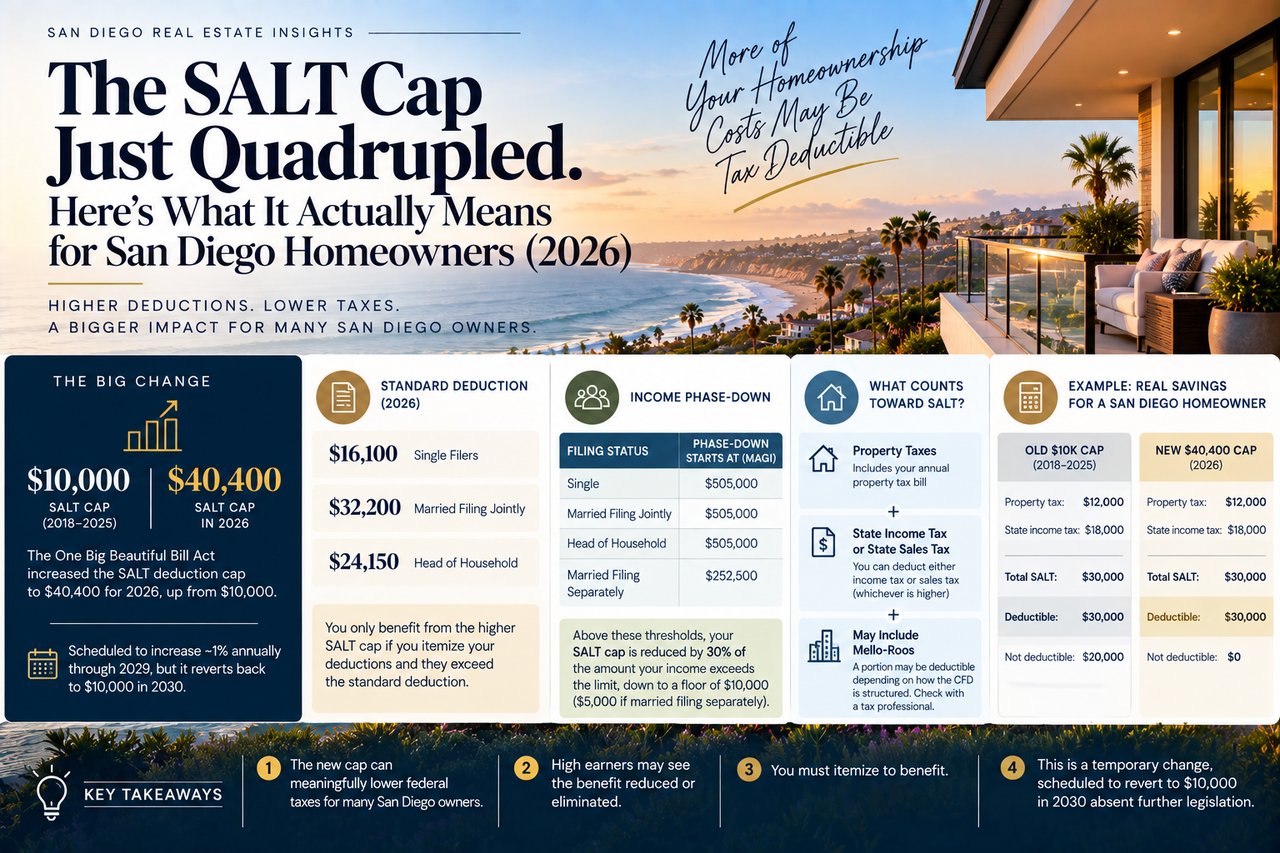
The SALT Cap Just Quadrupled. Here's What It Actually Means for San Diego Homeowners (2026)
For nearly eight years, California homeowners could only deduct $10,000 in combined state and local taxes on their federal return, a cap that barely covered the property tax bill alone on a lot of San Diego homes, let alone state income tax on top of it. That changed with the One Big Beautiful Bill Act, which raised the SALT deduction cap to $40,400 for 2026. It's a real, material change for a lot of San Diego owners, but it comes with enough conditions, an itemizing threshold, a phase-down for higher earners, and a hard sunset date, that the headline number alone doesn't tell you whether it actually helps your specific tax return.
What actually changed
The SALT deduction, short for state and local taxes, covers property taxes plus either state income tax or state sales tax, whichever you choose to deduct, combined into a single itemized deduction on your federal return. The Tax Cuts and Jobs Act capped that combined deduction at $10,000 starting in 2018, a number that hadn't moved since, even as home values and property tax bills climbed steadily higher. The new law quadruples that cap to $40,400 for 2026 for single, married filing jointly, and head of household filers, with a $20,200 cap for those married filing separately. The cap is also scheduled to tick up roughly 1 percent annually through 2029. None of this is permanent, though. Absent further legislation, the cap reverts back down to $10,000 in 2030, which makes this a defined, roughly four-year window rather than a lasting fix.
The catch nobody mentions in the headline: you have to itemize
An expanded deduction only matters if you're itemizing your deductions in the first place, and a meaningful share of taxpayers simply don't, because the standard deduction is often larger than what they'd claim by itemizing. For 2026, the standard deduction sits at $16,100 for single filers, $32,200 for married couples filing jointly, and $24,150 for head of household filers. Your property tax, state income tax, mortgage interest, and charitable giving all have to add up to more than that standard deduction before the SALT expansion provides any benefit at all. This is exactly where San Diego's housing costs actually work in homeowners' favor for once: a $1.2 million home carrying a property tax bill around $14,000 to $15,000 a year, easily reached in many of the communities covered on this blog, especially once Mello-Roos is factored in, is already a big step toward clearing that itemizing threshold before state income tax or mortgage interest are even added in. In a lower-cost state, that same $10,000 to $40,000 SALT expansion might do nothing for a typical homeowner who never itemizes in the first place. In San Diego, it's much more likely to actually apply.
The phase-down that claws the benefit back for higher earners
The expanded cap isn't available in full to every income level. The deduction begins phasing down once your modified adjusted gross income crosses $505,000 for single, married filing jointly, and head of household filers, or $252,500 for those married filing separately. Above that threshold, your allowable SALT cap is reduced by 30 percent of the amount your income exceeds the threshold, and it can't be reduced below a floor of $10,000, or $5,000 for married filing separately, no matter how high your income climbs. Run the math and the phase-down eats the entire expanded benefit surprisingly fast: a household with $545,000 in MAGI, $40,000 over the threshold, sees their cap reduced by $12,000, landing at $28,400 rather than the full $40,400. Push income up further, and by roughly $606,000 in MAGI, the cap has phased all the way back down to the original $10,000 floor, meaning high earners above that level are, for SALT deduction purposes, right back where the old law left them. For San Diego's higher-earning buyers, particularly the dual-income professional households common in the coastal and North County communities covered elsewhere on this blog, that phase-down threshold is worth running through an actual tax projection rather than assuming the full $40,400 applies.
A rough example of how this plays out
Picture a married couple filing jointly with $350,000 in combined household income, comfortably under the phase-out threshold, who own a home assessed around $1 million with a property tax bill of roughly $12,000 a year, plus around $18,000 in California state income tax. Under the old $10,000 cap, they could only deduct $10,000 of that $30,000 combined SALT bill, losing $20,000 of real tax liability to the cap every year. Under the new $40,400 cap, assuming their total itemized deductions clear the $32,200 standard deduction threshold once mortgage interest and other items are included, they can deduct the full $30,000, a meaningful shift in their actual federal tax bill. Compare that to a household earning $650,000, solidly past the phase-out threshold, who would see their cap reduced back down toward the $10,000 floor regardless of how much SALT they actually paid. Same state, same property tax bill, very different outcome, entirely a function of income.
What this means for Mello-Roos specifically
For owners in communities like Pacific Highlands Ranch, Carmel Valley, or other Mello-Roos-heavy areas covered elsewhere on this blog, it's worth understanding that a portion of an annual Mello-Roos special tax bill may be deductible as part of your SALT total, depending on exactly how the underlying Community Facilities District assessment is structured. This is genuinely fact-specific rather than a blanket rule, and it's worth confirming with a CPA how your particular CFD bill is treated before assuming the full amount counts toward your SALT deduction, but it's one more reason the true after-tax cost of owning in a high-Mello-Roos community is more favorable under the new cap than it was under the old $10,000 ceiling.
Property tax and income tax, not property tax alone
It's worth being precise about what actually fills up that $40,400 cap, because the deduction isn't just your property tax bill. SALT covers property taxes combined with either state income tax or state sales tax, whichever you elect, and California's state income tax is high enough for most homeowners that it, not sales tax, is almost always the more favorable choice to pair with property tax. For a lot of San Diego owners, state income tax alone can consume a large share of the new $40,400 ceiling before property tax is even added in, which means high earners with substantial California income tax liability may find their cap filled by income tax with comparatively little room left for property tax, even before the phase-down for high MAGI households applies on top of that.
Why the temporary window matters for planning
Because this expanded cap is currently scheduled to revert to $10,000 starting in 2030, it functions less like a permanent change to California homeownership economics and more like a defined planning window. Owners with some flexibility over the timing of income, deductions, or major purchases have roughly four years where a larger share of their property tax bill actually reduces federal tax liability than either the years before this law or, under current law, the years after 2029. That's a conversation worth having with a tax professional specifically, not just a real estate agent, since decisions like Roth conversions, the timing of a sale that generates capital gains, or bonus and equity compensation timing can all interact with where your MAGI lands relative to that $505,000 phase-out threshold.
What this means if you're buying in San Diego right now
The expanded SALT cap doesn't change what a home costs to purchase, but it can meaningfully change the true after-tax cost of carrying it, particularly for buyers whose household income sits comfortably under the $505,000 phase-out threshold and who are already itemizing or close to it. If you're comparing the ongoing cost of a higher-priced home against a lower-priced one, it's worth running an actual projection of your itemized deductions under the new cap rather than defaulting to whatever assumptions applied under the old $10,000 limit, since the gap between the two scenarios is larger than most buyers expect.
What this means if you're selling in San Diego right now
This isn't a detail that changes your listing price, but it is a legitimate, current talking point for buyers weighing the real cost of ownership, particularly move-up buyers looking at a meaningfully higher property tax bill than what they're used to. A buyer who understands that a larger share of that higher tax bill is now potentially deductible, income permitting, may view the total carrying cost differently than they would have under the prior cap, and it's a reasonable thing to mention if a buyer's own agent or lender hasn't already raised it.
The bottom line
The SALT cap increase to $40,400 for 2026 is real money for a meaningful share of San Diego homeowners, particularly households under the $505,000 MAGI phase-out threshold who are already itemizing given how quickly property tax bills add up in this market. It's not a benefit that applies evenly, higher earners see it clawed back fast, and non-itemizers see no benefit at all, and it's currently scheduled to disappear again in 2030 without further legislation. This is general information, not tax advice, and the specifics of your own income, deductions, and filing status matter enough that a CPA should run your actual numbers rather than relying on the general thresholds here. If you want to talk through how this affects the real cost of a home you're considering buying or already own, reach out and we'll go through it together.