University City Is Quietly Becoming One of San Diego's Biggest Growth Stories (2026)
University City doesn't get talked about the way La Jolla or Carmel Valley does, even though it sits right between them, anchors one of San Diego's biggest retail and office hubs, and backs up to UC San Diego itself. That's starting to change. A new state law aimed squarely at neighborhoods like this one, a major apartment project replacing aging office buildings, and a luxury retail expansion already opening in phases are all converging on the same few square miles right now, and the housing market underneath it is shifting along with them.
A neighborhood built around a university and a mall
University City's identity has always been shaped by its two biggest anchors. UC San Diego sits at its western edge, feeding a steady stream of students, faculty, and staff into the surrounding housing stock, while Westfield UTC, one of the largest shopping centers in the county, sits at its center and functions as a genuine neighborhood hub rather than just a mall people drive to from elsewhere. That combination has made University City a long-running mix of condos and apartments geared toward the university crowd alongside detached single-family homes in its quieter residential pockets, a split that shows up clearly in the price data.
What the price data actually shows
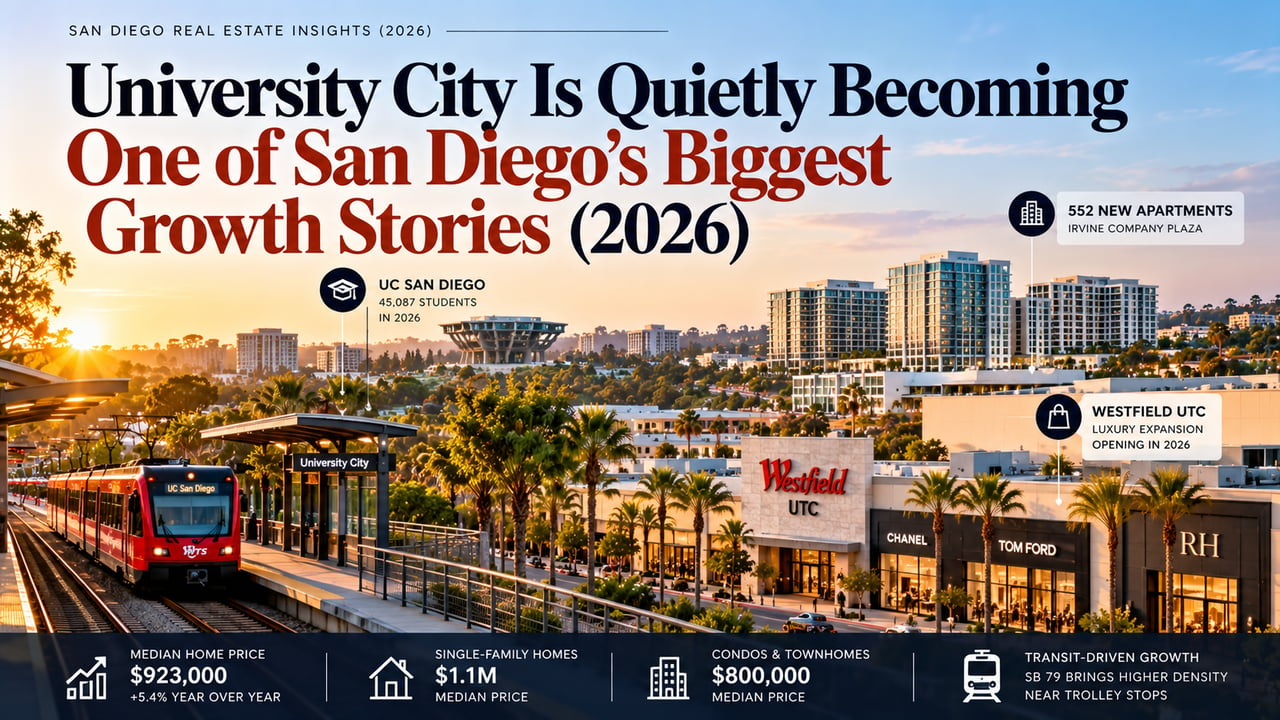
University City's median home price across all property types sits around $923,000 as of January 2026, up 5.4 percent from a year earlier, a healthier pace of appreciation than several other San Diego neighborhoods are currently posting. That blended figure hides a real gap underneath it, though. Detached single-family homes carry a median sale price closer to $1.1 million, reflecting the premium on University City's limited stock of houses with private yards, while attached condos and townhomes, many of them clustered near the campus, trade at a noticeably lower median closer to $800,000. Inventory is tight on top of that: the market has been running at roughly a month and a half of supply, with homes typically going under contract in around 45 days, numbers that put University City closer to a seller's market than the buyer-friendly conditions showing up in some of downtown's high-rise condo segment.
The law that could reshape density near the trolley
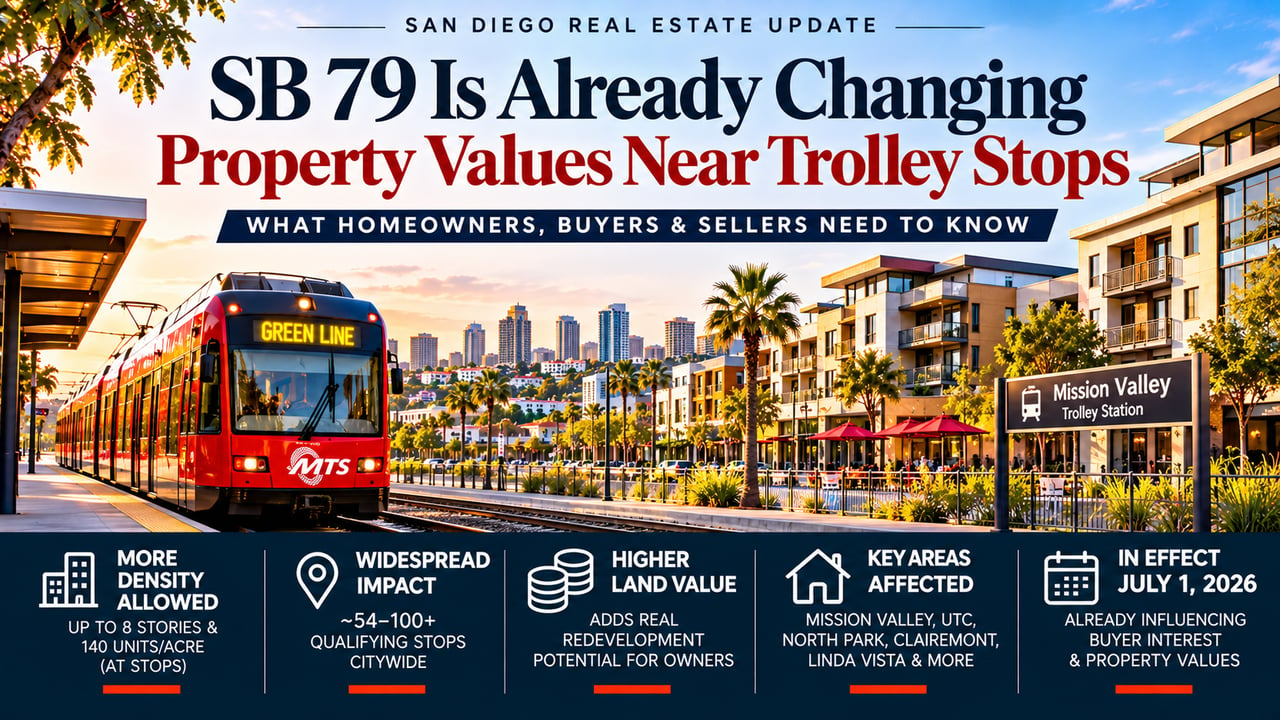
The bigger story for University City's long-term trajectory is a new state law, Senate Bill 79, which took effect statewide on July 1, 2026, and is specifically designed to push significantly more housing density near transit stops. SB 79 requires cities to approve qualifying residential development within a set radius of major trolley and bus rapid transit stops, and the density requirements are substantial: up to 140 dwelling units per acre and buildings as tall as 85 feet within 200 feet of a stop, scaling down to 80 units per acre and 55 feet out to a half mile away. University City sits directly on San Diego's trolley network, which makes it one of the neighborhoods most directly affected by the law, not a distant bystander to a policy written for somewhere else.
The city isn't applying SB 79 uniformly everywhere at once. San Diego is phasing in the law's requirements over roughly six years across about three-quarters of the areas near qualifying transit stops, but it's treating areas not eligible for that phase-in differently, and notably, the city has flagged portions of University City as high fire risk, a designation that affects how and when the new density rules actually apply there. The practical upshot is a neighborhood where some parcels near trolley stops could see meaningfully larger residential buildings move through approval faster than they would have before, while other nearby areas get a longer runway before the same rules kick in, which makes where exactly a property sits relative to a trolley stop a genuinely important question for anyone evaluating University City real estate with an eye toward the next several years.
A major apartment project is already replacing aging office space
SB 79 is a policy framework, but University City already has a concrete example of the kind of transit-oriented redevelopment it's meant to encourage. Irvine Company is tearing down two aging 1980s-era office buildings on the western portion of its Plaza campus, at the corner of La Jolla Village Drive and Genesee, to build 552 apartment units across two new buildings, with unit sizes ranging from studios up to three bedrooms and amenities including a fitness center and a sizable park. That's a direct, visible example of office space converting to housing in exactly the kind of transit-adjacent location SB 79 is built around, and it's happening now rather than sitting on a planning document somewhere.
Westfield UTC is in the middle of its own transformation
The retail side of University City is moving at the same time. Westfield UTC's luxury expansion, a 70,000-square-foot addition on the north side of the center near La Jolla Village Drive, on the site Nordstrom vacated when it relocated within the mall, began opening in phases starting in early 2026. The expansion is bringing in higher-end retailers including Restoration Hardware near the food court along with luxury fashion names like Chanel, Tom Ford, and Carolina Herrera, a clear bet that University City's trade area can support a meaningfully more upscale retail mix than it has historically carried. For anyone evaluating the neighborhood's long-term desirability, a mall actively investing in a luxury repositioning rather than quietly declining is a genuinely good sign about where the surrounding area is headed.
The campus next door keeps getting bigger
A lot of University City's rental demand traces directly back to UC San Diego's own growth, and that growth hasn't slowed down. The university's total enrollment reached 45,087 students in fall 2026, a record high and part of a steady upward trend that's been running for years. Every incoming class beyond what the campus's own dorms can absorb becomes demand for housing in the surrounding neighborhood, and University City, sitting directly adjacent to campus with easy trolley access, captures a disproportionate share of that overflow compared to neighborhoods farther away. That's part of why the attached condo and townhome segment here behaves differently than it does in neighborhoods without a major university next door, with steady rental demand that isn't purely tied to the broader for-sale market's ups and downs. The same proximity also puts University City close to the Torrey Pines biotech and research corridor just to its north, giving the neighborhood a second source of high-earning renters and buyers beyond the student population alone.
Why this combination matters for buyers and investors
Individually, a new density law, one redeveloped office campus, and a mall renovation would each be a modest, standalone story. Together, they describe a neighborhood where the underlying zoning, a major private landowner, and the anchor retail center are all pointing in the same direction at the same time, toward more housing, more density near transit, and a more upscale overall profile. That's the kind of alignment that tends to show up in property values before it shows up in headlines, and University City's relatively tight current supply, combined with appreciation already outpacing some other San Diego neighborhoods, suggests the market may already be picking up on some of this.
What this means if you're buying in University City right now
Pay close attention to where a specific property sits relative to the nearest trolley stop, since SB 79's density rules could meaningfully change what gets built nearby over the next several years, and that effect won't be uniform across the neighborhood given the city's phased rollout and the fire-risk carveouts already in place. If you're drawn to the area for its proximity to UC San Diego and Westfield UTC, understand that the attached condo segment and the detached single-family segment are really two different markets with a few hundred thousand dollars of separation between their medians, so compare within the right category rather than against the blended neighborhood number.
What this means if you're selling in University City right now
A tight supply environment and a healthier-than-average appreciation rate are real points in your favor right now, and it's worth highlighting proximity to the redeveloping Westfield UTC and the broader momentum around the neighborhood's transit-oriented growth as part of your listing story, not just the property itself. If your home sits near a trolley stop affected by SB 79, understand that buyers increasingly researching these changes themselves will likely ask about it, so having a clear, honest answer ready is better than letting it surface as a surprise during escrow.
The bottom line
University City is in the middle of a genuine growth moment, with a new state transit-density law taking effect in 2026, a 552-unit apartment project already replacing aging office buildings on the Irvine Company's Plaza campus, and Westfield UTC rolling out a luxury expansion that signals real confidence in the area's trajectory. Home prices are appreciating faster here than in a lot of comparable San Diego neighborhoods, and the combination of policy, private investment, and retail repositioning all pointing the same direction is the kind of setup worth paying attention to before it becomes obvious to everyone else. If you want help figuring out what a specific University City property is worth given where the neighborhood is actually headed, reach out and we'll go through the real numbers together.