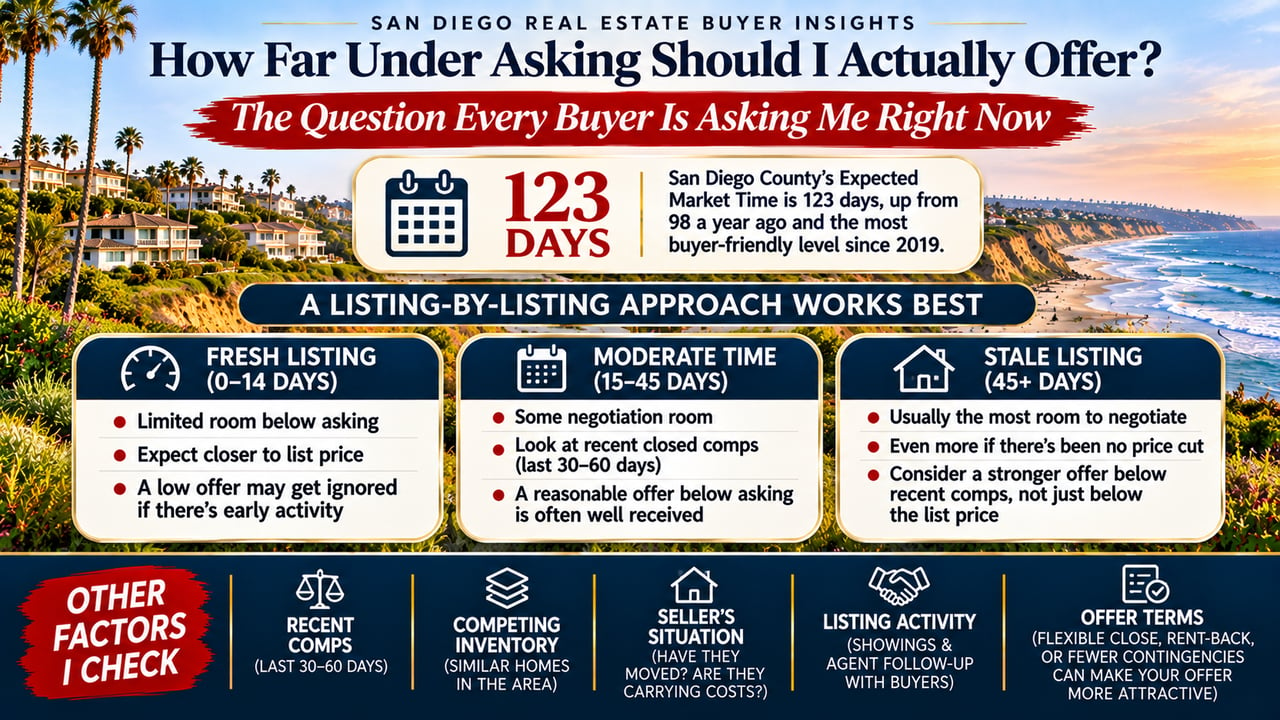
How Far Under Asking Should I Actually Offer? The Question Every Buyer Is Asking Me Right Now
This is the question I'm getting from almost every buyer I'm working with right now. San Diego County has shifted into genuine buyer's market territory for the first time in years, Expected Market Time sitting at 123 days, the most buyer-friendly reading since January 2019, and buyers who spent the last few years conditioned to offer over asking just to be competitive are suddenly staring at a listing wondering whether they can go in low. The honest answer is that it depends entirely on the specific listing in front of you, not on a flat percentage you can apply across the board, so here's how I actually walk someone through figuring that out.
Why there's no universal number
I'd love to give buyers a clean rule, offer five percent under and you're fine, offer ten and you're safe. That number doesn't exist, because the right offer depends on how that specific home is performing against its specific competition, not on a countywide average. A home that's been live for four days with three scheduled showings this weekend is a completely different situation than a home that's been sitting for six weeks with no activity, even if they're priced identically and located two blocks apart. Treating both the same way, whether that means offering full price on the stale one or lowballing the fresh one, is how buyers either overpay or lose a home they actually wanted.
The first thing I check before recommending a number
Before I tell a buyer what to offer, I pull the actual listing history, not just the current price, but how long it's been active, whether it's already had a price reduction, and how it compares to what's closed nearby in the last 30 to 60 days rather than the last six months. Say a buyer is looking at a home in Encinitas listed at $1,250,000 that's been on the market for five weeks with one prior price cut. That combination, time on market plus an existing reduction, tells me the seller has already absorbed some disappointment about where the market landed, which is very different information than a home that just hit the market this week at the same price point. The first scenario supports a meaningfully more aggressive opening number than the second one does, even though the list prices might be identical.
How days on market should actually shape your number
As a rough framework, the longer a home has sat without a reduction, the more room there usually is to open below asking, because every week that passes without an offer is a week the seller has had to sit with the idea that their number might be off. A home in its first two weeks, especially one that's well priced and well presented, usually doesn't have much room in it at all, and a lowball offer there is more likely to get ignored than taken seriously. A home past the 45 or 60 day mark, especially one that hasn't had a price adjustment yet, often has real room, sometimes more than buyers expect, because the seller is usually closer to that gut check about whether to cut the price or keep waiting than they're letting on publicly.
Why the current market changes the math, but doesn't erase it
Here's what's different about offering below asking right now compared to a year or two ago. With more inventory and more selection available to buyers countywide, sellers have less ability to simply reject a reasonable offer and wait for a better one, since there are more competing listings pulling buyer attention elsewhere. That gives buyers real leverage that didn't exist in the tighter market of a few years ago. What it doesn't do is make every number work. A home that's priced accurately and generating real activity still doesn't need to accept a lowball offer just because the countywide numbers favor buyers, the same way a well-presented home in a strong pocket like Carlsbad or Carmel Valley can still draw a competitive offer even while the broader county has shifted. The leverage is real, but it's local and listing-specific, not a blanket discount available on every home you look at.
What I actually tell buyers to look for before writing the offer
Beyond time on market, I have buyers look at a few specific things before settling on a number. How many other active listings are realistically competing for the same buyer pool, since a glut of similar inventory in a specific pocket gives you more room than a street with almost nothing comparable for sale. Whether the seller has already moved, since a vacant home usually means real carrying costs working against the seller every month it sits. And whether the listing agent has been proactively reaching back out to buyers who toured earlier, which is often a tell that the seller is getting impatient and more open to a number below the list price than the listing itself suggests.
A realistic walkthrough
Say you're looking at a $975,000 home in Cardiff that's been on the market for six weeks, hasn't had a price cut yet, and the comps that have actually closed nearby in the last month support something closer to $930,000 to $945,000. In that situation, I'd likely have a buyer open somewhere in the $910,000 to $920,000 range, below the recent comps, not just below the list price, with language in the offer acknowledging the time on market directly. That's a very different conversation than a $975,000 home in the same neighborhood that just listed three days ago with two showings already scheduled for the weekend, where I'd tell a buyer that same opening number is far more likely to get them passed over than taken seriously.
When I tell buyers not to push too hard
Leverage cuts both ways, and I don't want a buyer so focused on getting a discount that they lose a home they'd genuinely regret missing. If a property checks every box for a buyer, the right school boundary, the right commute, a lot or layout that's genuinely hard to replace, I'll tell them to offer closer to list even in a market that favors buyers, because the cost of losing that specific home to someone else's slightly stronger offer is usually a lot higher than the few percent they might have saved by pushing harder. The buyer's market gives you room to negotiate. It doesn't mean every home is worth negotiating hard on.
The number isn't the only lever you have
A lower purchase price is the first thing buyers think about, but it's often not the most useful lever available in today's market. A seller sitting on a home that's been slow to move may care just as much about certainty and timeline as they do about the exact number on the contract. An offer that comes in a little below asking but pairs it with a flexible close date, a rent-back period if the seller needs extra time to move, or fewer contingencies because your financing is already fully underwritten can land better than a slightly higher offer that reads as less certain to actually close. Price matters, but in a market where sellers are more willing to negotiate, the terms around the price are often where a thoughtful offer actually wins.
What this means if you're buying right now
Don't anchor your offer to a flat percentage below asking. Look at how long the specific home has been sitting, whether it's already seen a price cut, and what's actually closed nearby in the last month rather than the last six. A stale, unreduced listing usually has real room in it. A fresh, active one usually doesn't, regardless of what the countywide numbers suggest you should be able to get away with.
What this means if you're selling right now
If your home has been sitting for a while without a price adjustment, understand that buyers and their agents are reading that exact signal and factoring it into the number they open with. A proactive price adjustment, paired with fresh marketing, often puts you back in control of that number instead of leaving buyers to guess at how much room you actually have.
The bottom line
How far under asking you should offer depends on the specific listing in front of you, how long it's sat, whether it's already been reduced, and what's actually closed nearby recently, not on a flat percentage pulled from a countywide trend. San Diego's shift toward buyers gives you real leverage, but it's leverage you have to apply listing by listing, not a discount that applies evenly across every home you're considering. If you're weighing an offer on a specific property and want help figuring out where the real room is, reach out and we'll look at the numbers together.