San Diego's First "Forever Home": What Fire-Resistant Concrete Construction Means for Rancho Bernardo and Beyond
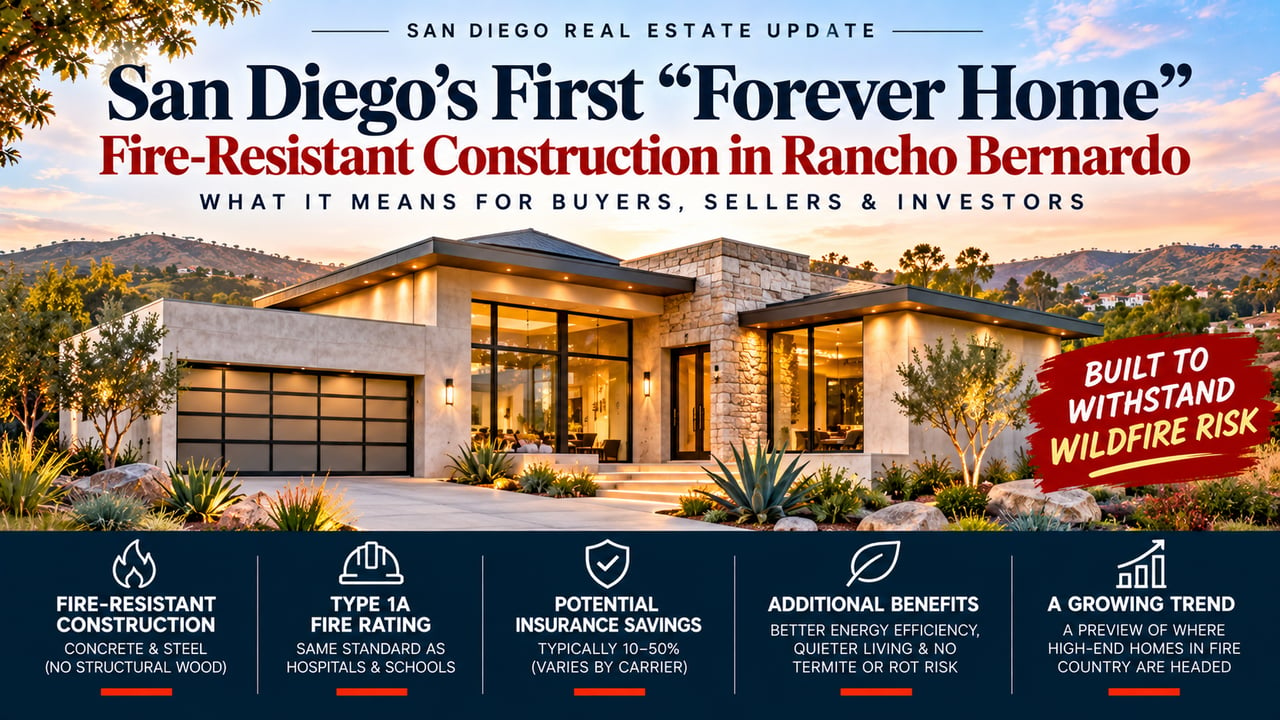
A new single-family home going up in Rancho Bernardo right now looks fairly ordinary from the street. What's different is everything you can't see. There's no plywood roof decking, no dimensional lumber framing the walls, no structural wood anywhere in the building at all. It's built from concrete and insulated steel panels instead, carrying a fire rating normally reserved for hospitals, schools, and other commercial buildings. It's the first San Diego project from a company branding its homes as "Forever Homes," and it's worth understanding both because of what it signals about where high-end residential construction is heading in fire country, and because of what it could mean for insurance and resale value down the road.
What's actually different about this house
The project is a $1.57 million, 4,000-square-foot home built by PHNX Development, a design-build team led by architect Laurie Fisher that specializes in insulated concrete form construction, commonly shortened to ICF. The basic idea behind ICF has been around for decades: build the walls from interlocking, hollow insulating foam blocks, then fill the cavity with reinforced concrete, producing a wall assembly that's both energy efficient and structurally massive in a way wood framing simply isn't. What makes this particular project notable is how far PHNX has pushed the concept, pairing the concrete walls with insulated steel panels and a newly patented steel beam system that eliminates structural wood from the entire building, including the roof.
The result is a home with a Type 1A fire rating, the same classification code typically applies to large commercial buildings, hospitals, and schools, not single-family houses. PHNX is careful about the exact language here, and it's worth being careful about it too. They describe the home as fire-resistant rather than fireproof, because under extreme enough heat, anything can eventually fail. The meaningful distinction is that the building itself doesn't provide fuel the way a wood-framed home does. A wildfire approaching a conventional home finds walls, roof decking, and framing that can ignite and spread fire internally. A wildfire approaching this kind of structure finds very little combustible material to work with in the first place.
Why Rancho Bernardo, specifically
Rancho Bernardo isn't a random choice for a project like this. The community sits along the wildland-urban interface in a part of San Diego County that has a real history with fire, and homeowners there have spent the better part of two decades navigating exactly the kind of insurance non-renewals, rising premiums, and defensible-space requirements that have become a defining feature of owning property near open space anywhere in California. A buyer or builder choosing to put the first fully fire-resistant home of this kind in San Diego into Rancho Bernardo, rather than a less fire-exposed part of the county, is making a fairly direct statement about where this kind of construction actually matters most.
The cost question, and where this project sits on it
Industry cost data on ICF construction in California generally puts the shell-level premium somewhere in the 5 to 15 percent range above comparable wood framing, with finished ICF homes often running somewhere between $150 and $160 per square foot before accounting for finishes, site conditions, and design complexity. Run that math against this specific project and the numbers don't line up neatly, which makes sense once you account for what's actually being built. At $1.57 million for 4,000 square feet, this home is pricing out closer to $390 per square foot, reflecting not just the ICF shell and the patented steel roof system, but a fully custom architectural design rather than a standard production-built floor plan. The lesson for anyone curious about this type of construction for their own project is to treat the oft-cited premium figures as a starting point for the structural shell specifically, not a ceiling on what a finished, architect-designed fire-resistant home will ultimately cost.
What it could mean for insurance
This is the part of the story that matters most for anyone thinking about resale value or long-term ownership costs. Insurance carriers have increasingly started recognizing concrete and masonry construction as a meaningfully lower risk category in fire-prone markets, and discounts tied to that recognition vary widely depending on the carrier, ranging anywhere from roughly 10 to 15 percent on the more conservative end up to discounts some sources put as high as 50 percent for the most fire-resistant construction types. Given how much attention this blog's coverage of San Diego's wildfire insurance market has already given to non-renewals and premium increases in exposed zones, a construction method that genuinely changes how an insurer underwrites a specific property is a real, structural answer to a problem that's otherwise been getting worse across the county, not just a marketing angle.
It's worth being clear-eyed about the caveat here too. Insurance discounts for fire-resistant construction aren't standardized across carriers the way, say, a fire sprinkler discount might be, and a homeowner considering this kind of build should get a specific underwriting quote based on the actual construction documentation rather than assuming a particular percentage applies automatically.
The benefits that have nothing to do with fire
Fire resistance tends to dominate the conversation around ICF construction, understandably given the context here, but it's worth knowing that the same qualities that make a concrete and steel structure resistant to fire also tend to deliver a handful of other benefits that matter to everyday ownership. Concrete walls packed with insulation are dramatically better at blocking outside noise than a standard wood-framed wall, which matters more than people expect in a community near a busy road or flight path. They also tend to perform better on energy efficiency, since the thermal mass of the concrete and the continuous insulation layer reduce the temperature swings a home's HVAC system has to fight against, which can meaningfully lower utility bills over time. And because there's no structural wood to worry about, homeowners sidestep an entire category of long-term maintenance concerns tied to termites, rot, and moisture damage that eventually catches up with most wood-framed homes somewhere in their lifespan. None of that replaces the fire-resistance story as the headline here, but it's a real part of why this kind of construction tends to show up in marketing material as a lifestyle upgrade and not just a risk-mitigation one.
A broader shift, not an isolated project
This Rancho Bernardo home isn't happening in a vacuum. California has seen growing interest in fire-resistant residential construction generally over the past couple of years, including entire planned communities built around concrete and ICF construction specifically because of wildfire risk, and that interest has only intensified following recent, high-profile wildfire losses elsewhere in the state. For a region like San Diego County, where wildfire risk and insurance availability have become closely linked topics for buyers and sellers alike, a locally built, commercially-rated fire-resistant home is a useful real-world data point for where high-end new construction may increasingly be heading in exposed areas, even if it remains a small share of the market for the foreseeable future given the cost and specialization involved.
What this means if you're buying in a fire-exposed part of San Diego
If you're building new construction, or considering a custom home, in a wildland-adjacent community like Rancho Bernardo, Poway, Scripps Ranch, or similar areas, it's worth at least asking your architect or builder whether ICF or a comparable non-combustible system is realistic for your budget and timeline, and getting a real insurance quote based on that construction type before you commit to a conventional wood-framed design by default. For buyers looking at existing resale homes, this kind of construction remains rare enough that you're unlikely to encounter it outside of custom new builds, but it's a good reminder to ask directly about any fire-hardening features, roofing material, and defensible space work a current owner has already completed, since those details increasingly matter for both your safety and your future insurance costs.
What this means if you're selling a fire-resistant or fire-hardened home
If your property includes meaningful fire-hardening features, whether that's full ICF construction, a Class A fire-rated roof, ember-resistant vents, or defensible space work that goes beyond the legal minimum, make sure that's front and center in your listing rather than an afterthought. Buyers in wildfire-exposed communities are increasingly sophisticated about insurance availability and cost, and a home that can point to concrete, documented fire-resistant features has a real story to tell that a generic listing description doesn't capture. If you're not sure how your specific features might translate into an insurance advantage for a buyer, it's worth getting a sense of that from an insurance broker before you finalize your listing narrative.
The bottom line
San Diego's first "Forever Home" in Rancho Bernardo is a small project with an outsized signal. Built from concrete and steel instead of wood, carrying a fire rating usually reserved for hospitals and schools, it represents a genuine, structural answer to the wildfire and insurance pressures that have reshaped homeownership in exposed parts of San Diego County over the past several years. It won't be the mainstream way most homes get built anytime soon given the cost and specialization involved, but it's a real preview of where high-end new construction in fire country may be headed, and a useful reference point for anyone weighing fire-hardening decisions on their own property right now. If you want to talk through what fire-resistant construction or hardening upgrades could mean for a specific property, reach out and we'll go through it together.