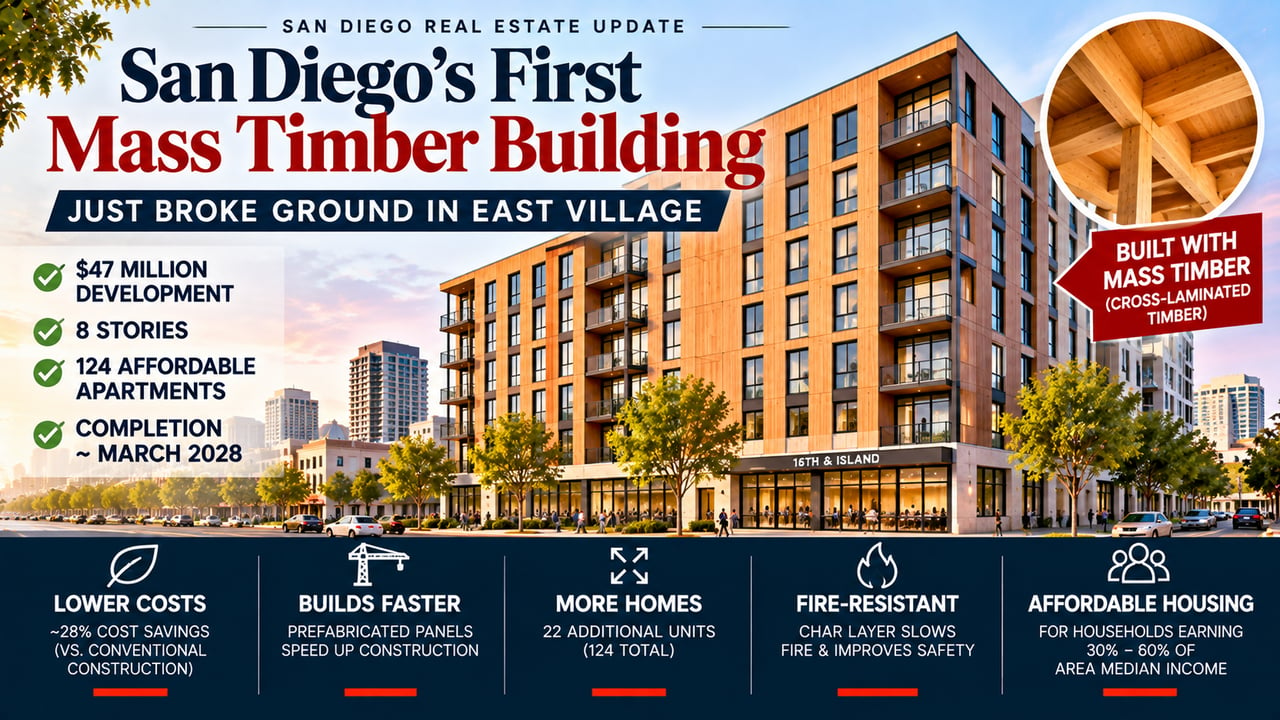
San Diego's First Mass Timber Building Just Broke Ground in East Village
On October 29, 2026, civic leaders gathered at the corner of 16th Street and Island Avenue in East Village to break ground on a building that looks, on paper, like dozens of other affordable housing projects working their way through San Diego's development pipeline. What's actually going up there is something the county hasn't seen before. 16th & Island will be San Diego's first affordable housing development built from mass timber, large engineered wood panels doing structural work that's almost always handled by steel and concrete in a building this size. It's a $47 million, eight-story, 124-unit project from Father Joe's Villages, construction started November 2, and it's worth understanding both because of what it says about where affordable housing construction is headed and because of what it means for a corner of East Village that's been quietly densifying for years.
What mass timber actually is, and why it matters here
Mass timber refers to large, engineered wood panels, cross-laminated timber being the most common version, manufactured by pressing and gluing layers of lumber together under heat and pressure until they behave structurally more like a single solid slab than a collection of individual boards. Builders assemble these panels off-site in a factory, then truck them to the job site and erect them the way you'd stack prefabricated concrete panels, rather than framing a building board by board on location. The result is a structural system that can support a mid-rise building, in this case eight stories, without the steel frame or poured concrete core that a building this size would typically require.
The appeal for a project like 16th & Island comes down to cost and speed as much as anything else. Prefabricated panels go up faster than conventional framing because so much of the manufacturing work happens before the panels ever reach the site, which compresses the construction timeline and reduces the amount of skilled on-site labor a project needs. Mass timber also takes up meaningfully less interior space for structural support than a comparable steel or concrete system, which matters directly for a housing project since every square foot not used for structure is a square foot that can go toward an actual unit.
The numbers behind the decision
Father Joe's Villages didn't arrive at mass timber as a sustainability talking point first, they arrived at it because an earlier version of this project's financing fell apart in 2024 and the organization needed a way to make the numbers work again. The pivot paid off in a fairly dramatic way. Switching to a prefabricated mass timber system, combined with alternative material sourcing and more efficient contracting, reduced the projected development cost at 16th & Island from roughly $530,000 to $380,000 per apartment, a savings of close to 28 percent. That's not a marginal efficiency gain, that's the difference between a project that can actually get built in this financing environment and one that can't.
The savings showed up in the unit count too. Because mass timber needs less interior space dedicated to support beams and columns than steel or concrete, Father Joe's was able to add 22 additional units to the project without adding a single additional floor, bringing the final count to 124 apartments. Rents at 16th & Island will be affordable to households earning between 30 and 60 percent of San Diego County's area median income, and construction is projected to wrap in roughly 17 months, putting completion around March 2028.
Why East Village specifically
East Village has been the center of gravity for downtown San Diego's residential growth for years now, and this blog's own market report on the neighborhood has covered the broader condo and apartment pipeline reshaping its skyline. 16th & Island adds a different kind of project to that story, affordable, service-connected housing from an organization with deep roots in the neighborhood's homelessness services work, built with a genuinely new construction method rather than another version of the steel-and-glass high-rise East Village has gotten used to seeing. Father Joe's Villages has operated in and around East Village for decades, and a project like this one sits at the intersection of two things the neighborhood has needed simultaneously for years, more housing supply generally, and specifically more housing that's actually affordable at incomes well below what new downtown construction typically targets.
A fire-resistance angle worth knowing about
It might seem counterintuitive that an all-wood structural system would carry real fire-safety advantages, but mass timber panels behave differently under fire than the dimensional lumber used in conventional wood framing. The dense, solid cross-laminated panels char on the outside when exposed to flame, and that char layer actually insulates the structural wood underneath, slowing the rate at which the material loses strength compared to the exposed studs and joists in a standard wood-framed building. It's a genuinely different fire performance profile than people often assume when they hear "wood building," and it's part of why mass timber has been approved for taller buildings in fire codes across the country in recent years, including projects well beyond affordable housing specifically. Developers on projects like this one have also pointed to lower long-term insurance costs as a byproduct of that improved fire performance, a theme that keeps showing up across very different construction stories in San Diego's current building environment, mass timber here, insulated concrete form construction in Rancho Bernardo's recent "Forever Home" project, each arriving at a different fire-performance answer through a completely different material.
A broader shift, not a one-off experiment
16th & Island isn't happening in isolation. Mass timber construction has been gaining ground across California and the rest of the country over the past several years, moving well beyond its early niche of boutique office buildings and university projects into mainstream multifamily and affordable housing development, as more architects, contractors, and lenders get comfortable with the material and more jurisdictions update their fire codes to accommodate taller wood structures. The sustainability argument has helped drive that shift too. Mass timber production generally carries a lower carbon footprint than steel or concrete manufacturing, since the wood itself stores carbon rather than releasing it the way cement production does, and that environmental case has made the material increasingly attractive to public agencies and nonprofit developers weighing financing options that factor in environmental criteria alongside straightforward cost. For a city like San Diego, chronically short on affordable housing and increasingly creative about how it finances that housing, a project that cuts both cost and carbon at the same time is the kind of proof of concept that tends to get repeated rather than treated as a one-time curiosity.
Father Joe's Villages' track record in the neighborhood
It's worth understanding who's actually building this project, because Father Joe's Villages isn't a developer parachuting into East Village for a single deal. The organization has operated in and around the neighborhood for decades, running shelter, rehabilitation, and permanent housing programs that have made it one of the most established names in San Diego's homelessness services and affordable housing world. That history matters for how 16th & Island gets managed once it opens, since the organization's model typically pairs housing with on-site services rather than simply handing over keys, and it's part of why a project at this scale and income level was able to secure the financing and community support to move forward even after an earlier version of the deal fell through in 2024. A newer, less established developer attempting the same pivot to an unfamiliar construction method might not have found the same path back to a workable budget.
What this means if you're watching East Village as a buyer or investor
16th & Island itself isn't a market-rate project, so it won't directly move comps on a condo a few blocks away, but it's a useful signal about the kind of construction innovation now reaching San Diego's affordable and mixed-income housing pipeline, and that matters for anyone trying to understand where East Village's broader growth is headed over the next few years. A neighborhood that's absorbing new supply across multiple income tiers and multiple construction methods at once is a neighborhood where density, amenities, and street-level activity are all likely to keep increasing, which has historically been a tailwind for the surrounding market-rate product rather than a drag on it. If you're evaluating a condo or investment property near this corridor, it's worth treating East Village's affordable housing pipeline as part of the same growth story as its market-rate pipeline, not a separate, unrelated category of news.
What this means if you're involved in development or construction decisions yourself
For anyone building or renovating property in San Diego, 16th & Island is a real, documented data point on what mass timber can do to a project's cost structure, a roughly 28 percent per-unit savings and a meaningful unit-count increase without adding floors. That's not a number every project can replicate, 16th & Island benefited from factors specific to its scale, financing structure, and nonprofit development model, but it's a legitimate reason to at least ask a architect or contractor whether a mass timber system pencils out for a mid-rise project of your own, especially if you're working in a part of the city where height limits or floor-area constraints make every square foot of non-structural space valuable.
The bottom line
San Diego's first mass timber affordable housing project broke ground in East Village at the end of October 2026, and it's a genuinely new kind of building for this city, 124 units, eight stories, built from engineered wood panels instead of steel and concrete, delivered at close to 28 percent less per unit than the project's original cost projections. It's a story about construction innovation as much as it's a story about affordable housing policy, and it's one more example of San Diego's development community solving a hard financing problem with a genuinely different building method rather than simply scaling back the project. If you're trying to understand how East Village's growth is likely to look over the next several years, or you're curious whether a construction method like this could make sense for a project of your own, reach out and we'll go through it together.