SB 79 Is Already Changing What Property Near San Diego's Trolley Stops Is Worth
If you own a house, a duplex, or a small apartment building within walking distance of a San Diego Trolley station, something changed under your feet on July 1, 2026, whether you noticed it or not. That's when California's Senate Bill 79 took effect, and it's the kind of law that doesn't show up as a new building overnight, it shows up first as a change in what your land is worth to the person standing on your porch with a purchase offer. Understanding what SB 79 actually does, where it applies in San Diego, and what it means depending on whether you're buying, selling, or just sitting on a property you already own near a qualifying stop, is worth real time right now, because the window between a law taking effect and the market fully pricing it in is exactly when the most money changes hands.
What SB 79 actually allows
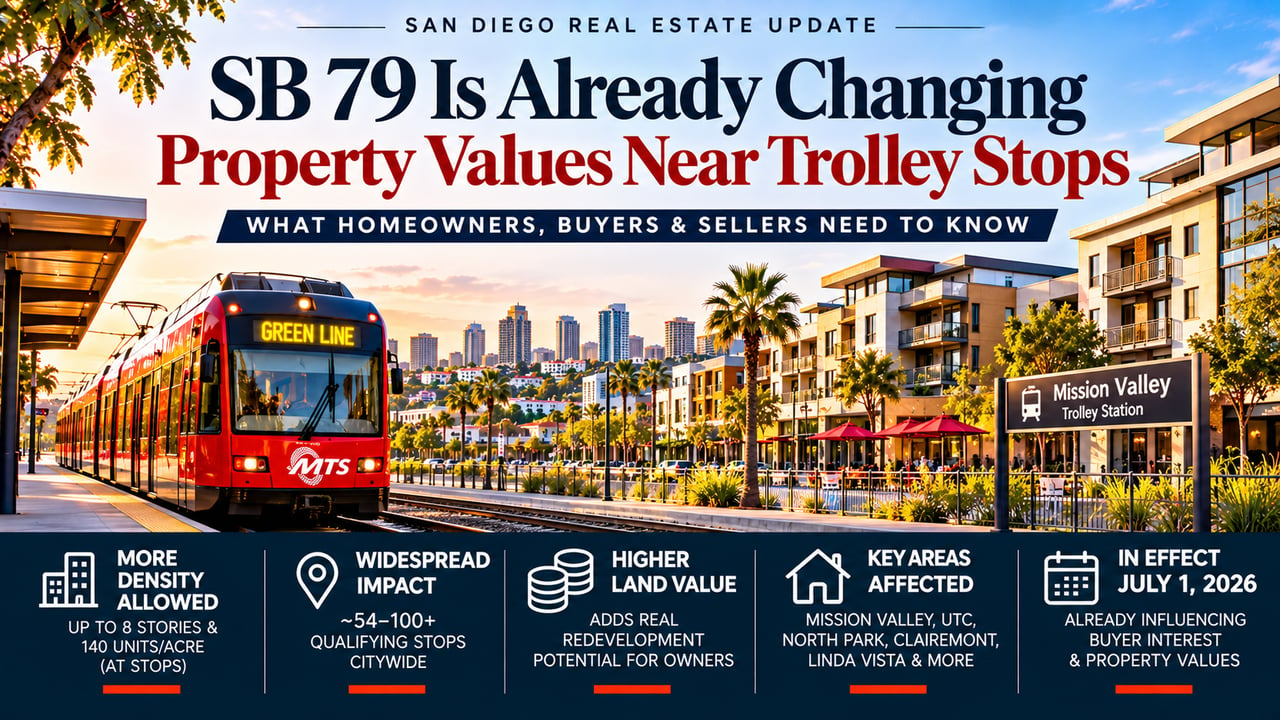
SB 79, authored by state senator Scott Wiener, requires cities and counties to approve qualifying housing developments near what the law calls transit-oriented development stops, major trolley stations and certain high-frequency bus stops, regardless of what the local zoning on that parcel used to allow. The density and height the law unlocks depends on how close a property sits to the stop itself. Directly adjacent to a trolley station, the law supports buildings up to eight stories and as dense as 140 dwelling units per acre. Move out toward a half mile from the stop and the numbers step down, generally landing around five stories and somewhere between 80 and 100 units per acre depending on the exact distance band. A property that local zoning capped at two or three stories a year ago can, in the right location, now legally support something far larger, and that single fact is what's actually driving the land value conversation.
It's worth being precise about what the law does not do. SB 79 doesn't force any individual owner to redevelop their property, rezone their lot against their will in any practical sense, or require anyone to sell. What it does is remove the local zoning ceiling that used to cap what a developer could build there, which changes who's interested in that parcel and what they're willing to pay for it, even if the current owner has no plans to do anything differently.
How San Diego chose to implement it
Cities got some real discretion in how broadly to apply SB 79's distance radius, and San Diego's City Council used it. Rather than applying the law's full one-mile outer boundary everywhere, the Council voted 6-0 in May 2026 to limit the SB 79 provisions to within a one-mile walking distance of qualifying stops, while also building in delays for sensitive areas, including locations with high flood risk, high fire risk, and designated historic sites. The city has been working through a formal identification process ever since, confirming an initial batch of 54 bus stops and trolley stations as meeting the technical definition of a TOD stop under the law, with city planners evaluating as many as 52 additional bus stops that could eventually push the total past 100 qualifying locations once SANDAG confirms them.
That phased, mapped-out approach matters for anyone trying to figure out whether a specific property actually qualifies. This isn't a blanket rule that applies the same way across the entire city on the same day. It's a station-by-station, stop-by-stop determination, which means the honest answer to "does SB 79 apply to my property" is almost always "check the specific stop," not "check the neighborhood."
Which San Diego neighborhoods are actually affected
The upzoning isn't evenly distributed across the city, it follows the trolley lines and the highest-frequency bus corridors, which means some neighborhoods are affected far more directly than others. Along the Green Line through Mission Valley, stations including Mission Valley Center, Hazard Center, Fashion Valley, Stadium, and Rio Vista all qualify, putting a meaningful stretch of that corridor's commercial and residential parcels under the new density rules. University City and the broader UTC area, University Heights, Clairemont, and North Park all have qualifying stops as well, and several of those overlap with neighborhoods this blog has already covered as walkable, transit-connected pockets for entirely different reasons. The Morena Boulevard corridor along Linda Vista and Bay Park, home to the Tecolote Road and Clairemont Drive Blue Line stations, falls into this same category. If you own property, or you're shopping for property, in any of these areas, it's worth treating "is this within walking distance of a trolley stop" as a real due-diligence question rather than a background detail.
What this means if you own property near a qualifying stop
This is the part of the SB 79 story that deserves the most attention, because it's the part most property owners haven't fully absorbed yet. A parcel that used to be valued almost entirely on its existing use, a single-family home, a small apartment building, a modest commercial strip, can now carry real additional value tied to what a developer could build there instead. That gap between a property's value as it currently sits and its value to someone who wants to redevelop it under the new density rules doesn't close automatically or immediately. It closes as more buyers, agents, and appraisers catch up to what the zoning change actually means for a specific address, and in the meantime, some owners are going to sell for less than their land is genuinely worth simply because they didn't know to ask the question.
If you own something near one of these stops and a developer or investor reaches out with an unsolicited offer, that's often a signal worth taking seriously rather than dismissing, but it's also worth getting an opinion on what the land is actually worth under its new development potential before accepting a number, rather than assuming the first offer reflects it. You're under no obligation to sell or redevelop just because the zoning changed, but if you're even considering a sale in the next few years, understanding your property's development value, not just its value as a home, should be part of that conversation from the start.
What this means if you're buying near a transit stop right now
For buyers, SB 79 cuts in a couple of different directions depending on what you're actually looking for. If you want a quiet, low-density residential street and you're shopping within a block or two of a qualifying trolley stop, it's worth understanding that the neighborhood's physical character in that immediate radius could look meaningfully different in five or ten years than it does today, and that's a reasonable thing to factor into a long-term purchase decision. On the other hand, if you're an investor or you're simply comfortable with the idea of density arriving nearby, buying ahead of that change, in a location you believe will eventually see redevelopment interest, is a legitimate strategy that plenty of buyers in gentrifying transit corridors have used successfully in other cities that adopted similar laws earlier.
Either way, the research step is the same: find out whether a specific property or a specific block actually sits within a confirmed TOD stop radius before you assume anything, because the city's list of qualifying stops is still being finalized and isn't a simple matter of counting blocks from any trolley line on a map.
What this means if you're selling near a transit stop right now
If your property sits within walking distance of one of the newly qualifying stops, that's a detail worth raising with your agent before you list, not after an offer comes in. A listing that only markets a property's value as a home, when that property also carries real redevelopment value under SB 79, is very likely leaving money on the table, and the buyers most likely to recognize that value, developers and investors, are exactly the audience a standard residential listing often doesn't reach effectively. Getting a sense of your property's development potential before you set a price, even if you ultimately sell to someone who just wants to live there, protects you from underpricing something the market may already be quietly re-evaluating.
The bottom line
SB 79 took effect on July 1, 2026, and in the months since, it's quietly rewritten what property near roughly 54 to 100-plus San Diego transit stops is actually worth, even though almost none of the new buildings the law makes possible have broken ground yet. That gap between a law changing and a market fully pricing it in is exactly where opportunity and risk both concentrate, for owners who don't realize what they're holding, for buyers who don't realize what they're walking into, and for sellers who list without understanding the second kind of value their property now carries. If you own property near a trolley or major bus stop in Mission Valley, University City, North Park, Clairemont, or along the Morena corridor, or you're shopping in one of those areas, it's worth figuring out exactly where that specific address sits relative to the city's confirmed TOD stop list before you make your next move. Reach out and we'll go through what SB 79 actually means for your specific property or your search.