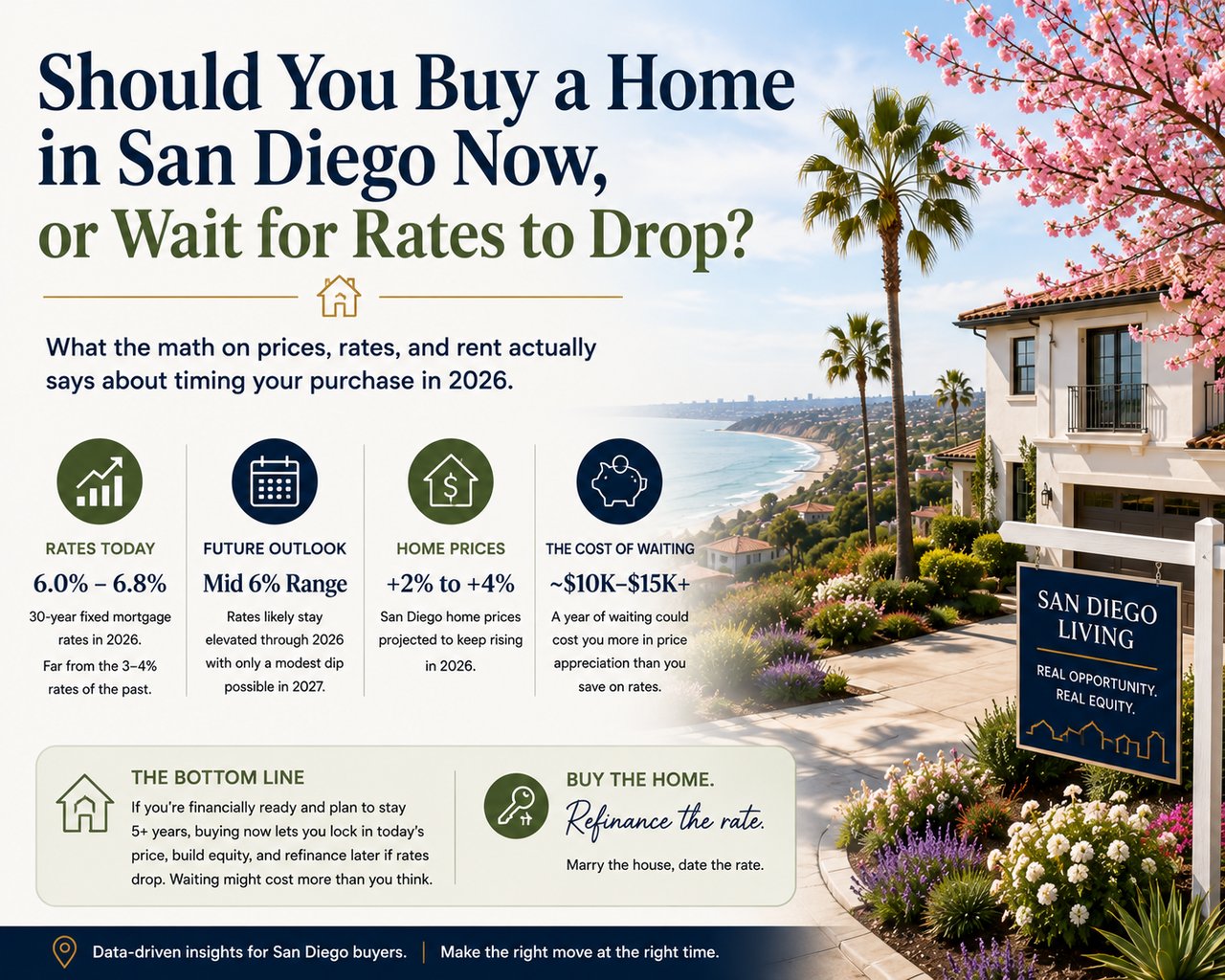
Should You Buy a Home in San Diego Now, or Wait for Mortgage Rates to Come Down?
Short answer: for most financially ready buyers, yes. Forecasters expect mortgage rates to stay in the mid 6 percent range through 2026 and likely into 2027, while San Diego home prices are projected to keep rising 2 to 4 percent a year. That combination usually means the cost of waiting outweighs the savings from a modest future rate drop.
It's one of the most common questions San Diego buyers are asking right now. Rates have been stuck in the mid 6 percent range for a while, prices haven't budged much either, and it's tempting to sit tight until something gives. But "wait for rates to drop" is a strategy with its own hidden costs, and in a market like San Diego, those costs are easy to underestimate. Here's what the actual numbers say.
Where Mortgage Rates Actually Stand Right Now
Thirty year fixed mortgage rates have been running roughly between 6.0 and 6.8 percent through 2026, depending on the lender and loan program. That's a meaningful improvement from the peaks of a couple of years ago, but it's still far from the 3 to 4 percent rates many buyers remember from the early 2020s, and there's no indication those rates are coming back anytime soon.
What Forecasters Are Actually Saying About the Future
This is where it gets interesting, because the experts don't fully agree, and the disagreement matters for how you plan.
Fannie Mae and the Mortgage Bankers Association expect the 30 year fixed rate to hover in the mid 6 percent range, roughly 6.5 to 6.8 percent, through the rest of 2026. Morgan Stanley has floated a more optimistic scenario in which a drop in the 10 year Treasury yield could pull mortgage rates down to around 5.50 to 5.75 percent by mid-2026, but their own strategists expect rates to climb back up again in the second half of the year and into 2027. In other words, even the rosier forecasts describe a dip, not a lasting decline.
Looking further out, the picture stays mixed. Fannie Mae's mid-2026 outlook has rates remaining elevated through the rest of the year with only a slight easing in 2027, averaging around 6.3 percent from the second quarter of 2027 onward. More optimistic forecasters, including the National Association of Realtors, see rates reaching the low to mid 5 percent range by mid-2027, while more conservative voices like Freddie Mac expect something closer to 5.55 percent. Nobody is forecasting a return to sub-5 percent rates in the near term, and most analysts agree that any significant relief isn't likely before mid-2027 at the earliest, if it comes at all.
That's the core problem with waiting purely for rates: you could be waiting twelve to eighteen months for a decline that, by most forecasts, tops out around half a point lower than today, and even that isn't guaranteed.
The San Diego Market You'd Actually Be Buying Into
Meanwhile, the market you're waiting to enter isn't standing still. San Diego's median detached home price has been sitting around $975,000 to $1.1 million depending on the month and measure, up several percent year over year. Most forecasts call for continued price appreciation in the 2 to 4 percent range through 2026, which is slower than the pandemic-era boom but still a real, positive number.
Homes are taking a bit longer to sell than they did during the frenzy of a few years ago, with median days to pending running around 28 to 34 days, and the sale-to-list price ratio sits near 99 percent, meaning homes are still selling close to asking. Inventory has loosened slightly, but San Diego continues to face a structural supply constraint that limits new construction, which keeps a floor under prices even as the market cools from its hottest days. Affordability remains a real challenge too, with estimates suggesting only around 18 percent of San Diego households can currently afford a median-priced home.
Put simply, San Diego isn't a market where waiting is likely to hand you a materially cheaper home. It's more likely to hand you a slightly more expensive one.
The Real Math: What Waiting Actually Costs You
This is the part that tends to get lost in the rates conversation. A lower rate reduces your monthly payment, but it doesn't automatically save you money overall, because you're also paying a higher price for the same home and borrowing a larger loan.
Industry analyses of this tradeoff tend to land on a similar conclusion. In one common scenario, waiting a year for a rate that's half a point lower saves a buyer around $50 a month on their payment, but that same year of price appreciation adds roughly $10,000 to $15,000 to the loan balance and requires a larger down payment at closing. In a real example from a similar West Coast market, a buyer who waited six months for rates to improve did see rates drop slightly, but the home they wanted appreciated by $31,000 in the meantime, and their monthly payment actually went up, because the larger loan balance outweighed the small rate improvement.
Apply that logic to San Diego specifically. If prices rise even a conservative 3 percent over the next year, a $1,000,000 home today becomes roughly a $1,030,000 home a year from now. That $30,000 difference dwarfs the monthly savings from the kind of rate dip most forecasters are actually predicting, which tends to be half a point or less. Unless rates fall dramatically, which no major forecaster currently expects before mid-2027 at the earliest, the math tends to favor buying sooner rather than later for anyone who's otherwise ready.
Renting While You Wait Isn't Free Either
To be fair, waiting doesn't necessarily mean losing money every month. San Diego's rental market has actually softened somewhat in 2026, with average rents in the $2,400 to $3,300 range depending on unit size, and vacancy rates climbing to around 5.4 percent, up from historic lows near 2.6 percent a few years ago. Landlords are increasingly offering move-in specials and more flexible lease terms, which has taken some of the financial pressure off renters compared to the tightest years of the rental market.
That said, renting still comes with a real tradeoff. Every month spent renting is a month of housing payments that build no equity and capture none of whatever appreciation the market delivers. A softer rental market makes waiting more tolerable financially in the short term, but it doesn't change the longer-term math of missing out on equity growth in a market that's still, on net, appreciating.
The "Marry the House, Date the Rate" Approach
One strategy worth considering is buying now at today's price and today's rate, with the plan to refinance later if rates genuinely do fall. This lets you lock in the purchase price before further appreciation, start building equity immediately, and still capture the benefit of a lower rate down the road if the more optimistic forecasts materialize. The tradeoff is that refinancing isn't free, it typically costs a few thousand dollars in closing costs, so it only makes sense if rates fall enough to justify that cost, generally a decline of at least half to three quarters of a point.
Who Should Probably Buy Now
If you've found a home that fits your needs, can comfortably afford the payment at today's rates without stretching your budget to its limit, and plan to stay for five years or more, the case for buying now is strong. You lock in today's price before further appreciation, start building equity immediately, and retain the option to refinance later if rates do fall. Waiting on the hope of a meaningfully lower rate, given what forecasters are actually saying, means betting on an outcome that may not arrive for another year or two, if at all.
Who Might Reasonably Wait
Waiting makes more sense if your affordability is genuinely dependent on a lower rate, meaning you can't comfortably qualify or afford the payment at today's 6 to 7 percent rates even for a home that fits your needs. It also makes sense if your timeline is short, if you might need to move again within a couple of years, since transaction costs can outweigh any benefit from a small amount of equity growth. And if you're in a flexible rental situation with a landlord offering a good deal in today's softer rental market, there's less urgency to rush, provided you're using that time productively to save for a larger down payment rather than simply hoping rates fall.
Bottom Line
For most buyers who are financially ready, San Diego's 2026 market data doesn't support waiting purely for rates. Forecasters broadly agree that any meaningful rate relief is unlikely before mid-2027 and isn't guaranteed even then, while home prices are still expected to grow 2 to 4 percent a year in the meantime. That combination usually means the cost of waiting, in the form of a higher purchase price and lost equity growth, outweighs the monthly savings from a modest rate improvement. The exception is genuine affordability. If today's rates put a suitable home out of reach, waiting and saving is the more responsible path, and a refinance can still capture the upside if rates eventually fall. But waiting simply because rates might improve slightly is a bet that most current forecasts don't favor.