Down Payment Assistance in San Diego: Every Program Actually Available in 2026
Ask a first-time buyer in San Diego what down payment help exists and you'll usually get one of two answers: nothing, because the market is too expensive for programs like that to matter here, or a vague memory of some state grant that ran out of money years ago. Neither is accurate. There are at least five distinct programs currently active for San Diego buyers, ranging from state-run shared appreciation loans to a city-specific deferred loan that can cover $50,000 between down payment and closing costs, and they stack differently depending on where in the county you're buying and what your income looks like relative to your area's median. Here's what's actually open for applications right now, what each one requires, and how to think about combining them.
CalHFA MyHome Assistance Program
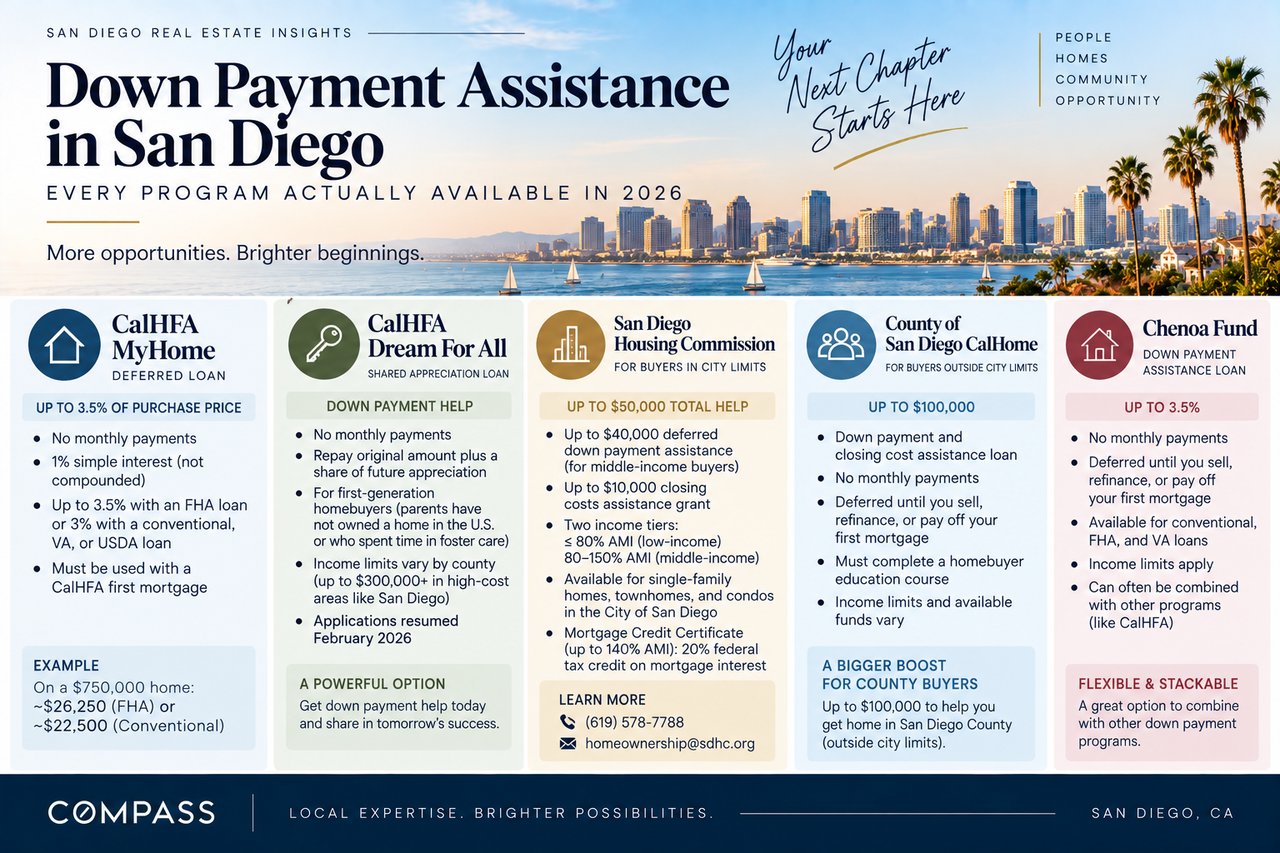
MyHome is a deferred-payment junior loan, meaning you don't make monthly payments on it, and the balance isn't due until you sell, refinance, or pay off your first mortgage. Interest accrues at a simple 1 percent annually rather than compounding, which keeps the eventual payoff relatively modest even if you hold the home for a decade or more. The amount available depends on which first mortgage you're pairing it with: up to 3.5 percent of the purchase price or appraised value, whichever is lower, when paired with an FHA first mortgage, or up to 3 percent when paired with a conventional, VA, or USDA first mortgage. The catch is that MyHome can only be used alongside a CalHFA first mortgage, meaning you're not layering this assistance onto just any lender's loan, you're going through CalHFA's own first mortgage program as the base. For a $750,000 purchase, that's a difference between roughly $26,250 in assistance through the FHA pairing versus $22,500 through the conventional pairing, real money either way but worth confirming with your loan officer before you lock in which first mortgage structure you're using.
CalHFA Dream For All
Dream For All works differently, and it's the program most people mean when they've heard California hands out large down payment grants. It's a shared appreciation loan: you get down payment help with no monthly payments, but when you eventually sell, refinance, or transfer the home, you repay the original loan amount plus a percentage of whatever appreciation the home gained while you owned it. The program shut down its first two funding rounds within days of opening in 2023 and 2024, then sat dormant until it resumed accepting applications again in February 2026, this time specifically targeted at first-generation homebuyers, meaning applicants whose parents haven't owned a home in the United States during the applicant's lifetime, or who spent time in foster care. Income limits are set by county and vary substantially, running from roughly $148,000 in lower-cost counties up to over $300,000 in the most expensive parts of the state, which makes it worth checking CalHFA's current published limit for San Diego County specifically rather than assuming a number from a different market applies here. Because it's a shared appreciation structure rather than a flat loan, Dream For All is worth running past a lender or financial advisor before you commit, since the eventual repayment amount depends entirely on how much the home appreciates, something nobody can predict with certainty at the time of purchase.
San Diego Housing Commission programs, for buyers inside city limits
If you're buying within the City of San Diego specifically, not the broader county, the San Diego Housing Commission runs its own first-time homebuyer program with two income tiers. Low-income buyers, meaning households at or below 80 percent of San Diego's Area Median Income, qualify for one tier of assistance. Middle-income buyers, defined as households between 80 and 150 percent of AMI, qualify for a separate and notably larger benefit: a deferred down-payment assistance loan of up to $40,000, paired with a separate closing costs assistance grant of up to $10,000. That's $50,000 in combined help before you've touched a dollar of state assistance, and it applies to single-family homes, townhomes, and condos anywhere within city limits. SDHC also administers a Mortgage Credit Certificate for buyers up to 140 percent of AMI, which isn't down payment help directly but functions as an ongoing 20 percent federal tax credit on the mortgage interest you pay each year, effectively lowering your real borrowing cost for as long as you hold the loan, subject to the certificate's annual federal allocation. SDHC can be reached directly at (619) 578-7788 or [email protected], and given that eligibility and available funding shift with the city's annual allocation, a direct call before you start house hunting is worth more than anything you'll find secondhand.
County of San Diego CalHome and Moderate Income Down Payment Assistance
Buyers purchasing outside city limits have a parallel option through the County of San Diego's own CalHome-funded program, and it's larger than most people expect. The county's Down Payment and Closing Cost Assistance loan can cover up to 17 percent of the purchase price toward the down payment, plus an additional 4 percent, capped at $10,000, toward closing costs. Like MyHome, it's a deferred loan with no monthly payments, though the interest accrual here is 3 percent simple interest annually rather than CalHFA's 1 percent, and repayment is triggered by the same events: selling, refinancing outside of an FHA streamline, paying off the first mortgage, or no longer living in the home as your primary residence. Eligibility requires total household income at or below 80 percent of the county's Area Median Income, and the program only applies in specific jurisdictions: the unincorporated areas of the county, plus the cities of Carlsbad, Coronado, Del Mar, Encinitas, Imperial Beach, La Mesa, Lemon Grove, Poway, San Marcos, Santee, Solana Beach, and Vista. Notably absent from that list is the City of San Diego itself, which runs its own separate program through SDHC rather than the county's. The county program also carries a purchase price cap, currently set at $676,000 and subject to periodic adjustment, which rules out a meaningful share of listings in coastal North County but still covers plenty of inventory in inland and southern parts of the county.
Access Granted, for a more targeted pool of buyers
Outside the government-run programs, Access Granted, administered through the San Diego Foundation, offers up to $70,000 in down payment assistance paired with required financial education for eligible buyers, and the program has now helped more than 100 San Diego homebuyers close. It's a smaller-scale, more targeted program than the county or state options, and eligibility criteria and funding availability are worth confirming directly given how quickly a program of this size can see its allocation committed in a given cycle.
How these programs actually stack
The practical question for most buyers isn't which single program to use, it's which combination is actually allowed. CalHFA's MyHome and Dream For All programs are both state-run and both require a CalHFA first mortgage, which means you generally can't mix a CalHFA down payment program with SDHC's or the county's down payment program on the same purchase, since each is tied to a specific first mortgage structure or a specific administering agency's underwriting. What you can realistically stack in many cases is a single down payment assistance loan, whichever one fits your income tier, location, and first mortgage choice, together with the Mortgage Credit Certificate, since the MCC is a tax benefit layered on top of whatever mortgage you end up with rather than a competing source of upfront cash. The right combination depends heavily on three factors working together: whether you're buying inside or outside San Diego city limits, where your household income falls relative to your area's median, and which first mortgage program your lender is placing you into. This is exactly the kind of decision worth running past a lender who works with these programs regularly before you write an offer, since choosing the wrong first mortgage path can quietly close off a down payment program you'd otherwise have qualified for.
What this means if you're buying
Figure out your household income relative to San Diego's Area Median Income and your target property's location before you start comparing programs, since those two facts alone eliminate most of the options that don't apply to you. If you're buying inside San Diego city limits and fall in the 80 to 150 percent AMI range, the SDHC middle-income program's combined $50,000 in assistance is likely your strongest single option and worth a call to (619) 578-7788 early in your search. If you're buying outside the city in one of the county's eligible jurisdictions and your income sits at or below 80 percent of AMI, the county's CalHome program's 17 percent down payment coverage is substantial, but check that $676,000 price cap against what you're actually shopping for first. And regardless of which local program fits, ask your lender directly whether pairing it with a CalHFA first mortgage would unlock MyHome or Dream For All instead, since the first mortgage decision is what determines which of these programs are even on the table.
What this means if you're selling to a buyer using assistance
A buyer using one of these programs isn't a weaker buyer, but their financing does move on a slightly different timeline than a conventional purchase, since deferred loans and shared appreciation structures both require additional underwriting steps beyond a standard first mortgage. If you're evaluating an offer that references CalHFA, SDHC, county CalHome funds, or Access Granted assistance, it's worth asking your agent to confirm the buyer has already been through the specific program's pre-qualification, not just a general mortgage pre-approval, since programs with capped annual funding can occasionally see their allocation exhausted mid-transaction in a way a conventional loan never would.
The bottom line
The idea that San Diego has no real down payment help for first-time buyers isn't true in 2026. Between CalHFA's MyHome and Dream For All programs, San Diego Housing Commission's city-specific assistance of up to $50,000 combined, the county's CalHome program covering up to 17 percent of the purchase price outside city limits, and Access Granted's up to $70,000 through the San Diego Foundation, there's meaningfully more available than most buyers assume, the challenge is figuring out which ones you actually qualify for and how they interact with your choice of first mortgage. If you're trying to figure out which of these programs actually fits your income, your target neighborhood, and your financing plan, reach out and we'll go through the real numbers together before you start house hunting.