Solana Beach Housing Market Report: A Small City With Two Very Different Markets (2026)
Solana Beach covers less than four square miles, making it one of the smallest cities in San Diego County, but it's also one of the hardest to describe with a single set of numbers. A median price of $2 million sits alongside single-family averages north of $4.6 million and condo listings closer to $1.6 million, a spread wide enough that quoting one figure to a buyer or seller tells them almost nothing useful about what they're actually looking at. Add in the strictest bluff-top building rules on the San Diego coast and a federal beach replenishment project already underway, and Solana Beach needs a more specific read than the neighborhood name it usually gets lumped under alongside Del Mar and Encinitas.
A city built from three genuinely different markets
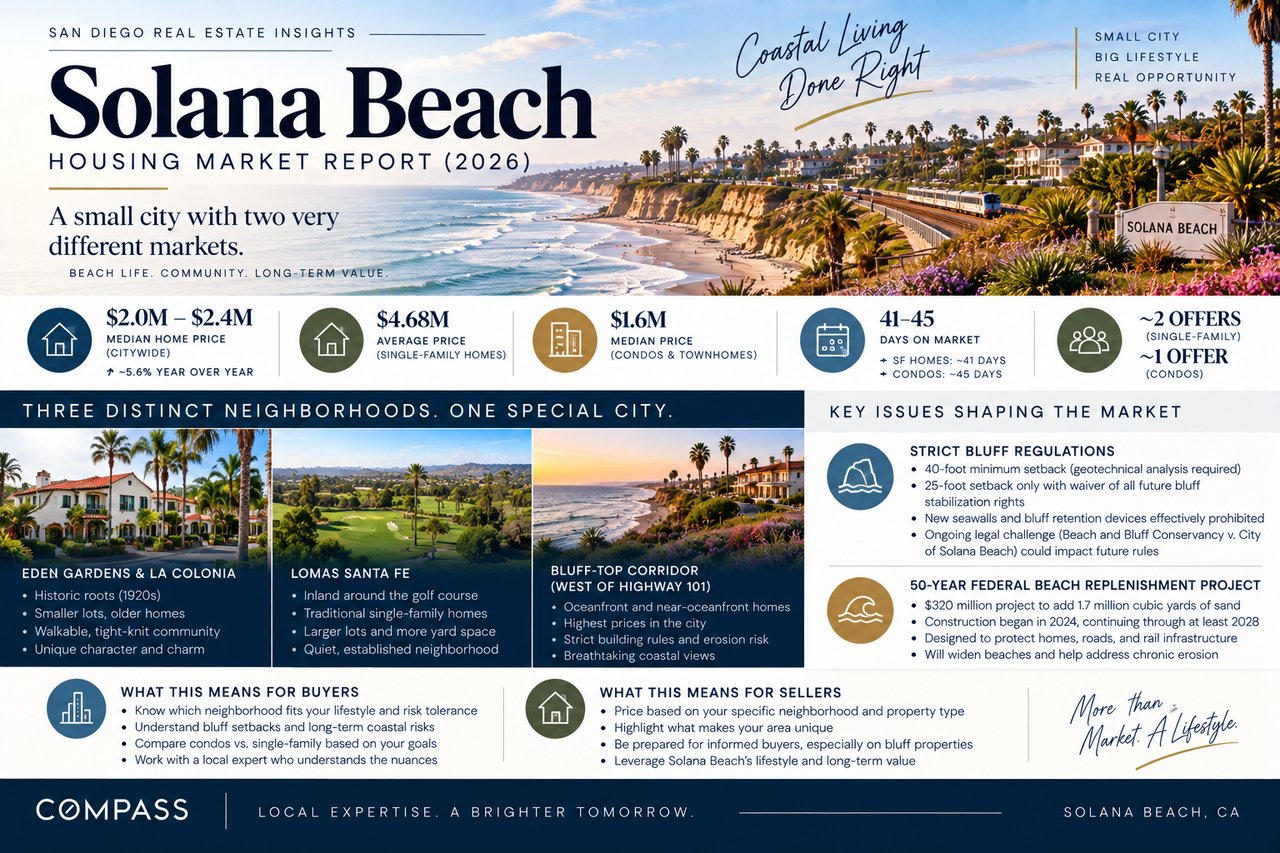
Solana Beach's real estate isn't one market wearing different price tags, it's three distinct areas that happen to share a zip code. Eden Gardens and La Colonia, the city's oldest residential area, trace back to the 1920s when Mexican and Mexican-American families settled near the ranch work and railroad jobs that built this part of the coast, and the neighborhood still carries that history in its smaller lots, older housing stock, and a tighter-knit, more walkable feel than the rest of the city. Lomas Santa Fe sits inland around the golf course and country club, offering the kind of traditional single-family lots and yard space that's harder to find closer to the water. Then there's the bluff-top corridor west of Highway 101, where oceanfront and near-oceanfront homes command the city's highest prices and carry its most serious long-term risk, since these are the properties sitting directly above an eroding coastline with almost no path to a private seawall. A listing description that just says "Solana Beach" without naming which of these three areas it's actually in is skipping the detail that matters most for both price and risk.
What the price spread is actually telling you
Citywide, Solana Beach's median home price runs around $2 million to $2.4 million depending on the month and data source, with the most recent 30-day figures closer to $2.375 million, up roughly 5.6 percent year over year. But that blended number obscures a real divide between property types. Condos have been listing at a median around $1.6 million, while single-family homes average closer to $4.68 million, a gap of nearly $3 million between the two segments. That's a far wider spread than most San Diego coastal cities show between their condo and single-family markets, and it reflects Solana Beach's built form: a small, largely built-out city with limited land left for new single-family construction, where the single-family stock that does exist skews toward larger, more expensive, often bluff-adjacent properties, while the condo and townhome inventory serves a meaningfully different buyer. Days on market tell a similar story split by segment, condo listings have been averaging around 45 days with roughly one offer, while larger single-family homes have moved a bit faster, around 41 days with closer to two offers, suggesting the detached market here is thinner but more competitive once the right buyer shows up, not unlike the pattern Pacific Highlands Ranch shows at the luxury end of Carmel Valley.
The strictest bluff rules on this stretch of coast
If you've read anything here about Encinitas's Coastal Bluff Overlay Zone, Solana Beach's rules will look familiar in structure but noticeably stricter in practice. New development has to be set back a minimum of 40 feet from the bluff edge, with geotechnical analysis required to account for 75 years of projected erosion plus a safety factor. A narrower 25-foot setback is available, but only if the homeowner formally waives all rights to ever construct a bluff stabilization device, meaning any upper or lower bluff retention structure, to protect the portion of the home sitting within that 40-foot zone. That waiver is the detail that separates Solana Beach from a lot of coastal jurisdictions: choosing the shorter setback isn't a minor tradeoff, it's a permanent decision to accept whatever the bluff does over the following decades without the option to armor against it later. New seawalls and other bluff retention devices are effectively prohibited under the city's Local Coastal Program and routinely rejected by the California Coastal Commission when proposed, a policy that's produced real friction with bluff-top homeowners. Beach and Bluff Conservancy v. City of Solana Beach, an ongoing legal challenge from bluff-top property owners, is currently contesting exactly this framework, and the outcome could shape what bluff-top owners are and aren't allowed to do to protect their homes going forward. Anyone buying west of the 101 in Solana Beach should treat these setback and armoring rules as a core part of underwriting the purchase, not a footnote a geotechnical report will smooth over later.
A 50-year federal project is already reshaping the beach itself
Separate from the setback fight, Solana Beach is partway through a federal Coastal Storm Damage Reduction and Beach Replenishment Project designed to run for 50 years, restoring the city's beaches and protecting the bluffs above them primarily through periodic sand nourishment rather than hard armoring. Construction on the current phase began earlier this year, and the project reflects a broader conclusion reached by the city and coastal regulators alike: that adding sand to a beach is a more economical and less destructive way to slow bluff erosion than lining the coast with concrete, which tends to accelerate erosion on adjacent, unarmored stretches. For property owners, this project is worth understanding less as a guarantee of stability and more as an ongoing, decades-long maintenance commitment that the city and federal government are making because the alternative, allowing the bluffs to erode unmanaged, isn't considered acceptable either. It's a meaningfully different approach than what's playing out at the Del Mar bluffs a few miles north, where the railroad itself, not just private property, is driving talk of a multi-billion dollar relocation.
Schools, and the Mello-Roos question that usually doesn't apply here
Most of Solana Beach falls within the Solana Beach School District for elementary grades, feeding into Earl Warren or Carmel Valley Middle School before reaching Torrey Pines High School through the San Dieguito Union High School District's address-based boundary, the same real, verifiable assignment covered in more detail in the Del Mar and Carmel Valley school boundaries breakdown. One detail worth flagging for buyers comparing Solana Beach against newer master-planned communities like Pacific Highlands Ranch or parts of Carmel Valley: Solana Beach's neighborhoods were largely built out well before Community Facilities District financing became the standard tool for funding new infrastructure, so Mello-Roos assessments generally aren't the carrying-cost factor here that they are in those newer communities. That's worth confirming property by property rather than assuming it universally, since individual developments can still carry their own assessments, but it's a structurally different cost profile than a lot of what's been built in San Diego over the past two decades.
Downtown, the train, and what's actually pulling buyers here
The Cedros Design District, Solana Beach's compact stretch of home furnishing showrooms, restaurants, and boutique retail along the railroad tracks, has become one of the city's clearer identity anchors, and its walkability from both the Coaster and Amtrak Solana Beach station gives the city a transit-connected, urban-adjacent feel that's unusual for a beach town this size. That combination, walkable downtown, train access, and a small, tightly bounded footprint, tends to draw a buyer profile weighted toward downsizers, empty nesters, and second-home buyers who want coastal access without the scale of a larger single-family lot, which helps explain why the condo and townhome segment here functions almost as its own separate market from the bluff-top estates a few blocks away.
What this means if you're buying in Solana Beach
Get specific about which of the three sub-markets you're actually shopping in before you compare a listing's price to a citywide median, since Eden Gardens, Lomas Santa Fe, and the bluff-top corridor west of the 101 are priced, built, and risk-profiled too differently for one number to guide you accurately. If you're looking at anything near the bluff, ask directly whether the property sits on the 40-foot or 25-foot setback, and if it's the shorter one, understand that you're buying a home whose owner has permanently waived the right to armor against future erosion. And if Mello-Roos costs have been a factor in comparing Solana Beach against newer communities like Pacific Highlands Ranch, confirm the specific property's CFD status rather than assuming Solana Beach's older housing stock means there's nothing to check.
What this means if you're selling in Solana Beach
Be precise about which neighborhood your listing sits in and lean into what actually distinguishes it, Eden Gardens' history and walkability, Lomas Santa Fe's traditional lots and golf course access, or the bluff-top corridor's oceanfront position, rather than letting "Solana Beach" carry the whole pitch. If you're selling a bluff-top property, have your setback documentation and any prior geotechnical reports ready, since a well-informed buyer doing real diligence on coastal risk is going to ask, and a seller who can answer clearly and specifically is going to look far more credible than one who can't. And if your property predates the CFD era and genuinely carries no Mello-Roos assessment, that's a real selling point worth stating outright when buyers are actively comparing your listing against newer, Mello-Roos-heavy communities nearby.
The bottom line
Solana Beach isn't a smaller, quieter version of Del Mar or Encinitas, it's its own small city split into three genuinely different markets, with a price spread between condos and single-family homes wide enough that a single median tells you almost nothing on its own. The bluff-top rules here are the strictest on this stretch of coast, with a 40-foot setback, a 25-foot alternative that comes with a permanent waiver of armoring rights, and a Local Coastal Program that routinely rejects new seawalls outright. None of that makes Solana Beach a harder place to buy or sell, it just means the diligence has to be specific to the neighborhood and, near the bluff, specific to the setback the property was built under. If you're evaluating a property in Solana Beach and want help sorting out which market you're actually in, reach out and we'll go through the real numbers together.