Carmel Valley Housing Market Report: What the Numbers Actually Say Right Now (2026)
Search for Carmel Valley home prices and you'll find a median anywhere from just over $1 million to $1.7 million depending on which site you land on, which isn't a great starting point if you're actually trying to price a listing or figure out what you can afford. Some of that spread is normal noise between data providers. Some of it is a mixup worth clearing up before we get to the real numbers. Here's what's actually happening in the Carmel Valley market as of August 2026.
The number everyone gets wrong first
Before anything else: there are two Carmel Valleys in California, and they are not remotely the same market. This Carmel Valley, the planned community in the 92130 zip code between Del Mar and Rancho Peñasquitos, is what this report covers. The other Carmel Valley sits in Monterey County near Carmel-by-the-Sea, a rural area of ranches and wineries with its own, very different price profile. Some national real estate data sites don't cleanly separate the two, which is almost certainly why you'll see wildly different median price figures depending on where you look. If a number seems out of step with everything else you're seeing for San Diego's Carmel Valley, check whether the source is actually pulling from the right one before you use it.
Where prices actually stand
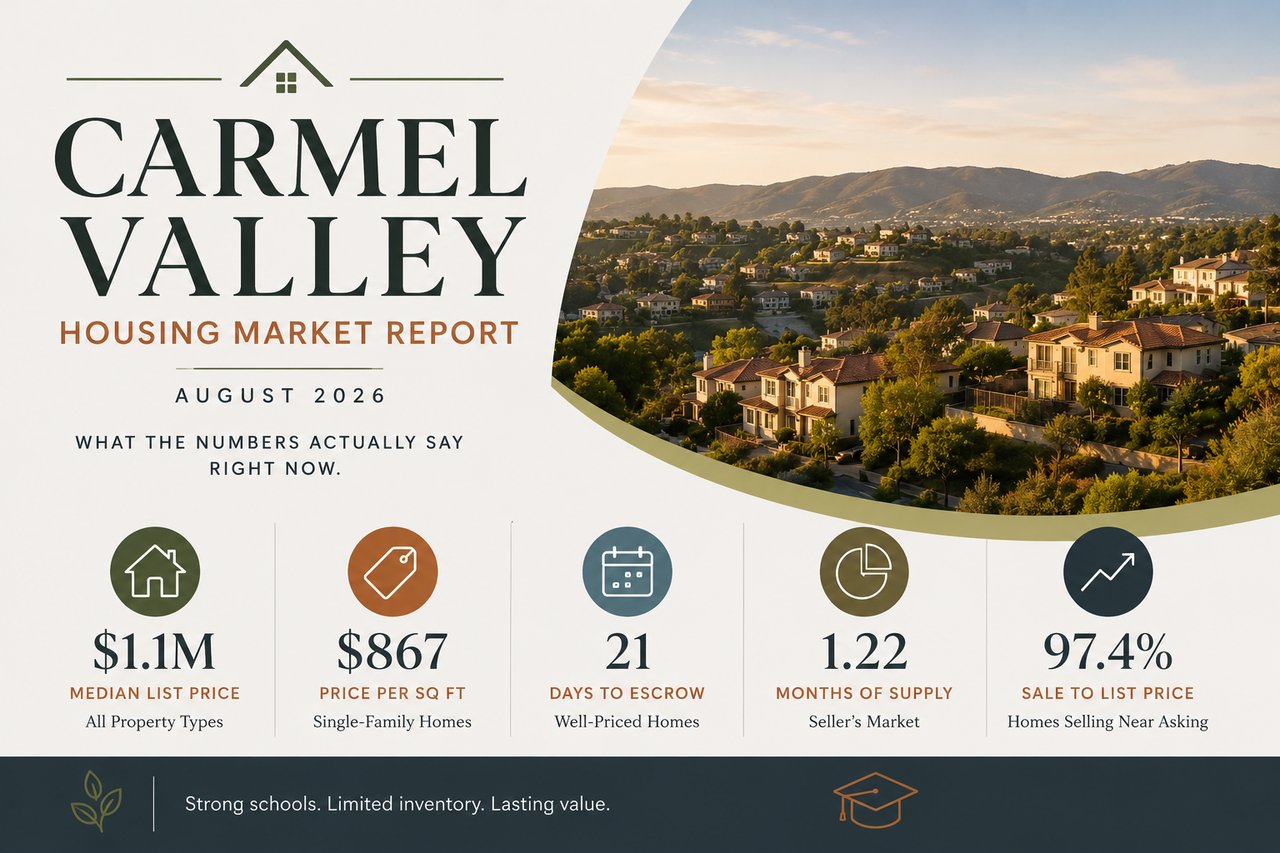
With that cleared up, here's the real picture. Active listings in the San Diego Carmel Valley have been selling at an average of $820 per square foot, with single-family homes specifically closing around $867 per square foot over the trailing six months, and homes currently on the market listed closer to $880 per square foot. As of late August 2026, the median list price sits around $1.1 million, though that figure moves quite a bit depending on the mix of what's listed at any given moment, since condos and single-family homes in this neighborhood occupy almost entirely different price tiers. Condos in Carmel Valley average roughly $719,000, while single-family homes average around $2.3 million, more than three times higher. A blended median from any given week says less about the market than it does about which type of home happened to be listed that week, which is exactly why the headline number bounces around so much between sources and month to month.
How fast homes are actually moving
Average days on market is running around 47 to 51 days depending on the source and the week measured, but that average hides a more useful pattern underneath it. Homes that are priced accurately for the current market are going into escrow in roughly 21 days, while homes that are priced aspirationally sit for considerably longer and drag the average up. That gap matters more than the average itself. A seller pricing realistically from day one is looking at a three week window to a signed offer, not the seven week figure the average suggests.
Just how tight inventory is
There were 72 active listings in Carmel Valley as of late August 2026, which works out to roughly 1.22 months of supply at the current pace of sales. Anything under about four to six months of supply is generally considered a seller's market, so at just over one month, Carmel Valley remains firmly tilted toward sellers even as the broader county has drifted toward more balanced, buyer friendly conditions this year. That's a meaningful local exception to the countywide trend, and it's the kind of gap that gets lost if you're only reading San Diego wide market reports instead of neighborhood specific data.
What sellers are actually getting for their homes
Sale to list price ratios in Carmel Valley have been running around 97.4 percent, meaning well positioned sellers are landing very close to their asking price rather than needing to negotiate down significantly. That's a strong number, and it reflects the tight inventory story above: with just over a month of supply, buyers don't have much room to hold out for a steep discount on a home that's priced in line with recent comparable sales.
Why single-family and condos are heading in different directions
This split shows up in the forecasts too, not just the current numbers. Coastal, top school district single-family markets like Carmel Valley are projected to see roughly 4 to 6 percent appreciation over the coming year, while condo pricing across the county, particularly units with high HOA dues, is expected to run flat to down as much as 3 percent. This mirrors the broader county wide divergence between detached and attached housing that's shown up in recent housing debrief data, but it's more pronounced here because Carmel Valley's single-family demand is propped up by something condos in the same zip code don't have as much of: school district pull.
Schools are doing a lot of the work in this market
Carmel Valley sits within the San Dieguito Union High School District, and its two flagship high schools carry as strong a reputation as any in the county. Torrey Pines High School holds a 10 out of 10 rating on GreatSchools and has been recognized as a National Blue Ribbon School multiple times. Canyon Crest Academy, technically located in neighboring Pacific Highlands Ranch but drawing heavily from and often described as part of the greater Carmel Valley area, also carries a 10 out of 10 rating. For a lot of buyers in this market, the decision isn't just about the house, it's about locking in a school assignment for years to come, and that pressure shows up directly in how competitively single-family homes in strong attendance zones are trading compared to condos in the same general area.
The carrying cost the sticker price doesn't show
A high sale to list ratio and a strong per square foot number only tell you what a buyer is paying to acquire the home, not what it costs to actually own it, and Carmel Valley has one of the more significant gaps between those two figures anywhere in the county. Much of Carmel Valley was built out as a master planned community, which means a meaningful share of homes here carry Mello-Roos special tax assessments on top of the base property tax bill, commonly ranging from roughly $3,000 to $25,000 or more a year depending on the specific bond district and lot. That's not a one time closing cost, it's a recurring obligation that typically runs for 20 to 40 years and transfers with the property. Two homes with identical list prices and nearly identical per square foot numbers can carry very different true monthly costs once you account for this, which is exactly the kind of detail that a raw market report misses and a buyer needs before comparing Carmel Valley against a similarly priced home in an older, non-CFD neighborhood.
How Carmel Valley compares to its immediate neighbors
Buyers cross-shopping Carmel Valley often widen their search to Del Mar, Pacific Highlands Ranch, and Del Sur, and it's worth knowing roughly how those markets sit relative to each other before assuming Carmel Valley is either the expensive option or the affordable one. Del Mar, closer to the coast and with a smaller, more exclusive inventory, generally trades at a premium above Carmel Valley's single-family numbers. Pacific Highlands Ranch, newer and drawing on much of the same school access through Canyon Crest Academy, tends to run in a comparable range to Carmel Valley itself, which is part of why the two areas get described interchangeably as often as they do. Del Sur, further north and east, typically offers a somewhat lower entry point but carries its own often substantial Mello-Roos load given its newer construction. None of these are direct substitutes for each other despite the geographic proximity, and a buyer who only compares list prices without factoring in school boundaries and special tax assessments is missing a big part of what actually separates them.
What this means if you're selling in Carmel Valley right now
With just over a month of inventory and a 97.4 percent sale to list ratio, this remains a market where accurate pricing gets rewarded quickly rather than punished. Homes priced in line with recent comparable sales are going into escrow in around three weeks. Homes priced aspirationally are the ones dragging the 47 to 51 day average up, sitting long enough to develop a stale listing reputation before a price cut finally gets attention. If you're selling a single-family home, current conditions and forecasts both favor you. If you're selling a condo, temper expectations against the softer countywide condo trend and be realistic that a Carmel Valley address alone won't fully insulate an attached home from that broader pressure.
What this means if you're buying in Carmel Valley right now
Move quickly and come in with a clean, well supported offer if you find a single-family home that fits, since 1.22 months of supply leaves very little room for buyers to sit on a decision. If school district access is part of your decision, and for most buyers here it is, confirm the specific attendance boundary for a property before you fall in love with it, since Carmel Valley, Pacific Highlands Ranch, and neighboring communities don't map perfectly onto San Dieguito Union's various school assignments. Condos are a different story right now, with softer pricing and more negotiating room than the single-family side of the market, which may be worth a look if the numbers on a house feel out of reach.
The bottom line
Carmel Valley remains one of the tightest, most competitive submarkets in San Diego County, running well below the county's broader shift toward buyer friendly conditions, largely on the strength of its schools and its single-family inventory. Condos in the same zip code are telling a noticeably softer story, and the various median price figures floating around online reflect everything from genuine market data to a data mixup with an entirely different Carmel Valley three hundred miles north. If you want a read on what a specific property in Carmel Valley is actually worth right now, or how current inventory affects your timeline as a buyer or seller, reach out and we'll go through the real numbers together.