Del Mar Housing Market Report: A Luxury Market That's Actually Cooling (2026)
Del Mar and Carmel Valley get lumped together constantly, close in miles, close in school access, close enough in name recognition that buyers cross-shopping the two assume they're looking at the same market with different price tags. They're not. While Carmel Valley is sitting at just over a month of supply with sellers landing 97 percent of asking price, Del Mar is telling a different story right now, one where luxury sellers are cutting prices by hundreds of thousands of dollars and homes are sitting on the market for months rather than weeks. Here's what the actual numbers say as of late August 2026.
Where prices stand, and why they're moving down
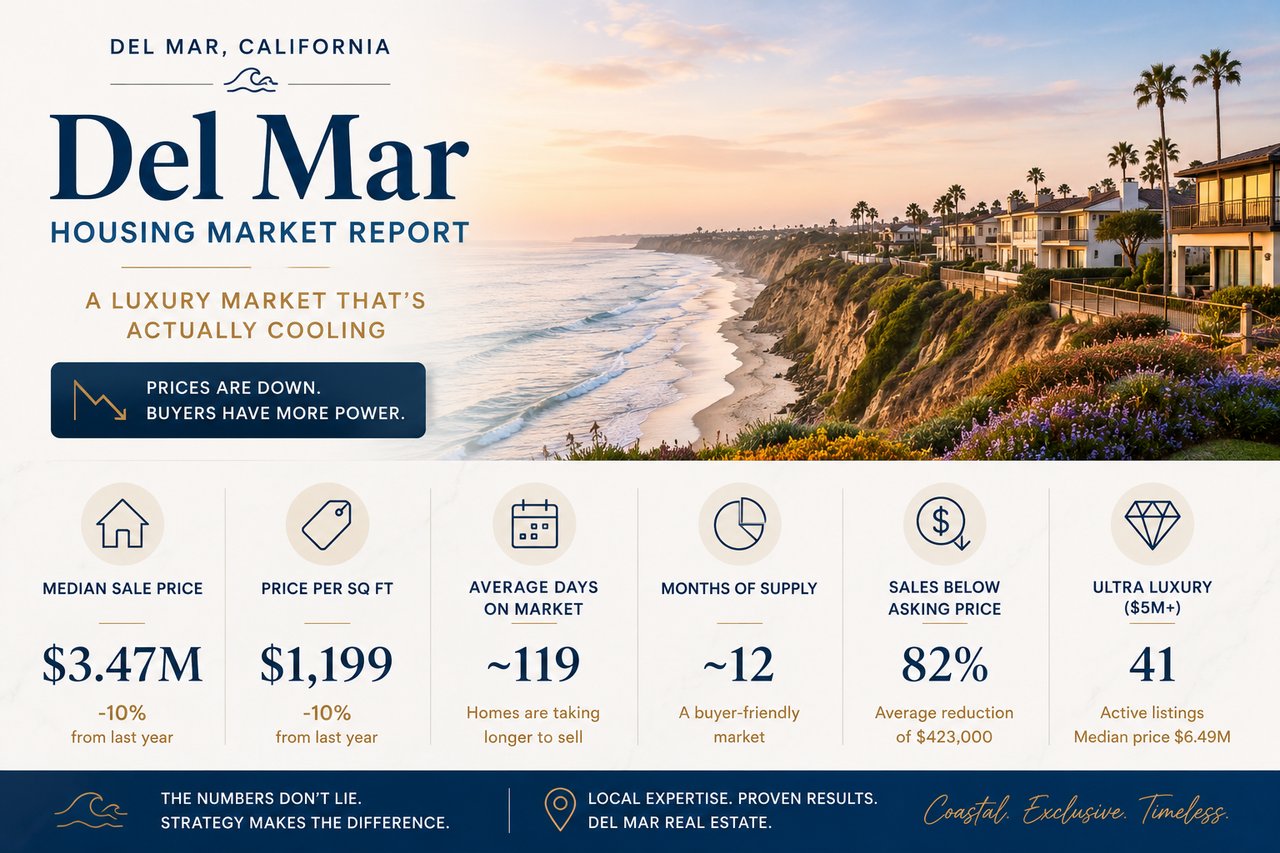
The median sale price in Del Mar is running around $3.47 million, down roughly 10 percent from a year ago. Price per square foot has followed the same direction, sitting near $1,199, also down about 10 percent year over year. That's a meaningful pullback for a market that spent the past several years moving almost entirely in one direction, and it's not a one month blip. The decline shows up consistently across pricing, days on market, and inventory data, which is what separates a real cooling trend from ordinary month to month noise.
Why the averages tell two different stories depending on the segment
Pull different sources on Del Mar right now and you'll see genuinely conflicting numbers, months of supply reported anywhere from under three months to over twelve, sale to list ratios bouncing between roughly 97 and 99 percent, and days on market cited as either around 47 days or as high as 119. That's not sloppy data collection, it's a symptom of how lopsided Del Mar's price distribution actually is. This is a market where a handful of ultra luxury listings well above $5 million sit alongside more modestly priced inland homes, and a blended average gets pulled hard toward whichever end happens to be more active that month.
The more internally consistent read, and the one that matches the price and price per square foot declines, points to a softening market overall: months of supply near 12, well above the four to six month line that typically marks a balanced market, and average days on market closer to 119. The faster, tighter figures some sources report likely reflect faster moving pockets within Del Mar, more affordably priced inland listings near Del Mar Heights, rather than the market as a whole. If you're pricing a listing or evaluating an offer, the segment your specific property sits in matters more than any single headline number floating around online.
How fast homes are actually moving
The days on market figure matters less on its own than what's happening underneath it. A striking 82 percent of Del Mar sales have closed below their original asking price, with an average reduction of roughly $423,000. That's not a rounding error on a luxury home, it's a signal that initial list prices in this market have been running ahead of what buyers are actually willing to pay, and that sellers are having to chase the market down rather than the other way around. Homes that list at a realistic number from day one are still moving in a reasonable window. Homes that list aspirationally, which has been common in Del Mar's luxury tier, are the ones dragging both the average days on market and the price cut statistics upward.
Inventory is thin in count, but heavy in time on market
There were about 80 active listings in Del Mar as of late August 2026, down close to 6 percent from a year earlier. That's a genuinely small number of homes for sale, which sounds like it should favor sellers. But a low listing count paired with a high months of supply figure tells you the issue isn't scarcity of buyers looking, it's how long each listing is sitting before it sells. Del Mar doesn't have an inventory shortage in the way Carmel Valley does. It has a pace problem, with homes accumulating on the market faster than they're closing.
What sellers are actually getting for their homes
Sale to list price ratios in Del Mar are running somewhere in the high 97 to nearly 99 percent range depending on the source, which on its face looks strong. But that ratio is measured against a list price that, in a large share of cases, already reflects one or more reductions from the original asking price. A home that cuts its price by $400,000 and then sells at 98 percent of that reduced number isn't landing close to its original ask, it's landing close to a number the market corrected it down to first. Sellers should read this ratio alongside the 82 percent price reduction statistic, not instead of it.
The ultra luxury tier is its own market within the market
At the very top, Del Mar currently has around 41 homes listed at a median price of $6.49 million, a distinct tier from the broader market described above. This segment tends to move on its own timeline entirely, driven by a small pool of buyers, unique oceanfront or view lots, and pricing that's less anchored to recent comparable sales simply because there are so few directly comparable sales to point to. If you're operating in this tier, whether buying or selling, generic market statistics are close to useless. Pricing here is closer to art than formula, and it benefits from an agent who's actually tracked recent ultra luxury closings rather than pulled a broad market report.
Schools are still part of the equation, even in a luxury market
Del Mar sits within the Del Mar Union School District for elementary and middle school, a smaller district with roughly 3,600 students spread across nine schools, feeding into San Dieguito Union High School District for high school. From there, students are zoned into either Torrey Pines High School or Canyon Crest Academy, the same two flagship high schools that anchor demand in Carmel Valley, both carrying a 10 out of 10 rating on GreatSchools. Even in a market where price softening is driven mostly by luxury pricing dynamics rather than school access, that overlap in school assignment is part of why Del Mar and Carmel Valley get cross-shopped so heavily by families in the first place. It's worth confirming the specific attendance boundary for any Del Mar property before assuming it lands in the school zone a buyer expects, since boundaries don't always follow the neighborhood lines people assume.
Del Mar Heights, the Village, and Beach Colony are not the same market
Del Mar isn't one neighborhood with one price curve, and buyers who treat it that way end up confused by wildly different listings under the same city name. Del Mar Heights sits inland and uphill, closer to I-5 and Highway 56, with a more suburban feel: larger lots, often a quarter acre or more, garages, pools, and the kind of layout families cross-shopping Carmel Valley are already used to. Olde Del Mar, the village core, is walkable, dense by comparison, and commands a premium simply for proximity to the beach, the racetrack, and the restaurant and shopping strip along Camino Del Mar. Beach Colony, oceanfront and compact, is almost entirely low rise condos, townhomes, and duplexes, a completely different property type and buyer profile than either of the other two. A single citywide median price obscures just how different these three pockets are from each other, which is exactly why the conflicting statistics mentioned earlier show up as often as they do.
How Del Mar compares to Carmel Valley right now
The two markets are close geographically and share school access through Torrey Pines High School, but they're moving in opposite directions at the moment. Carmel Valley has just over a month of supply and sellers landing 97.4 percent of list price with minimal negotiating room. Del Mar has roughly a year's worth of supply by some measures, a majority of sales closing well under original ask, and sellers who priced aggressively getting corrected by the market rather than rewarded for it. A buyer who assumes Del Mar carries the same seller's market intensity as Carmel Valley going in is likely to overpay or lose a negotiation they didn't need to lose. A seller pricing a Del Mar listing off Carmel Valley comparable sales is setting themselves up for exactly the kind of price cut showing up in the 82 percent statistic above.
What this means if you're selling in Del Mar right now
Price to the market you're actually in, not the market Del Mar was two years ago or the market a mile away in Carmel Valley right now. With 82 percent of recent sales closing below original ask and an average reduction north of $400,000, an aggressive opening price isn't buying you negotiating room, it's costing you time on market and inviting lowball offers once a listing starts to look stale. If you're in the ultra luxury tier specifically, work with someone who's tracked recent comparable closings in that narrow segment rather than leaning on broader Del Mar statistics that don't really apply to a $6 million-plus listing.
What this means if you're buying in Del Mar right now
This is a market where patience and a well-researched offer can actually work in your favor, a meaningful shift from the bidding-war conditions buyers have faced elsewhere in coastal San Diego. With months of supply running well above balanced market territory in the broader data, there's room to negotiate on a home that's already seen a price reduction or has been sitting for a while. Confirm which of Del Mar's distinct pockets, Del Mar Heights, the Village, or Beach Colony, actually fits what you're looking for before you start comparing prices, since a per square foot number from one doesn't translate to the others. And if school assignment matters to your decision, verify the specific boundary rather than assuming Del Mar automatically means Torrey Pines.
The bottom line
Del Mar is in the middle of a genuine luxury market correction, not a blip that a single strong month will reverse. Prices and price per square foot are both down roughly 10 percent year over year, the majority of sales are closing well under original asking price, and the conflicting statistics floating around online mostly trace back to how differently the Village, Del Mar Heights, and Beach Colony are each performing under one citywide label. That's a very different picture than Carmel Valley's tight, competitive conditions a few miles inland, and treating the two as interchangeable markets is a mistake for buyers and sellers alike. If you want a read on what a specific Del Mar property is actually worth in today's market, or how current conditions affect your timeline as a buyer or seller, reach out and we'll go through the real numbers together.