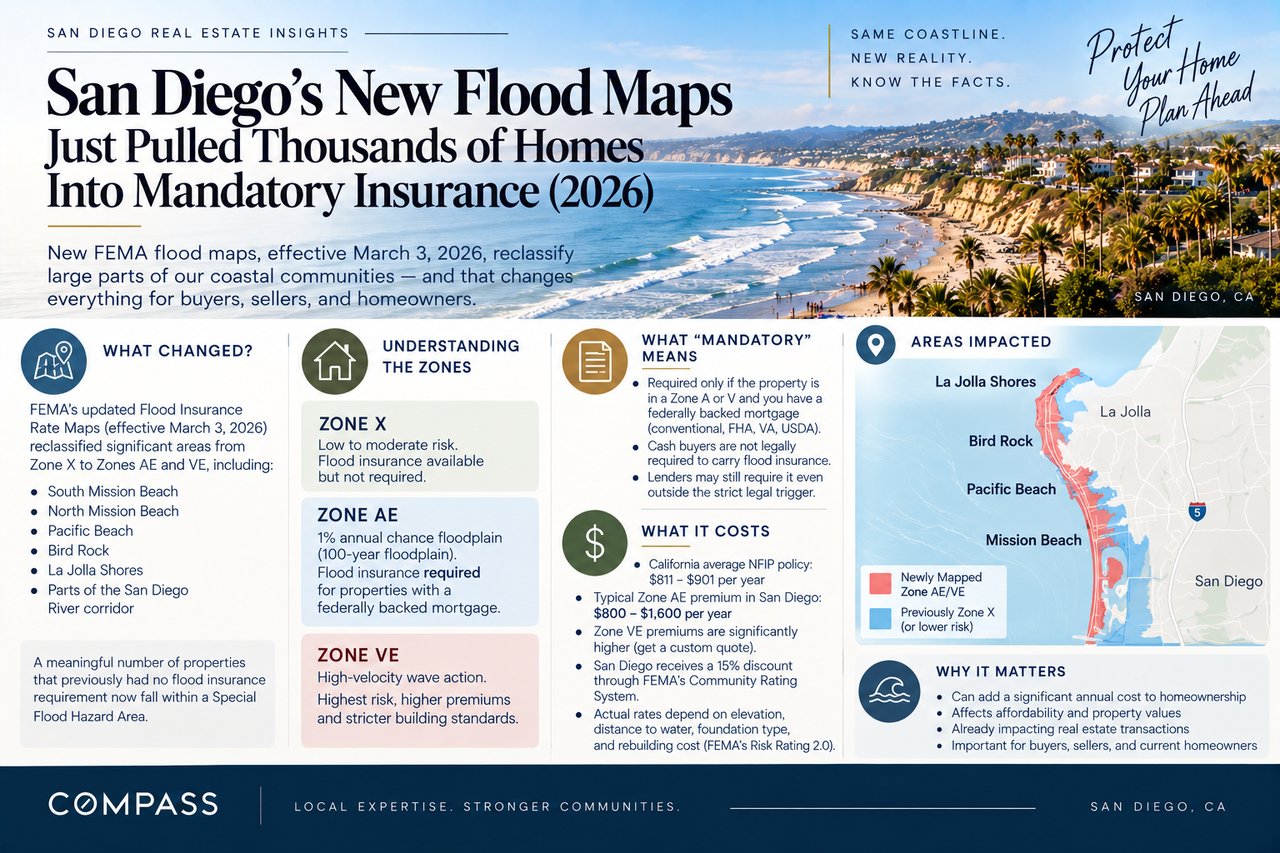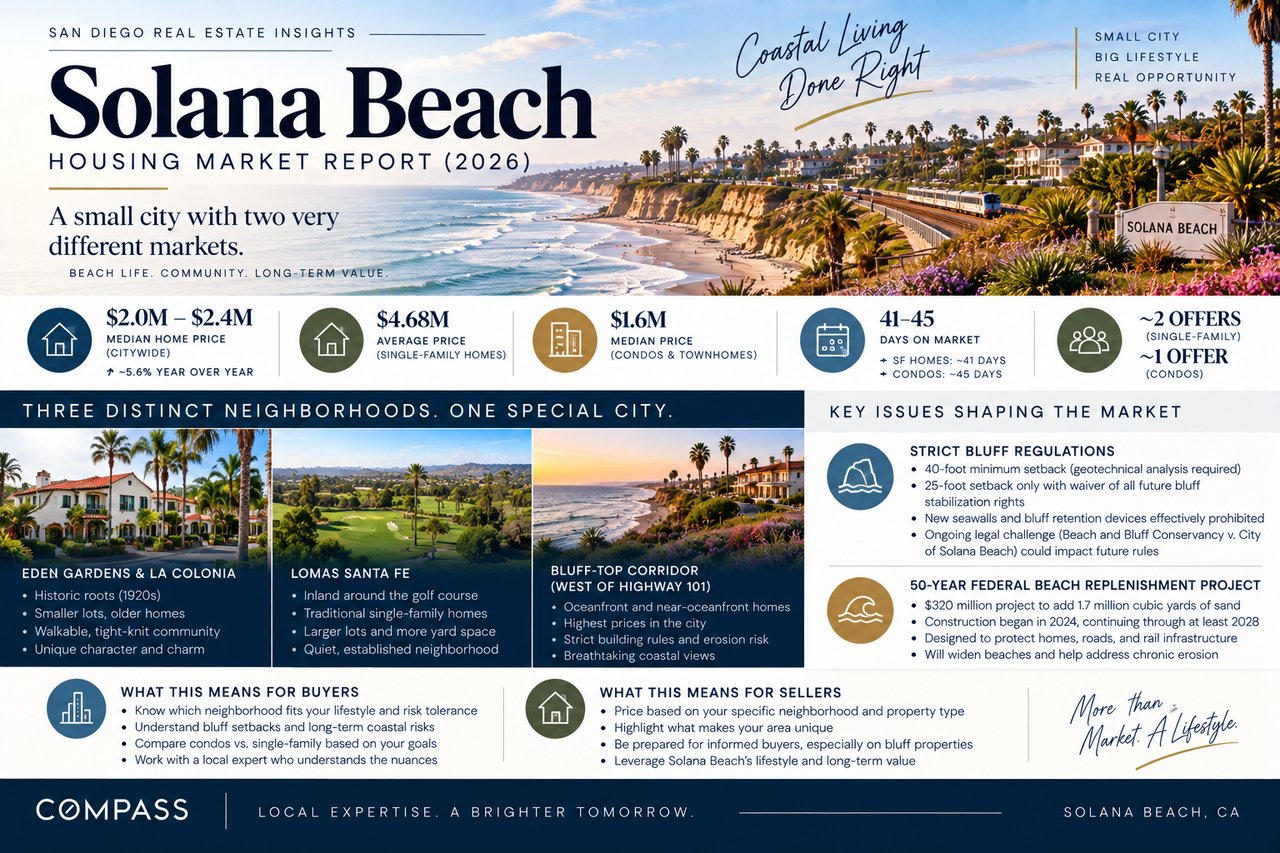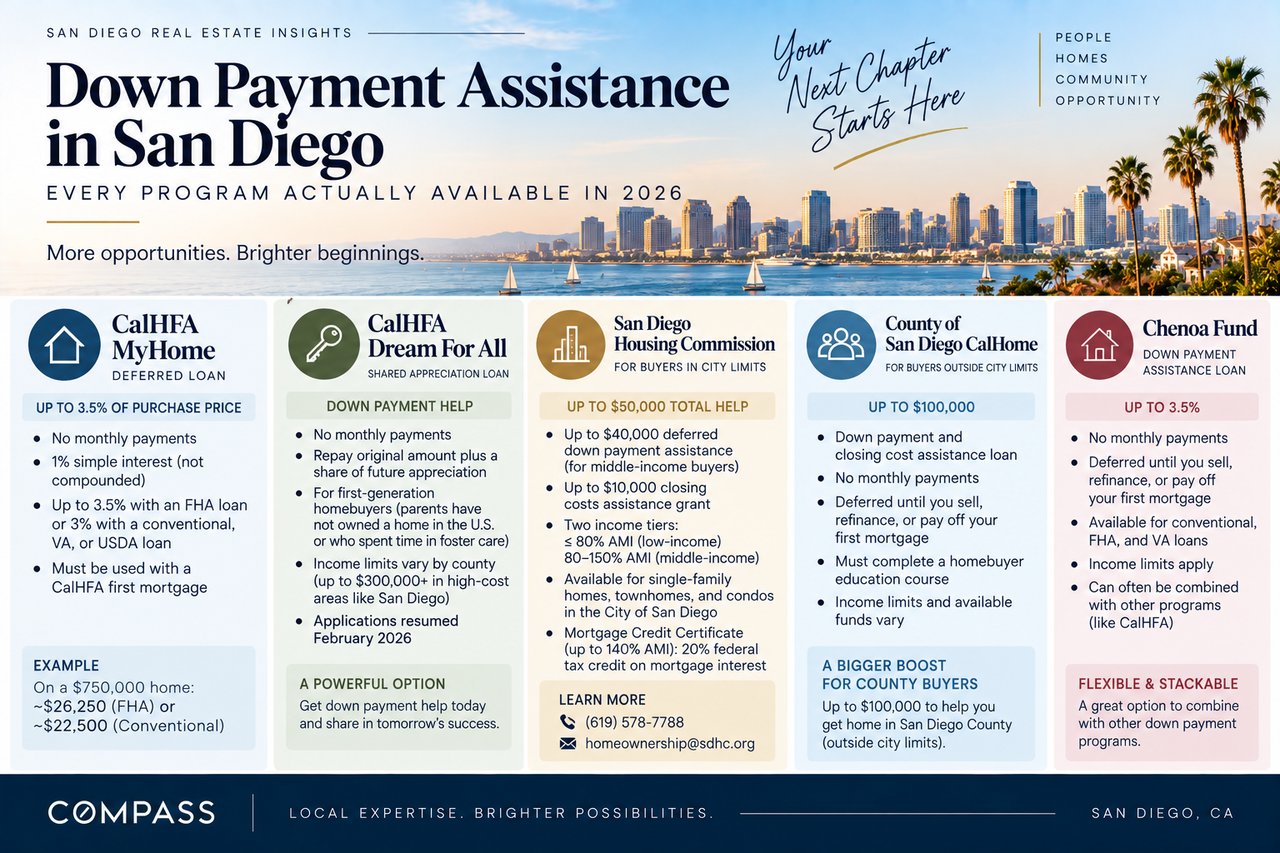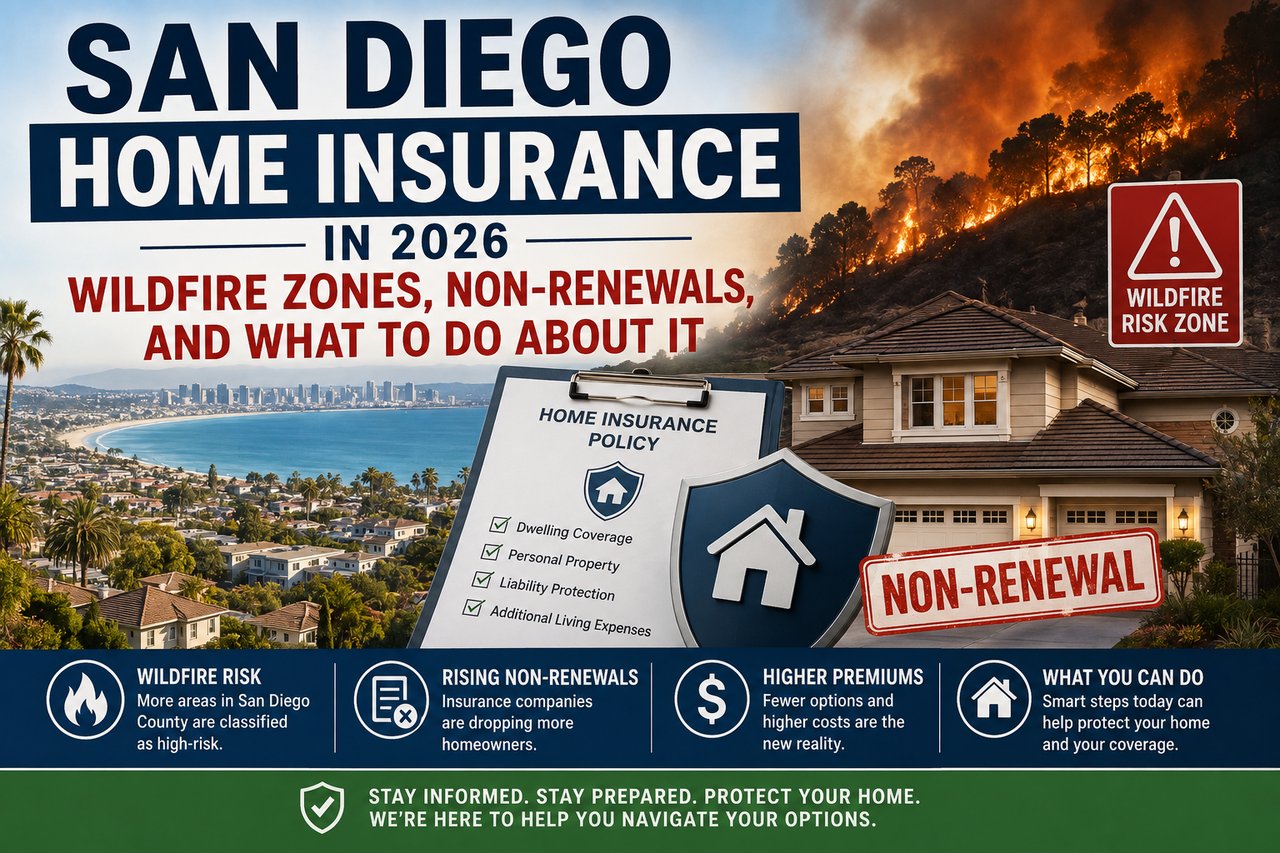
San Diego Home Insurance in 2026: Wildfire Zones, Non-Renewals, and What to Do About It
Getting or keeping home insurance has become its own hurdle in the San Diego real estate process, sometimes a bigger one than financing. Non-renewal letters are landing in mailboxes across the county, California's insurer of last resort is raising rates by nearly a third, and the rules determining who can get covered are changing mid-year. Here's where things actually stand and what homeowners and buyers can do about it.
Which San Diego neighborhoods are getting hit hardest
Carrier appetite in San Diego doesn't follow city limits. It follows brush maps, canyon topography, and CAL FIRE's hazard severity zones, which were updated countywide in the past two years and pulled more neighborhoods into the "high" and "very high" fire hazard designations, including areas that read as suburban rather than rural. Scripps Ranch, Poway, Rancho Bernardo, Ramona, Harbison Canyon, and Crest are seeing the most non-renewal letters, all areas with direct memory of major wildfire loss: the 2003 Cedar Fire and the 2007 Witch Creek and Guejito fires destroyed thousands of homes across these same communities.
Coastal and central San Diego, including most of Chula Vista, National City, and the urban core, still have a functioning standard insurance market. Their issue is price inflation rather than an inability to find coverage at all, though non-renewals have picked up here too, faster than in almost any other part of the state.
The FAIR Plan is growing fast, and it's about to get more expensive
The California FAIR Plan, the state's insurer of last resort for homeowners who can't find coverage on the standard market, is not a small backstop anymore. Policies in force reached 696,562 as of mid-2026, up 157 percent since September 2022, and total exposure hit $768 billion in June 2026, an 11 percent jump since September 2025 and a 250 percent increase since September 2022. Enrollment grew 43 percent between September 2024 and December 2025 alone, pushed higher by back to back wildfire seasons, bringing the plan to 668,609 policies by the end of 2025.
There are early signs the growth is slowing. The FAIR Plan added roughly 16,000 residential policies in the first quarter of 2026, well down from the 35,000 to 50,000 added in a typical quarter over the prior two years. That's a modest silver lining, but it comes alongside a steep rate hike: the FAIR Plan is raising rates 29.1 percent starting October 15, 2026, the largest increase in the plan's recent history, well above the roughly 20 percent hike in 2019 and the 16 percent increases in 2021 and 2023.
Why California changed the rules on insurers
Much of this is downstream of a genuine regulatory shift. Insurance Commissioner Ricardo Lara's Sustainable Insurance Strategy, the broadest overhaul of California insurance regulation since Proposition 103 passed in 1988, now allows insurers to use forward-looking catastrophe models, built with predictive algorithms and updated wildfire science, to price risk instead of relying purely on historical losses. The state has approved three catastrophe models for this purpose, from Verisk, Karen Clark and Company, and Moody's.
In exchange for that flexibility, insurers using the new models have to commit to writing 85 percent of their statewide market share in wildfire distressed zip codes, and they're required to factor in wildfire mitigation efforts, both community level and individual, when setting rates. That last part matters directly to homeowners, since it ties specific home hardening steps to specific pricing credit. As of mid-2026, Mercury, CSAA, and Travelers have filed or announced rates under the new framework, and Allstate has signaled it intends to file without yet confirming an approved rate.
Zone Zero and what home hardening actually buys you
San Diego is also rolling out mandatory Zone Zero rules, requiring a five-foot ember-resistant buffer around many homes where most combustible materials are prohibited. Beyond the safety case, hardening a home has become a direct lever on insurance cost. State regulation requires insurers to offer wildfire mitigation discounts, with the realistic range running under 1 to 20 percent per credited item and total discounts spanning roughly 4 to 40 percent depending on how much of the home qualifies.
The clearest path to a meaningful discount is certification through the IBHS Wildfire Prepared Home program, which has two tiers. The baseline Home designation covers roof, vents, and a Zone 0 perimeter; Home Plus adds non-combustible siding, tempered windows, and an extended 30-foot defensible space. Some carriers credit up to 50 percent of the wildfire portion of a premium for certified homes. Individual carrier credits vary: USAA offers 10 to 20 percent for baseline Wildfire Prepared qualification, Farmers offers 5 to 15 percent bundled with other hardening discounts, and Mercury offers 10 percent for a documented IBHS designation, with Mercury specifically authorized to offer larger wildfire mitigation discounts on new and renewal business starting July 1, 2026. IBHS also expanded the program's eligibility criteria this year, making close to 2 million more homes nationwide qualify for a designation in the first place.
If you've already been non-renewed
Homeowners who lose standard coverage have more options than they did even two years ago, though none of them are free. The FAIR Plan remains the fallback for fire coverage specifically, but it's fire only, meaning most homeowners layer a separate policy on top for everything else, called a difference in conditions policy.
The excess and surplus lines market, often called E&S or non-admitted insurance, has grown into a genuine alternative rather than a last-ditch option. Surplus lines homeowners policies in California surpassed 300,000 in 2025, up from roughly 50,000 in 2023, and new surplus lines business hit 320,000 policies in 2025. Notably, the average assessed value of homes entering this market dropped to about $800,000 in 2025 from $900,000 the year before, a sign that fairly typical homes, not just high-value or unusually remote properties, are now landing in the surplus lines market because the admitted market won't write them.
The most useful habit for anyone in this position is to re-shop the admitted market at every renewal rather than assuming a non-renewal is permanent. Carrier appetite shifts as new catastrophe models get approved and new capacity enters the market, and documented mitigation work, especially an IBHS designation, can re-qualify a home that was previously declined.
What this means if you're buying or selling
Insurability is now a due diligence item, not an afterthought. If you're buying in or near a fire hazard zone, get an insurance quote before you're deep into escrow, not after, since a home that can't be insured through a standard carrier can also affect your loan terms and your resale pool later. If you're selling in one of these areas, a documented IBHS designation, recent defensible space work, or evidence of Zone Zero compliance is worth highlighting the same way you'd highlight a new roof, since it directly affects what a buyer's insurance is going to cost.
This is the same due diligence logic that applies to condo purchases, where HOA insurance, not just your own policy, can affect a building's financing and your monthly dues. If you're evaluating a condo specifically, it's worth reading through what to check in an HOA's financial and insurance history before making an offer.
If you want help sorting out whether a specific property or neighborhood is likely to face insurance friction before you buy or list, reach out and we'll walk through what to check before you're under contract.