San Diego's Short-Term Rental Rules in 2026: Licenses, Caps, and What You Can Actually Buy
Buying a San Diego property with the plan to run it as an Airbnb used to be a simple math problem: purchase price, projected nightly rate, occupancy assumptions. It isn't anymore. The city's Short-Term Residential Occupancy ordinance now gates almost every part of that plan behind a license system with hard caps, and one of the four license tiers is already full with a waitlist that isn't moving. Here's how the tiers actually work, what a license costs, and where buyers planning on rental income keep getting tripped up.
The four tiers, and what each one actually allows
Every short-term rental of less than 30 days in the city now requires a Short-Term Residential Occupancy license, and which tier you need depends entirely on how you're using the property, not just how often you want to rent it.
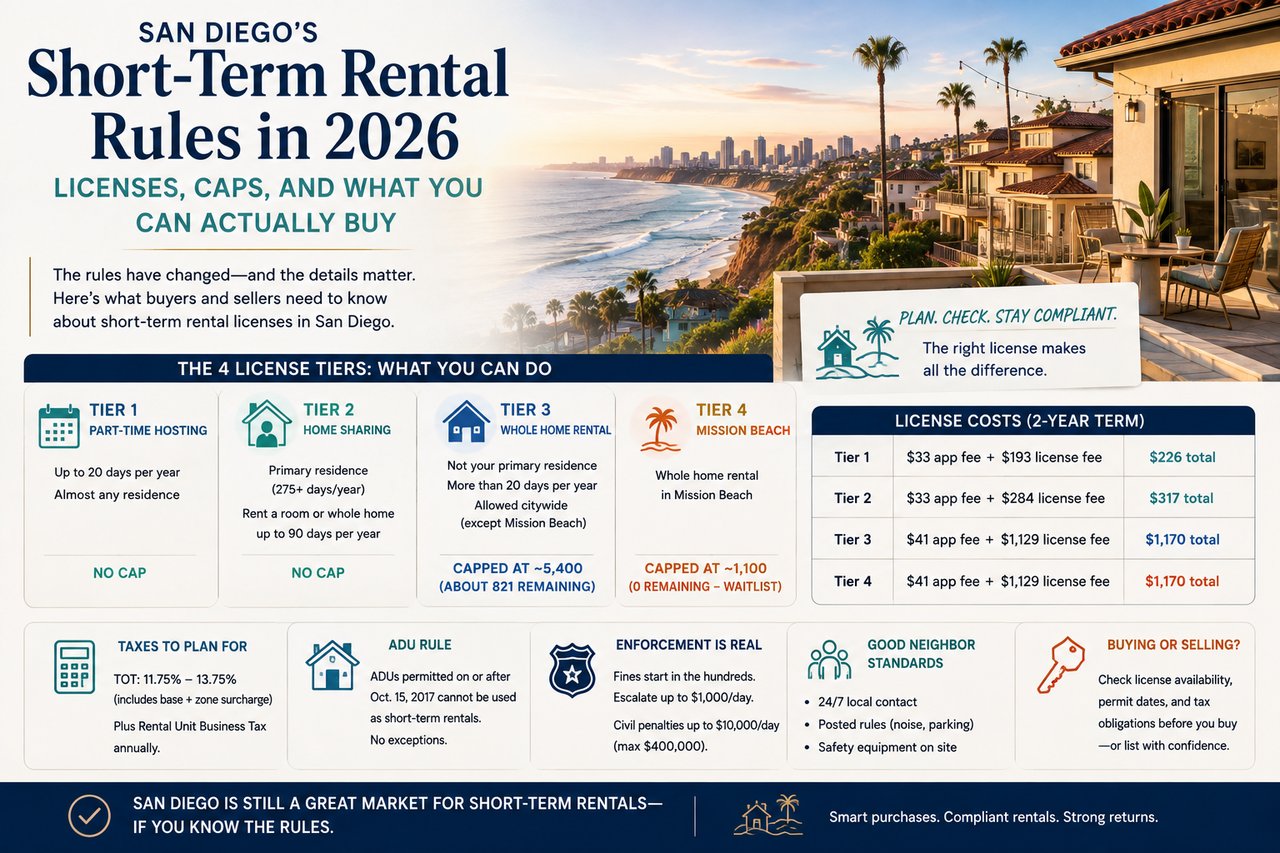
Tier 1 covers part-time hosting, up to 20 days a year, and applies to almost any residence. Tier 2 is home sharing, meaning you live in the property as your primary residence, defined as occupying it at least 275 days a year, and either rent out a room while you're there or rent the whole place for up to 90 days a year. Tier 2 has no cap, which makes it the most accessible option, but it only works if you're actually living there most of the year, not treating it as a part-time residence with a side income stream. Tier 3 is the one most investors are actually after: a whole home rental, operated more than 20 days a year, that is not your primary residence, available everywhere in the city except Mission Beach. Tier 4 is the equivalent for Mission Beach specifically, which the city carved out as its own category given how concentrated short-term rentals already were in that neighborhood before the ordinance existed.
The distinction between Tier 2 and Tier 3 is the one that catches people off guard. If you're picturing a straightforward investment property you'll rent out full time without living there, you need Tier 3, and Tier 3 is capped.
Why Tier 3 is the tier to actually worry about
Tier 3 licenses are capped citywide at 1 percent of San Diego's housing stock, which works out to roughly 5,400 licenses total. That number sounds like a lot until you see how quickly it's been consumed. As of mid-2026, the city had already issued around 4,840 Tier 3 licenses, leaving only about 821 remaining citywide. Tier 4 is further along: 1,098 licenses issued in Mission Beach against its cap, with zero remaining and an active waitlist for anyone who wants one next.
What that means in practice is that a property's eligibility for Tier 3 licensing is no longer something you can assume, it's something you have to check before you write an offer, the same way you'd check a condo's HOA reserves or a parcel's Mello-Roos status. A home that would make a great whole-home rental on paper is worth nothing as an investment if the city has no Tier 3 licenses left to issue by the time you close.
What a license actually costs
Licensing runs on a two-year term with an application fee plus a license fee, and the cost scales sharply with tier. Tier 1 costs $33 to apply plus a $193 license fee, for $226 total over two years. Tier 2 runs $33 plus $284, or $317 total. Tier 3 and Tier 4 both cost more to reflect the commercial nature of the use: $41 to apply plus $1,129 for the license, landing at $1,170 for the two-year term. That's before any of the ongoing tax obligations that come with actually operating the rental.
The tax bill beyond the license fee
A license is just the entry ticket. Every short-term rental operator also owes San Diego's Transient Occupancy Tax, and that tax got more complicated in 2025. The city's base TOT is 10.5 percent, but Measure C, effective May 1, 2025, layered a zone-based surcharge on top depending on how close the property sits to the Convention Center, replacing the old flat citywide add-on. Depending on zone, the effective combined rate now runs roughly 11.75 percent to 13.75 percent. Properties in Mission Beach, Pacific Beach, and La Jolla tend to land at the higher end of that range. On top of TOT, operators also owe the city's Rental Unit Business Tax annually, a separate obligation from the STRO license itself. None of this is optional or something a management company quietly absorbs, it directly reduces the net yield on a property you're underwriting as a rental.
The ADU short-term rental trap
This is the detail that's caught the most people off guard, especially anyone who read general ADU content and assumed a backyard unit is automatically fair game for Airbnb. It isn't. ADUs permitted before October 15, 2017 can be licensed for short-term rental under the standard tier system. ADUs permitted on or after that date cannot be used as short-term rentals at all, full stop, regardless of which tier you'd otherwise qualify for. The city isn't treating this as a minor technicality either. A 2025 enforcement sweep pulled more than 200 listings advertising ADUs as short-term rentals and issued 64 separate civil penalties at $1,000 a day each. If you're buying a property specifically because the listing mentions an ADU that could generate rental income, get the ADU's permit date in writing before you count that income in your pro forma.
Enforcement actually has teeth now
The city backed this ordinance with real enforcement capacity, not just a rule on paper. San Diego has hired roughly 16 enforcement officers dedicated to short-term rental compliance. First-time violations typically draw fines in the low hundreds of dollars, but continued violations escalate fast, up to $1,000 a day. Building and Land Use Enforcement can assess civil penalties up to $10,000 a day with a total cap of $400,000, and the City Attorney's office can separately pursue court penalties of up to $2,500 a day per violation. Operating unlicensed, or operating outside what your license tier actually permits, isn't a quiet risk anymore. It's an actively enforced one with escalating financial consequences that can add up faster than most people expect.
Good Neighbor standards apply on top of the license
Getting a license doesn't mean the operating rules stop there. Every STRO license comes with a set of Good Neighbor standards that hosts have to maintain regardless of tier: a local contact available 24 hours a day who can respond to complaints in person, posted rules on noise and parking, and required safety equipment like smoke detectors and fire extinguishers on site. These aren't box-checking exercises either, since noise and nuisance complaints are one of the most common ways an unlicensed or non-compliant rental first comes to the city's attention in the first place. If you're buying a property to operate as a rental, budget for a real local contact or management company that can actually show up, not just a phone number that goes to voicemail.
What this means if you're buying for rental income
Treat license availability as a hard constraint on your search, not a formality to sort out after closing. Before you get attached to a property you're planning to run as a whole-home rental, confirm current Tier 3 availability, since the remaining pool shrinks continuously and isn't guaranteed to be there by the time you're ready to apply. If the appeal of a specific property includes an ADU you're hoping to rent out separately, verify its permit date against the October 15, 2017 cutoff before that unit factors into your income projections at all. And build your TOT and Rental Unit Business Tax obligations into your actual net yield calculation from the start, not as an afterthought once you're already operating.
What this means if you're selling a property currently operating as a short-term rental
Buyers evaluating your listing as a rental play will ask about license status, and increasingly they know to ask. Have your STRO license tier, its expiration date, and your TOT compliance history ready to share rather than making a buyer chase it down. If your property is operating under a tier that doesn't match how a buyer intends to use it, for instance you're licensed under Tier 2 as an owner occupant but a buyer wants to run it as a pure investment, be upfront that they'll need to apply for a Tier 3 license themselves, and that availability is not guaranteed. Overstating rental income potential without disclosing licensing constraints is the kind of thing that surfaces during due diligence and can sink a deal that was otherwise clean.
The bottom line
San Diego's short-term rental market isn't the open field it was a few years ago. Whole-home rentals require a capped license that's already mostly gone, Mission Beach is completely full with a waitlist, taxes run well into the double digits once TOT and business tax are combined, and ADUs built in the last several years are off limits for short-term use entirely, with real enforcement behind that rule. None of this means short-term rental investing in San Diego is dead, plenty of licensed operators are doing well under the current system. It means the numbers only work if you check licensing status and permit dates before you buy, not after. If you're evaluating a property for rental income potential, or trying to understand what license status a listing actually carries, reach out and we'll go through the details before you write an offer.