Stacking California and San Diego Down Payment Assistance: What First-Time Buyers Can Actually Combine in 2026
Most people searching for down payment help assume there's one program out there that solves the problem, and they usually land on whichever one shows up first in a search or gets mentioned by a lender. The reality in San Diego is more useful than that: there's a state layer through CalHFA and a local layer through the San Diego Housing Commission and the county, and depending on your income, several of these can be combined on the same purchase. Here's what's actually available right now, what changed this year, and how the layers actually stack.
Who counts as a first-time buyer, and what you have to do first
Every program in this stack requires you to be a first-time homebuyer, which California defines as not having owned a home in the past three years, not literally never having owned one. You'll also need to complete a homebuyer education course through an approved provider, eHome's eight-hour online course is the one CalHFA accepts, before any assistance funds. Credit requirements vary by program and first mortgage type, but CalHFA's government loan programs generally set a 640 minimum credit score, with some conventional pairings requiring 660 to 680. None of this is unusual by itself. What matters is getting the education certificate and credit picture sorted early, since it's a prerequisite for layering anything else on top.
The base layer: CalHFA MyHome
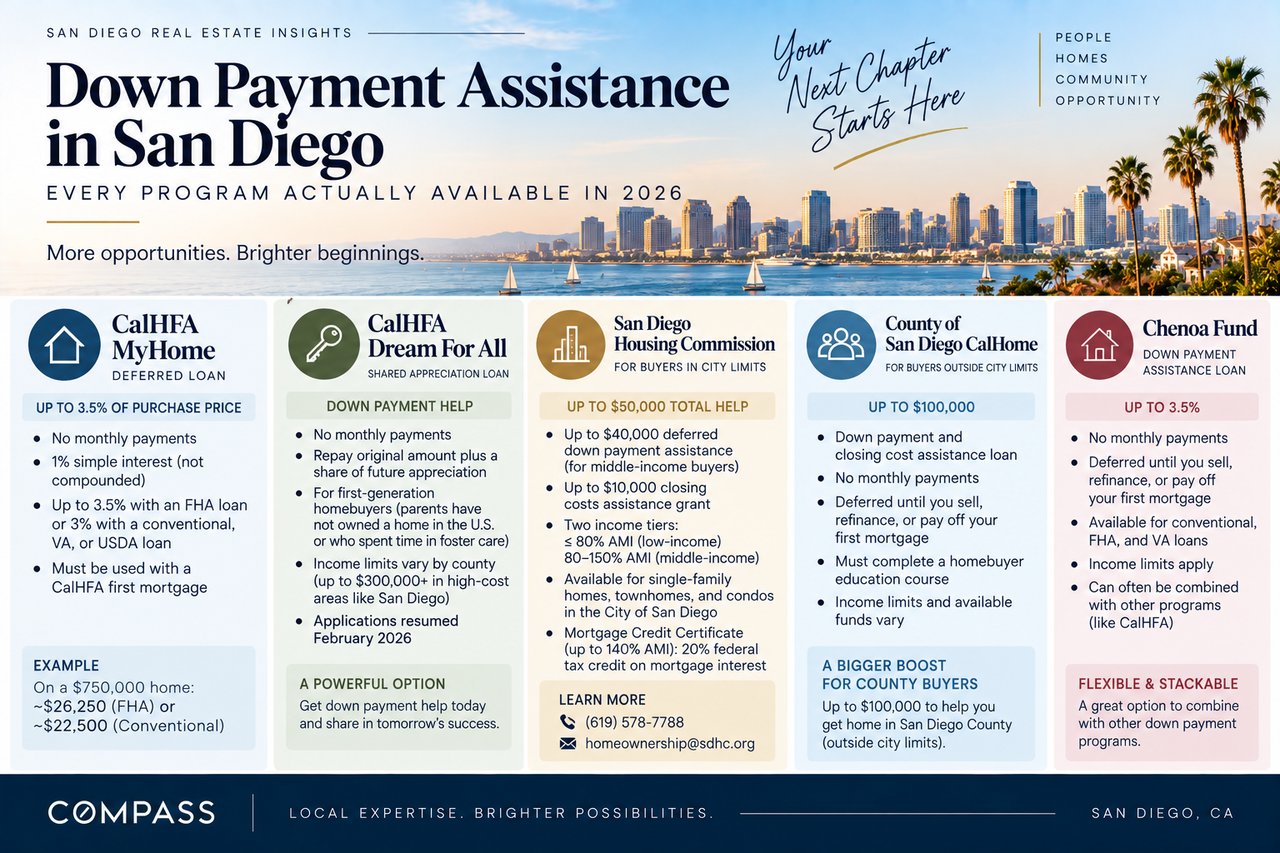
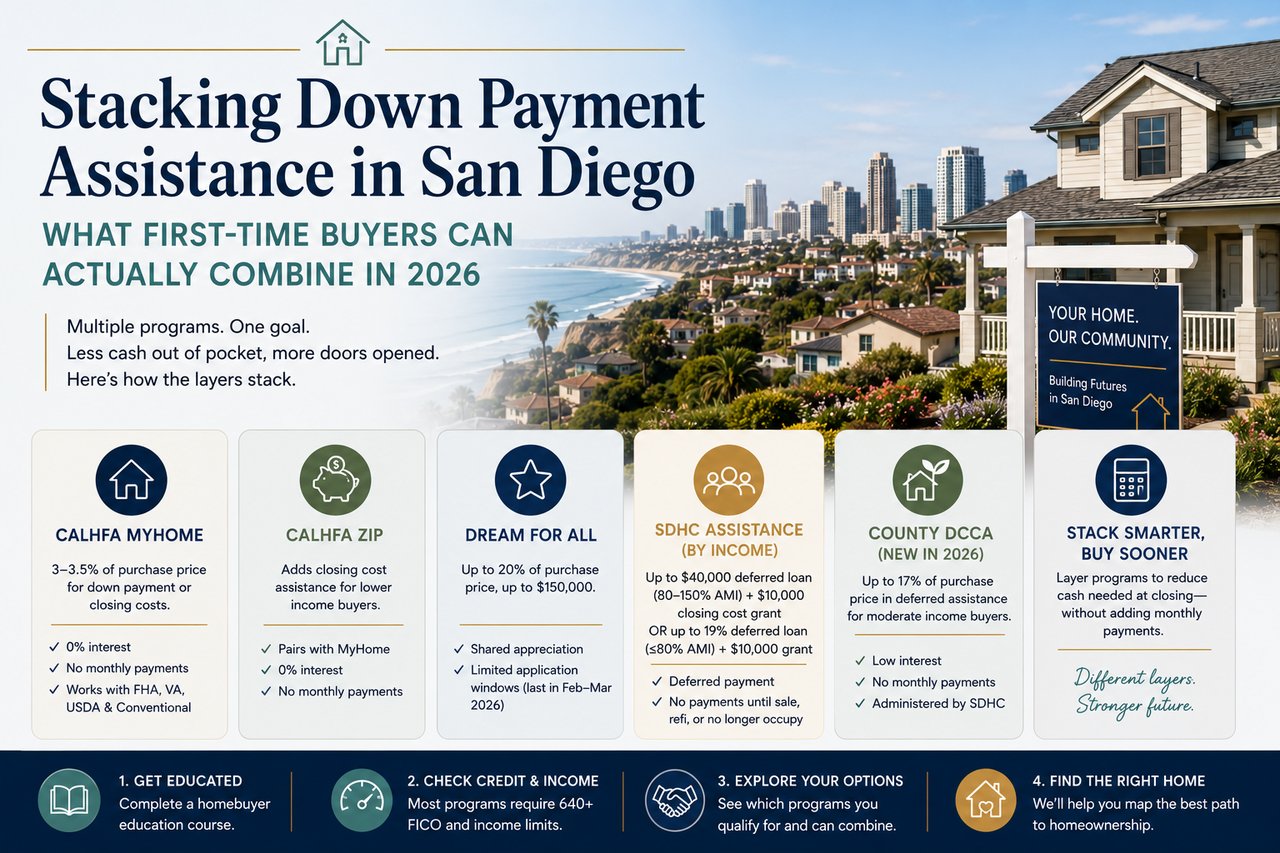
MyHome is the workhorse of California's down payment assistance and, unlike some of the programs below, it's open year round rather than running on a limited application window. It provides 3 to 3.5 percent of the purchase price toward your down payment or closing costs, structured as a silent second mortgage with zero interest and no monthly payment. You don't pay any of it back until you sell, refinance, pay off the first mortgage, or stop occupying the home as your primary residence. MyHome works alongside FHA, VA, conventional, and USDA first mortgages, which means it's one of the few assistance programs that pairs directly with VA financing if you're a military buyer trying to reduce out of pocket cash even further on top of a zero down loan.
Stacking CalHFA ZIP on top of MyHome
CalHFA also offers ZIP, its Zero Interest Program, which layers on top of MyHome rather than replacing it, and is generally aimed at lower income buyers who need help covering closing costs specifically rather than the down payment itself. Used together, CalHFA's own published example shows MyHome and ZIP combining for roughly $49,000 in total deferred assistance on a $700,000 purchase, with no monthly payment on either piece. That's the clearest illustration of what stacking actually looks like in dollar terms: two silent seconds working together, both deferred, both interest free, reducing what you need in liquid cash at closing without adding a second monthly payment to your budget.
Dream For All: bigger money, but it comes and goes
Dream For All is the most talked about California down payment program, and also the one people most often assume is available when it isn't. It offers a much larger benefit than MyHome, up to 20 percent of the purchase price or appraised value, capped at $150,000, but the tradeoff is a shared appreciation structure rather than a flat repayment. When you sell or refinance, you repay the original assistance amount plus a matching percentage of whatever the home appreciated in value, rather than just the dollar amount you borrowed. The program also doesn't stay open continuously. Its most recent 2026 application window ran February 24 through March 16, and as of now it's closed with no announced reopening date. If a lender or website describes Dream For All as something you can apply for today, confirm that directly with CalHFA before you build a purchase timeline around it, since the window nature of this program is exactly what trips people up.
The local layer: San Diego Housing Commission
This is where San Diego buyers get an advantage that doesn't show up in generic California down payment content, because SDHC runs its own assistance on top of whatever CalHFA offers, and it's structured in income tiers. Buyers earning between 80 and 150 percent of San Diego's area median income may qualify for a $40,000 deferred down payment assistance loan plus a separate $10,000 closing cost assistance grant. Buyers at or below 80 percent of area median income can access a larger benefit: a deferred payment second trust deed loan of up to 19 percent of the purchase price at a 3 percent interest rate, again paired with a $10,000 closing cost grant. Both come with the same kind of deferred structure as MyHome, no payments due until you sell, refinance, pay off the first loan, or stop occupying the property.
San Diego's area median income for 2026 sits at $130,900, though the exact qualifying dollar figure for the 80 and 150 percent tiers shifts by household size, so the number that matters is the one on SDHC's current published chart for your specific household, not a single figure that applies to everyone. It's worth pulling that chart directly rather than estimating, since the difference between qualifying at 80 percent versus 150 percent of AMI changes which tier of assistance, and which interest terms, you're actually eligible for.
The newest layer: the county's 2026 program
New for 2026, San Diego County added its own Down Payment and Closing Cost Assistance program for moderate income buyers, funded through the county's Housing and Community Services department and administered by SDHC. It offers a low interest, deferred payment loan of up to 17 percent of the purchase price, with the same no-payments-until-you-sell-or-refinance structure running through the rest of this stack. This is a genuinely new option, not a rebrand of an existing program, and it's worth asking about specifically since it's recent enough that not every lender or agent is bringing it up by default yet.
How the stacking actually works
In practice, most buyers aren't combining every program on this list at once, the combination that makes sense depends on income tier and which programs are open at the time you're buying. A moderate income buyer might pair CalHFA MyHome with the county's new DCCA program. A lower income buyer might qualify for SDHC's larger second trust deed loan alongside MyHome and skip the county program entirely. When Dream For All's window is open, some buyers have layered it with local assistance as well, though the exact combinability rules shift year to year, which is exactly why this is a conversation to have with a lender who actively originates CalHFA loans, not something to assume based on last year's version of a program.
What stays consistent across almost every combination is the basic shape of the deal: your first mortgage covers the bulk of the purchase, one or two silent second loans cover most or all of the remaining down payment and closing costs, and none of those seconds come with a monthly payment. The tradeoff is that they're deferred, not forgiven, so you're borrowing against future proceeds when you eventually sell or refinance, and in Dream For All's case, you're sharing some of your appreciation with the state as part of that repayment.
A rough example of how this plays out
Picture a household earning around 100 percent of San Diego's area median income buying a $650,000 condo with an FHA first mortgage. They'd likely qualify for CalHFA MyHome at 3.5 percent of the purchase price, roughly $22,750, as a zero interest silent second. Because their income falls between 80 and 150 percent of AMI, they could also apply for SDHC's $40,000 deferred assistance loan plus its $10,000 closing cost grant. Combined, that's close to $72,750 in layered assistance against a $650,000 purchase, none of it requiring a monthly payment, with the first mortgage covering the rest. That's not a guarantee, since actual approval depends on the lender, the specific building if it's a condo, and current program funding, but it illustrates why it's worth running the numbers on more than one program rather than assuming MyHome alone, or SDHC alone, is the ceiling.
What this means if you're house hunting in San Diego right now
Start with the homebuyer education course and a credit check before you're deep into house hunting, since both are prerequisites for every program above and neither takes long to complete. Then get a real household income figure and check it against SDHC's current AMI chart, since that number, not your general sense of whether you're "low income" or not, determines which tier of local assistance you can access. From there, talk to a lender who specifically works with CalHFA and SDHC programs, since the stacking rules and current program availability, especially for Dream For All, change often enough that generic online guides go stale within months.
The bottom line
The down payment gap that keeps a lot of San Diego buyers renting longer than they'd like isn't necessarily a $150,000 problem requiring one big program. For a lot of buyers it's a $700,000 purchase that needs $49,000 in combined MyHome and ZIP assistance, or a moderate income household layering CalHFA with the county's new program, structured so that none of it requires a monthly payment today. The programs exist, they can be combined more often than people assume, and the local SDHC and county layers are exactly the kind of detail that gets missed when you're only reading state level content. If you want help figuring out which combination actually applies to your income and the property you're considering, reach out and we'll map it out together before you start touring homes.