VA Loans in San Diego: What Military Buyers Actually Get, and Why Sellers Shouldn't Fear Them (2026)
San Diego County is home to Naval Base San Diego, Naval Air Station North Island in Coronado, MCAS Miramar, and Camp Pendleton just up the coast, which makes it one of the largest concentrations of VA eligible buyers anywhere in the country. And yet VA loans are still one of the most misunderstood pieces of financing in local real estate, both by the buyers who qualify for one and by the sellers who sometimes pass on a VA offer without really knowing why. Here's what a VA loan actually gets you in 2026, what it costs, and why turning down a VA buyer is usually a mistake, not a smart move.
Who actually qualifies
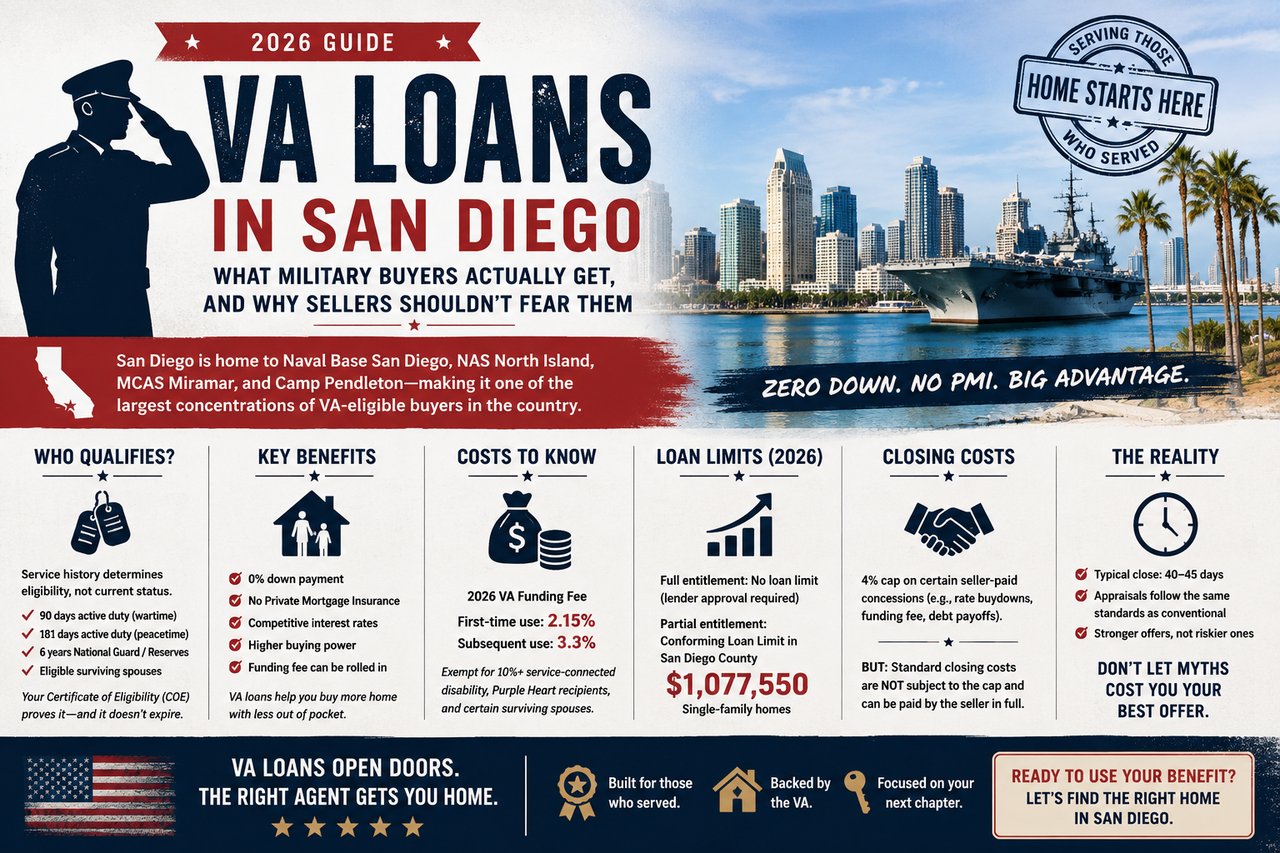
Eligibility comes down to service history, not current military status. You typically qualify with 90 consecutive days of active duty during wartime, 181 days of active duty during peacetime, or six years of service in the National Guard or Reserves. Eligible surviving spouses can qualify as well. The document that proves it is the Certificate of Eligibility, or COE, which a lender pulls directly and which doesn't expire once issued. Beyond service history, you still need to clear a lender's credit and income requirements the same as any other loan, VA eligibility gets you into the program, it doesn't replace underwriting.
What the loan actually gives you
The core benefit hasn't changed in decades and it's still the best deal in residential lending: zero down payment, no private mortgage insurance regardless of how little you put down, and rates that are typically competitive with or better than conventional financing. On a $900,000 San Diego purchase, skipping a 20 percent down payment and monthly PMI is not a small thing, it's tens of thousands of dollars at closing and a materially lower payment every month compared to a conventional buyer putting less down.
In place of PMI, VA loans carry a one time funding fee. For 2026, that fee is 2.15 percent of the loan amount on a first time zero down VA loan and 3.3 percent on subsequent use. It can be rolled into the loan rather than paid in cash, and it's waived entirely for veterans with a service connected disability rating of 10 percent or higher, Purple Heart recipients, and certain surviving spouses. That exemption alone is worth checking before assuming the fee applies to you.
On loan size, most VA borrowers with full entitlement have no cap at all and can borrow above the conforming limit with zero down if the lender approves it. Where partial entitlement comes into play, meaning you still have an existing VA loan or have used some of your benefit before, the conforming loan limit used for those calculations in San Diego County is $1,077,550 for a single family home in 2026. Given how much of the county sits above the old loan limit thresholds, that matters more here than in most parts of the country. Your entitlement amount, and how much of it is still available, shows up directly on your COE, so it's worth pulling that document early rather than assuming you have full entitlement left if you've financed a home with a VA loan before.
What it costs to carry versus what it costs to close
The absence of PMI is easy to undersell. On a conventional loan with less than 20 percent down, PMI commonly runs somewhere between 0.5 and 1.5 percent of the loan amount annually, which on a $900,000 San Diego purchase can mean several hundred dollars a month added to the payment until enough equity builds up to remove it. A VA borrower skips that entirely from day one, which is part of why VA borrowers often qualify for more home, or carry a meaningfully lower payment on the same home, than a conventional buyer making the same income. The funding fee is the tradeoff, but because it's a one time cost that can be financed into the loan rather than a recurring monthly charge, the math tends to favor VA financing over the life of the loan even before accounting for the rate itself.
Closing costs work differently, and it's not what people assume
This is the part that trips up both buyers and listing agents. The VA caps seller paid concessions at 4 percent of the home's value, and a lot of people stop reading right there and assume that's the total a seller can contribute toward closing. It isn't. The 4 percent cap only applies to a specific bucket of extras, things like a seller paid funding fee, temporary rate buydowns, prepaid items, or paying off a buyer's debt to help with qualifying. Normal closing costs, meaning the fees actually tied to originating and closing the loan, aren't subject to that cap at all and can be covered by the seller in full if that's what's negotiated. In practice, a seller can often pay all standard closing costs and still offer additional concessions within that 4 percent bucket on top. Structuring an offer around this correctly is where a lender who actually does VA loans regularly matters more than the rate they're quoting.
The myth that keeps costing sellers their best offer
Plenty of sellers and their agents still treat a VA offer as a red flag, expecting a slower close, a pickier appraisal, or a deal that's more likely to fall apart. That reputation is mostly outdated. VA loan closings now typically run 40 to 45 days, in line with conventional financing, not the extended timelines people remember from years ago. The idea that VA appraisals demand extensive repairs has also loosened further this year. Effective for appraisals ordered on or after May 1, 2026, the VA removed several items from its Minimum Property Requirements, including dropping peeling exterior paint as an automatic repair trigger unless it signals an actual structural issue like water intrusion, and eliminating the oxygen depletion sensor certification requirement for ventless fireplaces. The VA's actual standard has always been narrower than its reputation: the property has to be safe, structurally sound, and sanitary, not immaculate.
The buyers themselves also tend to be underrated. VA borrowers go through the same income and credit underwriting as anyone else, and military households often bring stable federal income and a demonstrated track record of on time payments. A seller passing on a VA offer in favor of a conventional buyer with a similar price and terms is frequently trading away a strong buyer based on outdated assumptions rather than any real difference in deal risk.
Buying a condo with a VA loan works differently than you'd expect
If you're using a VA loan on a condo, the unit has to sit on the VA's own approved condo list, which is separate from the Fannie Mae and Freddie Mac warrantability rules that govern most conventional condo financing. San Diego has plenty of VA approved buildings, including complexes in Coronado like Coronado Cays and Coronado Palms, Sea Colony in Point Loma, and Colony Homes in Mira Mesa, alongside many others scattered through the county. But approval isn't universal, and a building being fine for a conventional buyer says nothing about its VA status. Check a specific address against the VA's approved condo list before writing an offer, not after, since a condo that isn't on the list can stall a purchase entirely or force a switch in financing mid escrow.
VA loans are assumable, which is a bigger deal than it used to be
One feature that gets overlooked entirely is that VA loans are assumable. If you sell a home with a VA loan on it, a qualified buyer, veteran or not in many cases, can take over your existing loan, including your interest rate, rather than originating new financing at whatever rate the market offers that day. In a rate environment where 30 year fixed rates have spent the last few years bouncing between roughly 6 and 8 percent, a home with an assumable VA loan carrying a rate from a few years back can be a genuine selling point, provided the buyer can qualify and has enough cash or secondary financing to cover the difference between the loan balance and the sale price. It's a narrow use case, but it's worth knowing about if you're a veteran homeowner thinking about your resale position, not just your purchase.
What this means if you're selling near a base
If your listing is in Coronado, Point Loma, Chula Vista, Mira Mesa, near Miramar, or up toward Oceanside and Camp Pendleton, you should expect VA offers and you shouldn't discount them out of habit. Ask your listing agent whether they've actually closed VA transactions recently rather than relying on secondhand horror stories. If the property is a condo, checking its VA approval status ahead of time, the same way you'd check Fannie Mae warrantability, removes one of the few genuine friction points in an otherwise straightforward transaction.
What this means if you're buying with a VA loan
Get your COE early and work with a lender who closes VA loans regularly, since familiarity with the funding fee exemptions and the seller concession structure directly affects how competitive your offer can look on paper. If you're eyeing a condo, confirm VA approval before you fall in love with the unit. And if you've used your VA benefit before, get clear on your remaining entitlement and how the $1,077,550 San Diego County limit applies to your specific situation, since partial entitlement math can catch buyers off guard on higher priced homes.
It also helps to have your offer explain itself. A short lender pre-approval letter that spells out zero down, no PMI, and confirms you're within your entitlement can do more to reassure a nervous seller than a higher price alone. Pairing that with an agent who can speak plainly to the listing side about current VA closing timelines and appraisal standards often does more to win a competitive offer than shaving off part of your ask price.
The bottom line
A VA loan is still the strongest financing tool available to the buyers who qualify for it, zero down, no PMI, a funding fee that's often exempt or rolled into the loan, and closing timelines that no longer lag conventional financing the way they once did. In a county with this much of a military presence, treating a VA offer as a lesser offer is a habit that costs sellers real money and costs qualified buyers homes they should have won. If you're weighing a VA offer as a seller, or figuring out how your entitlement and the funding fee actually apply to a specific purchase, reach out and we'll walk through the numbers together.