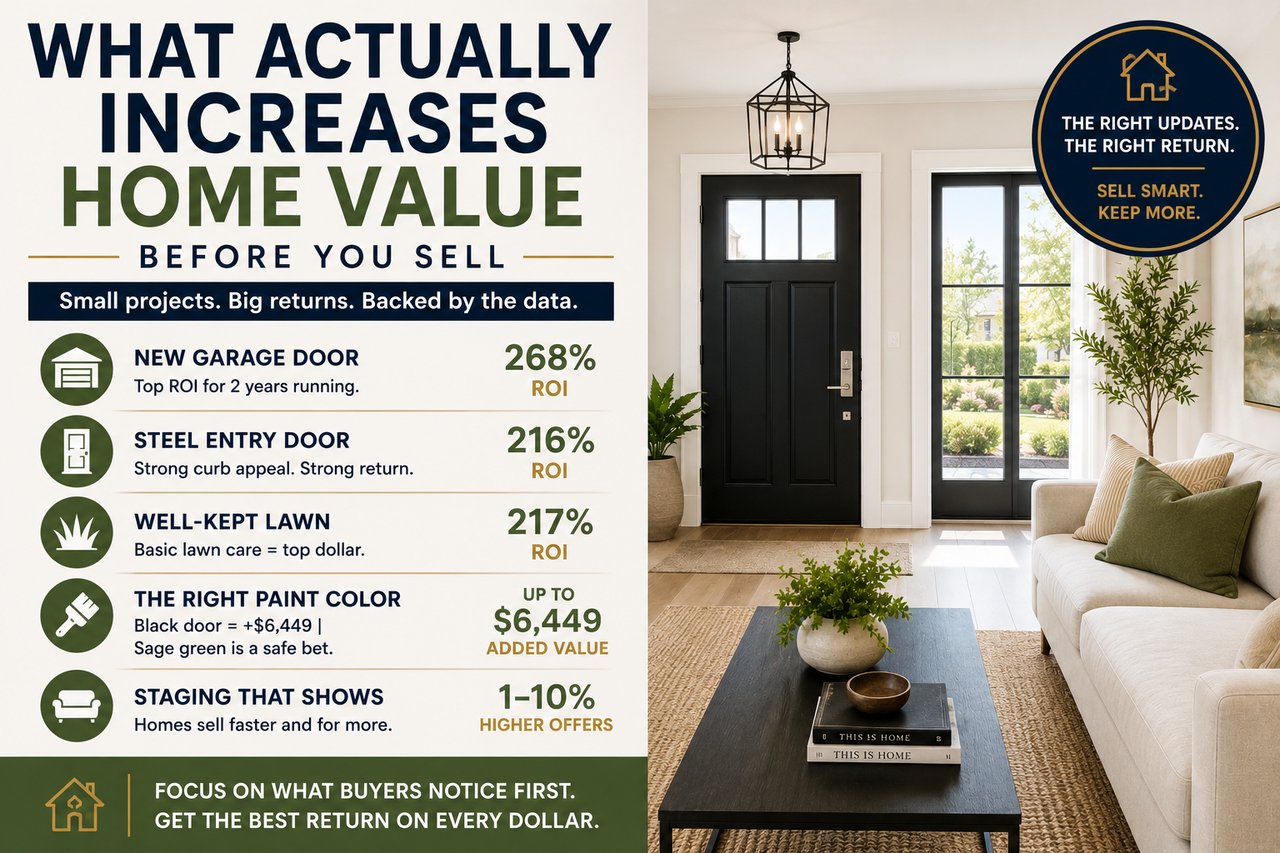
What Actually Increases Home Value Before You Sell
Most sellers ask me about the kitchen first. It's almost never the right place to start. The projects that move the needle before a sale tend to be smaller, cheaper, and less exciting than a full remodel, and the data backs that up pretty clearly once you look past the HGTV instinct to gut the kitchen and start over. If you're getting ready to list, here's what actually returns money at closing, what buyers are quietly judging you on, and what to skip entirely.
If you only take one thing from this, take this: a new garage door and entry door return more per dollar than any interior remodel, a well-kept lawn returns more than almost any landscaping project, the right paint color in the kitchen and on the front door is worth thousands, and a pre-listing inspection is the cheapest insurance you can buy against a deal falling apart. Everything past that is refinement, and the section below on what doesn't pay off is worth reading before you spend a dollar on anything bigger.
The exterior is doing more work than you think
According to the 2025 Cost vs. Value report, the highest-returning project in the country isn't inside the house at all. A new garage door costs under $5,000 on average and adds more than $12,500 in resale value, a 268 percent return, and it's held the top spot for two years running. A steel entry door isn't far behind, costing around $2,435 and returning about $5,270, a 216 percent ROI. Compare that to a minor kitchen remodel, which returns roughly 113 percent, still positive, but nowhere close to what a door replacement does for the money.
The reason is simple once you think about it from the buyer's side. A garage door and a front door are the first two things anyone sees before they've even stepped inside, and a dated, dinged-up version of either one plants a seed of doubt about how well the rest of the house has been maintained. You're not just buying curb appeal, you're buying the absence of a bad first impression, and that turns out to be worth a lot more per dollar spent than almost anything you can do in a kitchen.
Your lawn is quietly one of the best investments you can make
Basic lawn care, mowing, fertilizing, weed control, returns an average of 217 percent at resale according to the National Association of Realtors' most recent Remodeling Impact Report, and general landscape maintenance like mulching and pruning returns around 104 percent. A full yard refresh, a stone walkway, new plant beds, a few flowering perennials along the entry path, recovers roughly 100 percent of its cost and earns a 9.7 out of 10 on the report's homeowner satisfaction scale, one of the highest scores of any project measured. None of this requires a landscape architect. It requires a gardener for a few weeks before your photos get taken and enough advance notice that the yard actually looks lived-in and cared for rather than freshly attacked the morning of your first open house.
Paint color has a real dollar figure attached to it now
This one surprises people, but Zillow's color research puts actual numbers on something agents have said anecdotally for years: paint color affects sale price, and not by a trivial amount. A black front door adds an estimated $6,449 compared to homes with other door colors. In the kitchen, charcoal gray commanded an extra $1,373 and dark plum added $867, while ochre yellow came in $6,630 lower than a neutral choice in the same room. That's roughly an $8,000 swing between the best and worst kitchen color decision on an otherwise identical home.
Sage green has quietly become the safest bet across almost every room in the house, showing up as a top performer in Zillow's rankings more consistently than any other single color. None of this means you need to repaint the whole interior before listing. It means the handful of rooms buyers photograph and remember, the kitchen, the primary bedroom, and the front door, are worth getting right, and getting it wrong in those specific spots costs real money.
Staging isn't optional the way it used to be
The National Association of Realtors' most recent staging survey found that 83 percent of buyers' agents say staging makes it easier for buyers to picture themselves living in a home, and 58 percent said it positively shifts how most buyers view a listing outright. On the seller's side, 49 percent of listing agents reported that staging reduced time on market, and 29 percent saw offers come in 1 to 10 percent higher than they would have otherwise. Staging matters even more with younger buyers specifically, with 48 percent of Gen Z buyers and 40 percent of millennials calling it extremely or very important.
You don't need to hire a full staging company and rent furniture for three months to get most of this benefit. Clearing out excess furniture, depersonalizing family photos and collections, and making sure each room reads clearly as what it's supposed to be, a bedroom, an office, a dining room, rather than a catch-all storage space, captures most of the effect for a fraction of the cost.
Fix what an inspector is going to find anyway
Buyers in California are protected by some of the strictest disclosure laws in the country, and a home inspector working for the buyer is going to find whatever's wrong with your house regardless of whether you address it first. The only choice you actually have is whether they find it during your pre-listing prep, when you control the timeline and the contractor, or three weeks into escrow, when it becomes a negotiation with a buyer who's already emotionally attached and now feels misled.
A pre-listing inspection costs a few hundred dollars and gives you the chance to fix small things, a slow leak under a sink, an aging water heater, a roof section that needs patching, before they show up as a five-figure credit request during the buyer's inspection period. It also lets you price the home accurately from day one instead of getting surprised into a last-minute discount. Deals that fall apart in California more often die from a surprise found late than from a fair price. Getting ahead of your own inspection report is one of the cheapest ways to prevent that.
What adds value here in San Diego that doesn't show up in national guides
The national cost-versus-value data is useful, but it misses a few things that matter specifically for a San Diego sale. If your home sits near a canyon, hillside, or anywhere CAL FIRE has designated a high or very high fire hazard zone, documented wildfire hardening now functions almost like a renovation in its own right. An IBHS Wildfire Prepared Home certification, ember-resistant vents, a five-foot noncombustible perimeter, can qualify a home for insurance discounts of 10 to 20 percent or more from carriers like USAA, Mercury, and Farmers, and a buyer who can actually get insured at a reasonable rate is worth more to you than one who can't. Highlighting this work the same way you'd highlight a new roof is one of the more underused value plays in this market right now.
If you're selling a condo or a home inside an HOA, the paperwork itself has become a value driver. Buyers are pricing HOA reserve health, SB 326 balcony inspection status, and Mello-Roos amounts directly into their offers across the county right now, and a seller who hands over a clean reserve study, and a clear Mello-Roos statement on day one is going to move faster and negotiate less than one who makes a buyer chase down that information mid-escrow. It's not glamorous, but a complete, organized disclosure package is functionally a value-add in this market, because it removes the uncertainty buyers are currently paying to avoid.
What doesn't actually pay off
The flip side of all this is worth saying plainly, because it's where sellers lose the most money. A full luxury kitchen remodel, the kind with a $60,000 range and custom cabinetry, rarely returns anywhere close to its cost, and it almost never makes sense in a neighborhood where comparable homes aren't selling at that price point. I've watched sellers put $50,000 into a primary bathroom that looked incredible and added maybe $15,000 to their eventual sale price, because the house was still, at the end of the day, a three bedroom in a neighborhood where three-bedroom homes sell for what three-bedroom homes sell for. Buyers don't pay extra for a house that's nicer than everything around it. They pay for a house that's nicer than the other houses they're actually comparing it to.
Converting a garage into a bedroom or a home gym runs into the same ceiling, and it often subtracts value rather than adding it, since a lot of San Diego buyers are specifically shopping for covered parking and storage and will discount a home that's lost its garage even if the converted space looks great. High-end appliance packages fall into a similar trap. A $15,000 range and refrigerator set in a starter home doesn't pull the house into a higher price bracket, it just sits there as a sunk cost the next buyer didn't ask for and won't pay extra to inherit.
The same logic applies to bold, personal design choices. An accent wall in a color you love might feel like an upgrade to you and read as a $2,000 to $3,000 problem to a buyer who now has to imagine repainting it before move-in. Save the personality for the house you're staying in, and keep the one you're selling closer to neutral.
Swimming pools deserve a specific mention, because San Diego sellers ask about them constantly. NAR's outdoor project data consistently shows in-ground pools carrying the lowest return of any major exterior project, even though homeowners rate them among the highest for personal enjoyment. A pool might be the reason you loved living in the house. It's rarely the reason a buyer pays more for it, and in some cases it narrows your buyer pool by scaring off families worried about maintenance and safety. If you already have one, keep it clean and functioning. Don't build one to sell.
Where to actually put your money
If you're working with a limited budget before listing, the order that tends to make sense is exterior first, lawn and landscaping second, paint third, staging fourth. As a rough budget guideline, most of what's listed here can be done for somewhere between 1 and 3 percent of your home's expected sale price, well below what a major remodel would cost and, dollar for dollar, far more likely to come back to you at closing. Skip the big structural remodel unless something is genuinely broken, and if you're in an HOA or a wildfire-adjacent neighborhood, treat your paperwork and your insurability as seriously as you'd treat a renovation, because right now, buyers are treating it that way too.
If you want a second opinion on which of these actually makes sense for your specific home before you spend anything, reach out and we'll walk through what's worth doing and what isn't before you list.