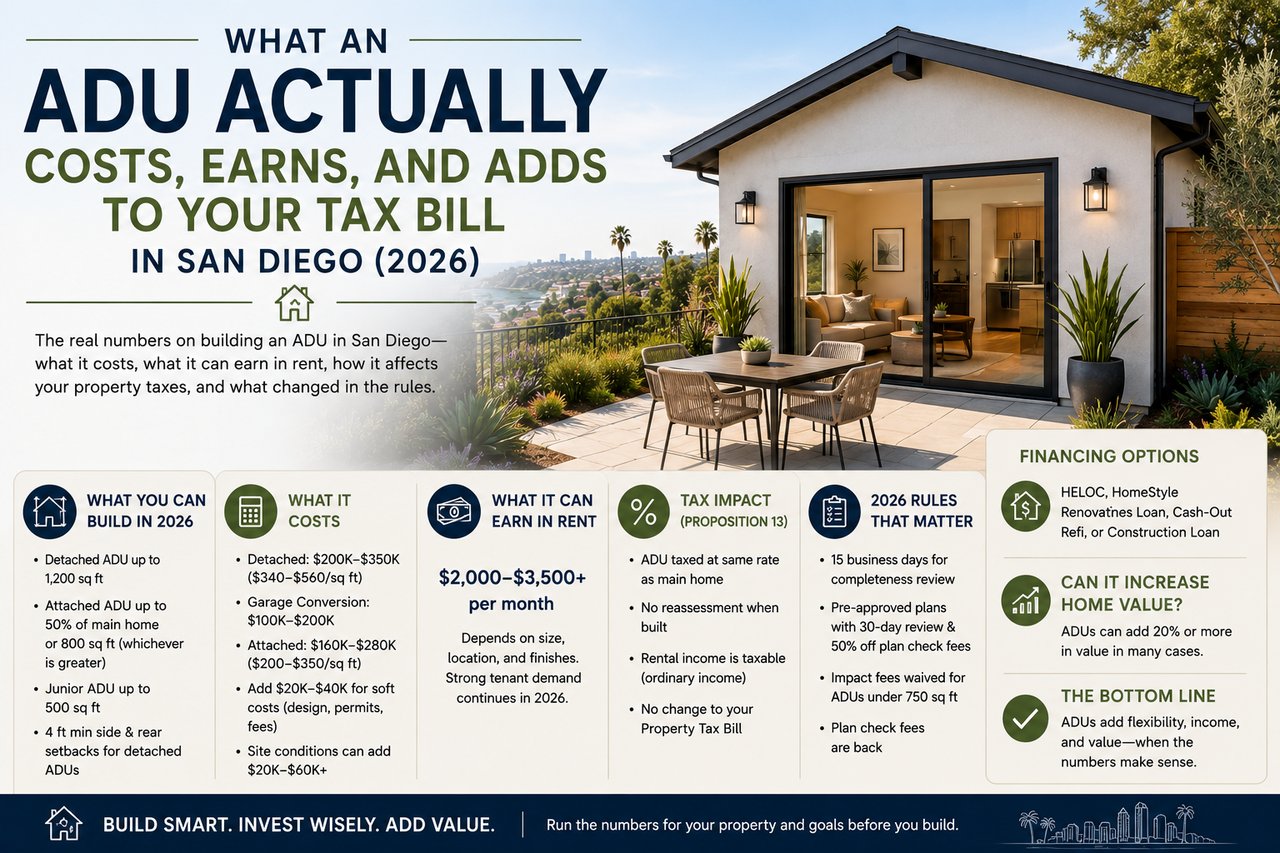
What an ADU Actually Costs, Earns, and Adds to Your Tax Bill in San Diego (2026)
Accessory dwelling units have become the default answer to almost every San Diego housing question, more space for aging parents, a rental unit to help cover the mortgage, a way to add value without buying a bigger lot. That reputation is mostly earned, but a lot of what circulates about ADUs, especially the idea that the state hands homeowners $40,000 to build one, is now out of date. Here's what an ADU actually costs to build in San Diego, what it can realistically earn in rent, what it does to your property tax bill, and what changed in the rules this year.
What you're actually allowed to build now
State law sets the outer limits, and cities can't shrink them below a certain floor. A detached ADU can be up to 1,200 square feet. An attached ADU can be up to 50 percent of the main house's floor area or 800 square feet, whichever is greater. A junior ADU, meaning a unit carved out of the existing house rather than added on, tops out at 500 square feet. Cities also can't cap a studio or one bedroom ADU below 850 square feet, or a two bedroom or larger unit below 1,000 square feet, regardless of local zoning preferences. SB 543 also changed how that square footage gets measured this year, shifting it to interior livable space rather than the broader living area calculation cities used before.
Setbacks got simpler too. Detached ADUs need a minimum of 4 feet from the side and rear property lines, and cities can't require more than that. Front setbacks generally follow whatever standard applies to the main house in that zone. If you're converting an existing structure, like a garage, or rebuilding in the same footprint, no setback applies at all.
Two other 2026 changes are worth knowing before you submit anything. Local agencies now have to review an ADU application for completeness and tell you in writing what's missing within 15 business days, which cuts down on the open ended review timelines that used to stall projects for months. And under AB 1332, San Diego now offers pre-approved ADU plans that come with a guaranteed 30 day review and a 50 percent cut in plan check fees, saving somewhere between $1,500 and $4,000 depending on the project. The tradeoff is you're building from a design someone else already drew, and you'll need to license that plan from the provider. One thing that didn't survive into 2026: the city's blanket plan check fee waiver for standard ADUs. Impact fees are still waived for units under 750 square feet under state law, but plan check fees are back on the invoice for most projects.
What it actually costs
This is where a lot of ADU research online gets people into trouble, because the number depends heavily on which type of ADU you're building. A detached, ground up ADU in San Diego typically runs $200,000 to $350,000 all in, working out to roughly $340 to $560 per square foot for turnkey construction. A garage conversion is meaningfully cheaper, usually $100,000 to $200,000, since you're not pouring a new foundation or running new utilities as far. An attached ADU, built onto the existing house, tends to land between $160,000 and $280,000, or about $200 to $350 per square foot.
Two categories of cost are easy to miss when you're working off an online calculator. Soft costs, meaning design, permitting, and school fees, typically add another $20,000 to $40,000 on top of construction. And site conditions, particularly slope and soil quality, which show up constantly on San Diego lots, can add $20,000 to $60,000 that generic per square foot estimates simply don't account for. If you're pricing a project on a hillside lot in places like Mount Helix or parts of Clairemont, get a soils assessment before you fall in love with a number from a website.
The $40,000 grant is gone, here's what to use instead
The CalHFA ADU Grant Program, which reimbursed up to $40,000 in pre-development costs like design, permits, and soil tests for income qualified homeowners, ran out of money. The last round of funding was fully allocated back in December 2023, and as of mid-2026 there's still no application window, waitlist, or announced relaunch date. CalHFA has gone as far as warning homeowners that anyone offering to "still get you" the grant is likely running a scam. If a contractor or lender brings it up as part of their pitch, ask them to show you the open application, not just cite the program by name.
The realistic financing options now are the same tools homeowners have used for any major addition. A HELOC draws against your existing equity and comes with no ADU specific restrictions, since the collateral is your current home rather than the unfinished unit, though the variable rate means your payment can move. Fannie Mae's HomeStyle Renovation loan got a notable expansion this year, now allowing up to three ADUs on a single unit property where zoning permits it, financing for ADUs on manufactured homes, and up to 50 percent of the loan disbursed upfront at closing to cover materials, permits, and design deposits. Cash out refinancing and construction to permanent loans remain options as well, particularly if rates make a refi worthwhile independent of the ADU.
One underwriting detail matters more than people realize: Fannie Mae now allows lenders to count up to 75 percent of an ADU's projected rental income toward mortgage qualification. If the ADU is what makes a purchase or refinance pencil out, get your lender to run that calculation before you're deep into design, not after.
What it can actually earn in rent
Numbers vary a lot by location, which is exactly why a countywide average isn't that useful for planning your own project. A one bedroom ADU in most of San Diego rents for roughly $1,600 to $2,200 a month, and a two bedroom typically lands between $2,000 and $2,800. Coastal areas run well above that. Pacific Beach ADUs are renting for $2,500 to $3,500 a month, with some listings pushing closer to $4,000.
It's worth underwriting these numbers conservatively rather than off peak 2022 rental figures. San Diego's broader rental market has softened in 2026, with average rent running $2,417 to $2,969 depending on the data source and year over year growth flat to slightly negative. Coastal ADUs in particular are increasingly competing directly with small apartments and condos for the same tenant pool, which is putting quiet downward pressure on what a new unit can actually command. Build your pro forma off current asking rents for comparable units nearby, not off what a neighbor's ADU rented for two years ago.
What it does to your property tax bill
This is the question I get asked most, usually with some version of "won't this reassess my whole house?" It won't. Adding an ADU counts as new construction under Prop 13, which does trigger a reassessment, but only of the ADU itself. The county assessor values the new unit independently, based on its cost or market value, and adds that figure to your existing assessed value. Your home's original Prop 13 base year value, and the 2 percent annual cap that comes with it, stays completely untouched.
In practice, that means a home assessed at $400,000 under its existing Prop 13 basis that adds a $300,000 ADU ends up with two separate components on the tax roll: the original $400,000 continuing to grow at its capped 2 percent a year, and a new $300,000 base value for the ADU that starts its own 2 percent cap from the year it's completed. Your total assessed value goes up by roughly what the ADU cost to build, not by a reassessment of the whole property to today's market value. If you've read anything I've written about Prop 13 or Prop 19 before, this is the same underlying mechanism, just applied to new square footage instead of a change in ownership.
Building for family versus building for income
The reason to build changes the project more than people expect. A unit for aging parents or adult kids doesn't need to satisfy a lender's rental income test, but it does need real privacy, its own entrance, and enough separation from the main house that it actually functions as independent living space rather than a glorified guest room. A unit built to generate rent needs the opposite kind of planning up front: a design that will appraise and rent well to a stranger, and a rent projection you've run past your lender before construction starts, since that 75 percent income allowance can be the difference between a loan that qualifies and one that doesn't. Deciding which of these you're actually building, before you hire a designer, saves a lot of expensive revisions later.
Buying a home that already has an ADU
A meaningful share of the ADUs sitting on San Diego lots today were built before current rules existed, and plenty of them were never permitted at all. If you're buying a home with a unit already on the property, ask specifically for the permit record or certificate of occupancy rather than taking the listing's word for it. An unpermitted ADU can't legally be counted as rental income when you apply for financing, it can complicate your homeowners insurance, and it can turn into an expensive retrofit if the city catches it later, which happens most often when an owner pulls a permit for an unrelated remodel and the inspector notices the unit out back. It's the same category of due diligence as pulling an HOA's reserve study or checking a parcel for Mello Roos: the paperwork tells you what the listing photos won't.
The bottom line
The real economics of an ADU in San Diego look different from the version that circulates online. Construction realistically costs $200,000 to $350,000 for a detached unit, the $40,000 state grant that everyone still references is gone with no relaunch date, rental income is solid but softening and should be underwritten off current comps rather than 2022 highs, and your property tax bill only reflects the new structure, not a reassessment of your entire home. None of that makes an ADU a bad investment. It just means the numbers deserve the same scrutiny you'd give any six figure project before you commit to one.
If you're weighing whether an ADU makes sense on a property you own, or you're evaluating a listing that already has one, reach out and we'll go through the real numbers together before you spend money on plans.